

Key takeaways
- Grade 1 English willow: premium appearance and usually the highest price, often roughly £350–£800 or equivalent depending on brand and specification.
- Grade 2–3 English willow: the sensible range for many serious club players, commonly about £180–£450.
- Grade 4–5 English willow: a lower-cost route into English willow, often around £100–£220.
- Kashmir willow: commonly about £40–£150, with junior and entry-level models at the lower end.
Best Cricket Bats for Every Playing Level
The best cricket bat for most players is a mid-weight bat with a balanced pickup, a full-size English willow blade, and a profile matched to where you score most often; beginners should prioritise control and affordability, while regular club players can justify lighter pickup, thicker edges, and higher-grade willow.
Quick picks by playing situation
| Player or situation | Best bat type | Useful target specification | Why it fits |
|---|---|---|---|
| Junior learning technique | Short-handle or junior Kashmir willow | 2 lb 2 oz–2 lb 8 oz; low to mid sweet spot | More affordable, durable, and easier to control |
| Adult beginner | Grade 3–4 English willow or good Kashmir willow | 2 lb 7 oz–2 lb 10 oz; balanced pickup | Forgiving without making timing difficult |
| Club batter playing weekly | Grade 2–3 English willow | 2 lb 8 oz–2 lb 11 oz; 38–40 mm edges | Good compromise between performance, durability, and price |
| Front-foot stroke player | Full-profile bat with a low sweet spot | 2 lb 9 oz–2 lb 12 oz; pronounced lower-middle mass | Helps drive and defend on lower-bouncing pitches |
| Back-foot or hard-pitch player | Mid- or high-sweet-spot bat | 2 lb 8 oz–2 lb 11 oz; slightly thinner shoulders | Quicker through horizontal-bat shots and easier to manoeuvre |
| Frequent competitive player | Grade 1 or 2 English willow | 2 lb 9 oz–2 lb 12 oz; pickup before raw weight | Higher-quality timber and carefully finished profiles |
English willow versus Kashmir willow
English willow is usually made from Salix alba caerulea and is selected for its combination of light weight, rebound, and traditional grain structure. Kashmir willow is generally denser and less expensive. It can be an excellent choice for beginners, casual players, school cricket, or anyone who expects rough use.
Our top picks


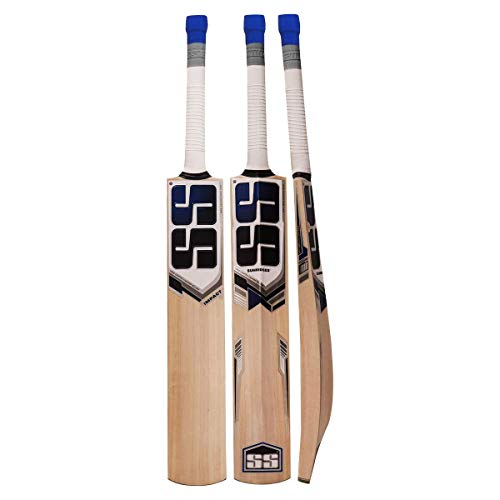

As an Amazon Associate we earn from qualifying purchases at no extra cost to you. Ratings are shown as listed on Amazon.
Grade numbers are useful, but they are not a universal performance scale. A Grade 1 bat normally has straighter, cleaner grains and fewer blemishes; lower grades may contain more knots, colour variation, or irregular grain. These marks do not automatically make a bat unsafe or ineffective. Profile, pressing, moisture, and the individual piece of timber matter just as much.
- Grade 1 English willow: premium appearance and usually the highest price, often roughly £350–£800 or equivalent depending on brand and specification.
- Grade 2–3 English willow: the sensible range for many serious club players, commonly about £180–£450.
- Grade 4–5 English willow: a lower-cost route into English willow, often around £100–£220.
- Kashmir willow: commonly about £40–£150, with junior and entry-level models at the lower end.
Prices vary significantly by country, season, customisation, and bat maker. Do not pay for a high grade solely because the blade has many straight grains: a well-balanced lower-grade bat may be more useful than a poorly balanced premium one.
Bat profiles: where the mass changes the experience
Low sweet spot
A low sweet spot places more timber toward the lower third of the blade. It suits front-foot players, slower pitches, and batters who regularly play drives. The trade-off is a heavier feeling toe and less natural speed in cuts, pulls, and late deflections.
Mid sweet spot
A mid-positioned sweet spot is the safest all-round choice. It offers enough support for drives while keeping the bat responsive for cuts and pulls. Players who face varied pitches or bat in several formats often find this profile easiest to live with.
High sweet spot
A high sweet spot removes some mass from the toe and can produce a faster pickup. It is useful on firm, bouncy pitches and for players who spend more time on the back foot. It may feel less powerful for low drives and defensive shots near the base of the blade.
Full versus concave profiles
A full profile retains more wood behind the hitting area, usually giving a solid response on mishits but increasing total weight. A concave profile removes material from the back of the blade to create a lighter pickup while retaining thick edges. It can be a strong choice for players who want a large-looking bat without carrying a very heavy one.
Weight and pickup matter more than the sticker
Two bats marked 2 lb 10 oz can feel completely different. The handle, splice, toe, shoulders, edge distribution, and balance point all affect pickup. A bat with a lower balance point may feel powerful but slower to lift; a higher balance point may feel quick but offer less authority through the drive.
For many adult players, the practical range is approximately 2 lb 7 oz to 2 lb 12 oz. Smaller or less experienced players may benefit from 2 lb 4 oz to 2 lb 8 oz, while powerful players with reliable timing may prefer 2 lb 10 oz to 2 lb 13 oz. Do not move up in weight because a heavier bat appears more powerful. If it delays the backswing or causes the bottom hand to dominate, it is too heavy for your technique.
A useful fitting test is to hold the bat in your normal stance, raise it into your backswing, and repeat the movement 10 times. The bat should travel smoothly without your front shoulder lifting, wrists collapsing, or hands tiring. A slightly lighter bat that you can control late in an innings is often more effective than a heavier bat that feels impressive for five minutes.
Edges, spine, toe, and handle shape
- Edge thickness: roughly 36–40 mm is common on balanced club bats, while some power-focused models reach approximately 40–42 mm. Thick edges do not guarantee a large effective hitting area; the bat still needs correctly distributed wood.
- Spine height: a taller spine can increase mass behind the sweet spot. Check where it peaks, because a high spine and low sweet spot produce a different feel from a high spine and high sweet spot.
- Toe design: a square toe can offer a traditional appearance, while a rounded or semi-rounded toe may reduce edges catching on the ground. Regardless of shape, the toe needs protection from damp pitches and careless tapping.
- Handle shape: an oval handle discourages the bat from twisting and is often preferred by top-hand players. A round handle permits more rotation and may suit players who use strong bottom-hand involvement. An intermediate or semi-oval handle sits between these sensations.
- Handle construction: cane handles are designed to absorb vibration. A good grip and intact rubber inside the handle are more important than choosing a particular marketing label.
What to choose from established bat makers
Brands such as Gray-Nicolls, Gunn & Moore, Kookaburra, New Balance, SG, DSC, and SS offer ranges across junior, Kashmir willow, and English willow categories. The brand name is less important than selecting the correct size, weight, profile, and preparation level.
For a first adult bat, look at each brand’s mid-range Grade 3 or Grade 4 English willow models, then compare the actual weight and pickup. For a junior, choose the correct size rather than buying an oversized adult bat for future growth. For a strong club batter, premium ranges from these manufacturers can be worthwhile, but only if the bat’s balance matches the player’s scoring areas.
Ownership: preparation and wear that listings rarely explain
English willow bats normally require knocking-in before match use. This compresses the surface fibres so they are less vulnerable to seam and edge damage. Follow the maker’s instructions, use a proper bat mallet, and increase impact gradually. Pre-prepared does not mean indestructible.
- Inspect the blade, edges, toe, and handle before every match.
- Keep the bat dry and store it somewhere ventilated, away from radiators and direct sunlight.
- Use an approved facing or protective sheet if the manufacturer permits it.
- Clean surface dirt with a dry or barely damp cloth; do not soak the willow.
- Do not use the bat for hard-ball practice until preparation is complete.
- Stop using it if the handle loosens, a deep crack opens, or the toe begins separating.
The toe and edges usually show damage first, especially when the bat is tapped on concrete or used against wet pitches. Small surface cracks can be normal, but spreading cracks, soft spots, excessive moisture, and handle movement need attention from a qualified bat repairer.
Final buying decision
Choose a Kashmir willow bat if affordability and durability come first. Choose Grade 3–4 English willow for the best value in regular club cricket. Move to Grade 1–2 only when you play often enough to benefit from premium timber and are prepared to maintain it. Within any category, select the bat you can lift repeatedly with a controlled pickup, then match its sweet spot to your pitch conditions and scoring style.



Write Your Review
No reviews yet. Be the first to share your experience!