

Key takeaways
- Bedrooms: Excellent for warmth, sound reduction, and low-impact comfort. A lighter-duty finish is often sufficient.
- Living rooms: A strong choice when furniture has broad protective feet and rugs do not trap grit or moisture.
- Home offices: Suitable if chair casters are designed for hard floors and a transparent chair mat is used. Narrow, hard casters can damage the finish.
- Kitchens: Possible, particularly with glue-down tile, but spills must be wiped promptly. Cork is not a substitute for waterproof flooring.
- Bathrooms and laundry rooms: Usually a poor choice because repeated wetting, leaks, humidity, and standing water can damage seams and cores.
- Mudrooms and entryways: Risky unless footwear is kept clean and dry. Sand, salt, and grit are unusually abrasive.
- Rooms with large animals: Cork can be comfortable for people and pets, but claws, wet accidents, and tracked grit require more maintenance. It is not a stable choice for areas routinely exposed to urine or water.
Best Cork Flooring for Comfortable Rooms: The Short Answer
The best cork flooring for most comfortable living rooms, bedrooms, home offices, and lightly used guest rooms is a floating cork plank with a factory-applied polyurethane or ceramic-reinforced wear layer, while glue-down cork tile is the better choice for kitchens, irregular rooms, and repairs over time.
Cork is warm underfoot, quieter than many hard floors, and naturally resilient. It is not, however, waterproof or immune to dents. The right choice depends less on the cork’s appearance than on its construction, protective finish, moisture exposure, subfloor, and installation conditions.
Our top picks
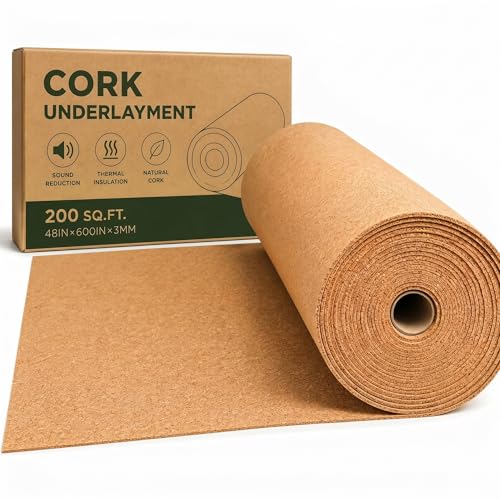


As an Amazon Associate we earn from qualifying purchases at no extra cost to you. Ratings are shown as listed on Amazon.
Cork Plank vs. Cork Tile
These two formats can look similar but behave differently during installation and ownership.
| Factor | Floating cork plank | Glue-down cork tile |
|---|---|---|
| Typical overall thickness | 10–12 mm | 4–6 mm |
| Common format | 12 x 36 in or 12 x 48 in | 12 x 12 in or 12 x 24 in |
| Installation | Click-lock, floating over underlayment | Adhered directly to a prepared subfloor |
| DIY difficulty | Moderate | Moderate to high |
| Repair method | Replace a plank, usually by disassembling from a wall | Replace one tile if matching material is available |
| Moisture tolerance | Limited; keep water from joints and edges | Limited; adhesive and seams still require prompt cleanup |
| Best use | Bedrooms, offices, living rooms, quick renovations | Kitchens, hallways, patterned layouts, rooms needing a low transition |
Floating cork plank
Plank flooring normally has a cork core, a decorative cork surface, a locking edge, and a factory finish. It installs faster because boards are not bonded to the floor. The thicker construction can feel more forgiving over a suitable underlayment, and it is usually the most approachable format for a homeowner.
The drawbacks are movement and edge sensitivity. A floating floor needs expansion space around walls, cabinets, pipes, and fixed objects. Water that reaches an unsealed joint can swell the fiberboard or cork-based core. Heavy built-in cabinets should not generally sit on top of a floating floor unless the manufacturer specifically permits it.
Glue-down cork tile
Tile is thinner and transfers the condition of the subfloor more directly. That makes preparation especially important: ridges, dust, cracks, and low spots can telegraph through the finished surface. In return, glue-down flooring can create a stable, low-profile installation and offers more layout freedom, including brick, checkerboard, and herringbone patterns.
Tile often makes long-term spot repair easier. Keep spare tiles from the original batch because cork color and texture can vary, and later production runs may not match.
Wear Layers: The Detail That Predicts Ownership
Look for the finish specification rather than choosing solely by color or nominal cork thickness. A finished cork floor may use water-based polyurethane, a tougher multi-layer polyurethane system, or a ceramic-reinforced finish. These coatings protect against abrasion and staining, but they do not make cork scratch-proof or waterproof.
| Room and traffic | Practical finish target | Why it matters |
|---|---|---|
| Bedroom or occasional guest room | Factory finish; approximately 2–3 protective coats | Lower traffic and fewer rolling loads |
| Living room or home office | Multi-coat polyurethane or equivalent commercial-grade finish | Better resistance to chair movement and regular walking |
| Hallway or busy family room | Higher-durability finish, preferably with documented recoat guidance | More grit, turning, and repeated abrasion |
| Kitchen | Durable factory finish plus carefully sealed perimeter and prompt spill removal | Frequent moisture and dropped food increase cleaning demands |
What wears first is usually the finish, not the entire cork layer. Grit under footwear acts like sandpaper; casters and chair legs create concentrated abrasion; sunlight can change the color unevenly. A floor that has lost its finish may be eligible for screening and recoating, but this depends on the product and the remaining surface condition. Do not sand aggressively unless the manufacturer confirms that the floor has enough material for it.
Where Cork Works—and Where It Does Not
- Bedrooms: Excellent for warmth, sound reduction, and low-impact comfort. A lighter-duty finish is often sufficient.
- Living rooms: A strong choice when furniture has broad protective feet and rugs do not trap grit or moisture.
- Home offices: Suitable if chair casters are designed for hard floors and a transparent chair mat is used. Narrow, hard casters can damage the finish.
- Kitchens: Possible, particularly with glue-down tile, but spills must be wiped promptly. Cork is not a substitute for waterproof flooring.
- Bathrooms and laundry rooms: Usually a poor choice because repeated wetting, leaks, humidity, and standing water can damage seams and cores.
- Mudrooms and entryways: Risky unless footwear is kept clean and dry. Sand, salt, and grit are unusually abrasive.
- Rooms with large animals: Cork can be comfortable for people and pets, but claws, wet accidents, and tracked grit require more maintenance. It is not a stable choice for areas routinely exposed to urine or water.
Subfloor Requirements and Moisture Limits
Cork needs a clean, dry, flat, and structurally sound base. A floating plank can hide minor visual imperfections, but it cannot correct an uneven floor. Glue-down tile demands even more precision because every depression can affect the bond and final appearance.
- Concrete must be tested for moisture using the flooring and adhesive manufacturer’s specified method.
- Wood subfloors should be firmly attached, free of squeaks that will remain accessible only after installation, and repaired where boards move or flex.
- Remove wax, grease, dust, loose paint, and adhesive residue before bonding tile.
- Correct significant high and low areas with a compatible leveling or patching compound.
- Allow flooring cartons to acclimate in the installation room, commonly for 48–72 hours, within the temperature and humidity range stated in the instructions.
Do not infer that “water-resistant finish” means “waterproof floor.” Cork expands and contracts with humidity, and the core or adhesive system can be damaged by moisture. Keep indoor humidity reasonably stable, use mats outside wet entries, and repair plumbing leaks before installation.
Installation: The Steps That Prevent Most Problems
- Measure the room and add waste. For a simple rectangular room, add about 5% for cuts; use 10% for angled walls, multiple doorways, or a patterned tile layout. For example, a 12 x 15-foot room is 180 square feet. At 10% waste, buy 198 square feet. If cartons cover 20 square feet, 198 divided by 20 equals 9.9, so purchase 10 cartons.
- Plan transitions and door clearance. Cork planks can raise the floor roughly 10–14 mm including underlayment. Check doors, appliances, stair noses, and transitions before ordering.
- Prepare the subfloor. Fill low areas, remove contamination, verify dryness, and vacuum thoroughly. Preparation is more important for glue-down tile than for a floating plank, but neither format should be installed over a moving or damp base.
- Mix cartons before laying. Cork has natural variation. Distributing boards from several cartons prevents noticeable blocks of one shade.
- Maintain the required perimeter gap. Floating floors commonly need an expansion gap around the room; follow the product’s exact dimension rather than guessing. Cover the gap with trim, not by pinning the floor tightly.
- Roll and protect glue-down tile. Adhesive instructions may require a floor roller and a curing period. Keep traffic and furniture off the surface for the stated time.
- Use the correct furniture protection. Felt pads should be clean and wide enough for the load. Lift furniture instead of dragging it, and replace pads when grit becomes embedded.
Cleaning and Durability Realities
Vacuum or dry-dust frequently, especially near exterior doors. Clean with a barely damp microfiber mop and a cleaner approved for the finish. Avoid soaking the floor, steam mops, abrasive powders, wax unless specifically permitted, and household products containing harsh solvents. Blot spills rather than spreading them across seams.
Use breathable mats, not rubber-backed products that can trap moisture or discolor the finish. Rotate rugs and furniture occasionally where strong sunlight creates uneven fading. A properly maintained cork floor can remain attractive for many years, but the protective finish is a consumable surface: busy areas may eventually need professional recoating even when the cork beneath remains sound.
Best Choice by Buying Situation
| Your situation | Best format | Priority specification |
|---|---|---|
| Lowest installation complexity | Click-lock plank | Clear instructions, stable locking edges, replacement-plank availability |
| Uneven or heavily repaired subfloor | Neither until leveled | Spend the budget on subfloor preparation first |
| Frequent traffic and office chair use | Plank or tile with high-durability finish | Documented finish system and a suitable chair mat |
| Kitchen with a low floor transition | Glue-down tile | Moisture-conscious adhesive and meticulous spill control |
| Bathroom, laundry area, or leak-prone room | Choose another flooring type | Cork’s moisture limits outweigh its comfort benefits |
Bottom Line
Choose finished cork plank when warmth, quietness, and a manageable installation matter most. Choose glue-down cork tile when you need a thin floor, a custom pattern, or simpler individual-tile replacement. In either case, prioritize a documented wear layer, a dry and level subfloor, sensible moisture control, and realistic room placement. The best cork flooring is not the thickest or most decorative option; it is the one whose finish and construction match the room’s traffic and moisture exposure.

Write Your Review
No reviews yet. Be the first to share your experience!