

Key takeaways
- Choose a 0.9-cu.-ft. automatic washer for the smallest practical storage footprint, a 1.6- to 2.0-cu.-ft. automatic model for the best overall apartment balance, a twin-tub machine for the lowest upfront cost and maximum hookup flexibility, and a 2.0- to 2.8-cu.-ft. model when reducing the number…
The best portable washing machine for most small apartments is a 1.6- to 2.0-cubic-foot twin-tub or fully automatic model: it offers useful capacity without demanding the floor space, water hookup, or storage commitment of a full-size washer.
Our top picks


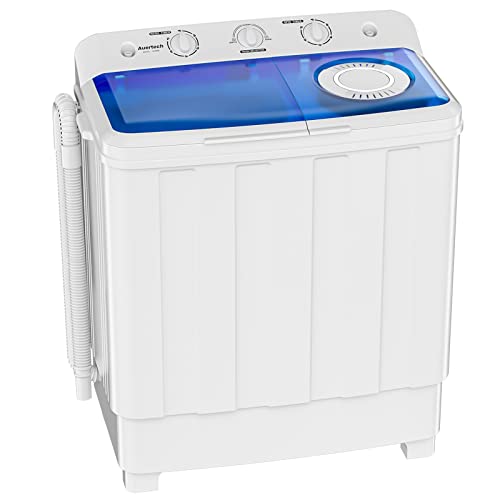

As an Amazon Associate we earn from qualifying purchases at no extra cost to you. Ratings are shown as listed on Amazon.
Best portable washing machines by living situation
| Best for | Recommended type or model | Typical capacity | What makes it a good fit | Main compromise |
|---|---|---|---|---|
| Smallest footprint | Compact 0.9-cu.-ft. fully automatic washer, such as the BLACK+DECKER BPWM09W | About 6.6 lb | Fits narrow utility areas and stores relatively easily | Small loads and less room for bulky towels |
| Regular apartment laundry | BLACK+DECKER BPWM16W or a comparable 1.6-cu.-ft. automatic washer | About 11 lb | Useful balance of capacity, portability, and simple faucet hookup | Heavier and deeper than sub-1-cu.-ft. machines |
| Lowest purchase cost | Compact twin-tub washer with a separate spinner | Wash tubs commonly hold 10–15 lb; spinner capacity is lower | Often costs roughly $120–$250 and needs no permanent installation | Manual transfer between wash and spin tubs |
| More laundry per load | 2.0- to 2.8-cu.-ft. automatic portable washer, such as the Magic Chef MCSTCW20S5 or GE GNW128PSMWW | Roughly 12–15 lb, depending on the model | Better for couples, frequent washing, and larger garments | Usually too large for a shallow cupboard and harder to move alone |
Our practical picks
Best overall: a 1.6-cu.-ft. fully automatic washer
A washer in this size class is the most balanced choice for many renters. The BLACK+DECKER BPWM16W, for example, is designed for a standard household faucet connection and has enough capacity for several shirts, underwear, socks, and light trousers in one load. It is still much smaller than a conventional top-loader, but it avoids the repeated water filling and clothing transfers required by a twin-tub machine.
Expect a footprint in the neighborhood of 20 inches wide by 20–22 inches deep, with a height around 35 inches. Confirm the current manufacturer dimensions before buying because hoses, control panels, and model revisions can change the required clearance. A suitable unit generally costs about $250–$450.
Best for the tightest storage: a 0.9-cu.-ft. automatic washer
The BLACK+DECKER BPWM09W is a sensible choice when width and weight matter more than throughput. Models of this type usually weigh around 45–50 lb and take up approximately 18–20 inches of width and depth. That makes them easier to roll into a closet or bathroom corner, although they are not light enough to carry casually up stairs.
Its roughly 6.6-lb load limit works well for one person washing frequently. It is less suitable for comforters, bath towels, jeans, or a week’s worth of clothing. A small drum also makes overloading tempting, which reduces cleaning quality and leaves laundry wetter after spinning.
Best value for hands-on users: a twin-tub washer
Twin-tub machines separate washing and spinning into two compartments. You fill the wash side, drain it, move clothing to the spinner, and repeat with rinse water. This design can be remarkably useful where a permanent hookup is impossible. It also tends to cost less than a fully automatic machine and may be easier to lift.
The trade-off is involvement. You must monitor the water level, move each load manually, and drain the machine after use. The advertised wash capacity also exceeds the effective spin capacity on many models. A 12-lb wash tub may accept only 5–8 lb in the spinner, so a large load must be divided before extraction.
Best for a couple: a 2.0- to 2.8-cu.-ft. automatic washer
Larger portable washers reduce the number of cycles, but they approach the storage and weight of a compact full-size appliance. The Magic Chef MCSTCW20S5 represents the roughly 2.0-cu.-ft. class, while the GE GNW128PSMWW is a larger 2.8-cu.-ft. example. These are more practical for two adults, frequent laundry, or households that wash work clothes separately.
Plan for roughly 24–27 inches of depth and a machine weight commonly above 100 lb in the larger class. They are portable in the sense that they can be rolled and connected when needed, not that one person can conveniently carry them from room to room.
What to compare before buying
Capacity versus usable capacity
Manufacturers quote drum capacity in cubic feet or maximum clothing weight, but neither number means you should pack the drum tightly. Leave enough space for clothing to lift and tumble. As a working rule, a 0.9-cu.-ft. washer handles one person’s small load; 1.6–2.0 cubic feet suits one or two people; and 2.8 cubic feet is more comfortable for regular family laundry.
Do not select a machine by asking whether it can physically hold a blanket. Check whether the blanket can move freely and whether the spinner can extract its water. Bulky items often need a laundromat-size machine even when they fit inside a portable drum.
Hookup requirements
Most fully automatic portable washers use a quick-connect adapter on a sink or utility faucet. You need a cold-water source, a drain that can accept the discharge hose, and a grounded electrical outlet. Some models allow warm water through a compatible faucet adapter, but many are intended primarily for cold-water operation.
Measure the faucet thread, sink clearance, hose length, and drain height before ordering. A machine may be “portable” yet unusable if the faucet adapter does not fit or the drain hose cannot be secured. Never leave a temporary connection pressurized while you are away; a loose adapter can release a substantial amount of water.
Cycle time and spin performance
A typical automatic portable cycle takes about 25–60 minutes, depending on the selected wash, rinse, and spin settings. Twin-tub laundry can be faster for small loads once you become familiar with it, but the operator adds filling, draining, and transfer time. A high spin speed does not automatically mean dry clothing: drum balance, load size, and fabric type matter just as much.
Look for a final spin of approximately 700–1,000 revolutions per minute in an automatic model, or a clearly stated spinner speed in a twin-tub model. Expect towels and thick cotton to remain damp. The better performance test is whether clothing comes out damp rather than dripping, without frequent unbalanced shutdowns.
Noise and apartment suitability
Compact washers commonly produce roughly 55–75 decibels during washing and more vibration during spin. Exact noise depends on the floor, load balance, and whether the machine touches a wall or cabinet. A level, rigid surface with a thin anti-vibration mat can help, but a soft, unstable platform can make shaking worse.
For an apartment, choose a machine with adjustable feet, a secure drain hose, and a lid that can remain closed during operation. Avoid running a high-spin cycle late at night if the unit sits above another residence. A lower-capacity drum that can be properly leveled may be less disruptive than a larger machine overloaded on every cycle.
Setup that prevents the most common problems
-
Measure the complete operating space. Add room behind the washer for hoses and several inches above the lid or controls. Measure doorways and the storage route, not just the final location.
-
Level the machine. Adjust the feet on a hard, flat surface. Check that the washer does not rock diagonally before adding laundry.
-
Secure the water and drain hoses. Run the drain hose into a sink or standpipe with a clamp or supplied holder. Do not rely on its weight alone.
-
Use less detergent than in a full-size washer. Portable drums use less water. Excess detergent creates residue, odor, and extra rinsing rather than cleaner clothes.
-
Distribute the load. Mix large and small items, keep heavy pieces from forming one clump, and reduce the load when the machine repeatedly pauses during spin.
-
Dry the interior afterward. Run a rinse or tub-clean cycle as directed, wipe the gasket and lid area, clean the lint filter, and leave the lid open until the drum is dry.
Ownership costs and durability realities
Purchase prices vary widely, but compact twin-tubs often fall around $120–$250, small automatic washers around $250–$500, and larger automatic portables around $500–$900. Electricity is usually a modest part of the cost; water, detergent, and replacement hoses matter more over time.
The parts most likely to cause trouble are drain pumps, inlet valves, lid switches, belts on some twin-tub designs, hose seals, and plastic drain fittings. Keep the machine dry between uses, do not drag it by its hoses, and inspect connections for cracking. A washer stored wet in a closed closet is more likely to develop mildew odors than one that receives heavy but properly maintained use.
For a simple cost estimate, suppose a $300 washer lasts three years and runs five loads weekly: 3 × 52 × 5 equals 780 loads, or about 38 cents of purchase cost per load before detergent, water, and electricity. Washing small loads efficiently and keeping the machine in service longer usually matters more than chasing a minor difference in cycle energy use.
Bottom line
Choose a 0.9-cu.-ft. automatic washer for the smallest practical storage footprint, a 1.6- to 2.0-cu.-ft. automatic model for the best overall apartment balance, a twin-tub machine for the lowest upfront cost and maximum hookup flexibility, and a 2.0- to 2.8-cu.-ft. model when reducing the number of weekly cycles matters more than easy lifting. Before buying, verify the actual dimensions, faucet compatibility, drain arrangement, spin capacity, and the route by which the machine will be moved into storage.

Write Your Review
No reviews yet. Be the first to share your experience!