

Key takeaways
- Blade edges wear first. Sand, wire, fencing and hidden stones can nick the cutters. Clean sap after every session and use the manufacturer’s specified blade lubricant.
- Tooth gaps are not branch guarantees. A stated 30 mm capacity does not mean every 30 mm branch should be cut routinely. Repeated heavy cuts can overload the motor and accelerate blade wear.
- Telescoping locks need care. Keep adjustment collars free of grit and confirm that every locking mechanism is fully engaged before raising the blade.
- Battery storage affects ownership. Store batteries cool and dry, avoid leaving them fully discharged, and follow the maker’s storage-charge guidance.
- Cleaning prevents avoidable faults. Remove leaves from vents, wipe the shaft and guard, and inspect fasteners before each use. Never clean or clear a jam with the battery connected.
The best pole hedge trimmers for tall hedges are the STIHL HLA 86 for maximum cutting capacity, the Husqvarna 120iTK4-H for occasional domestic work, and the EGO Power+ PH1420 for long, wide hedges where reach and runtime matter more than low weight. A good choice depends less on headline reach than on the combination of blade length, tooth gap, head adjustment, battery endurance, and how tiring the tool becomes when held above shoulder height.
Our top picks
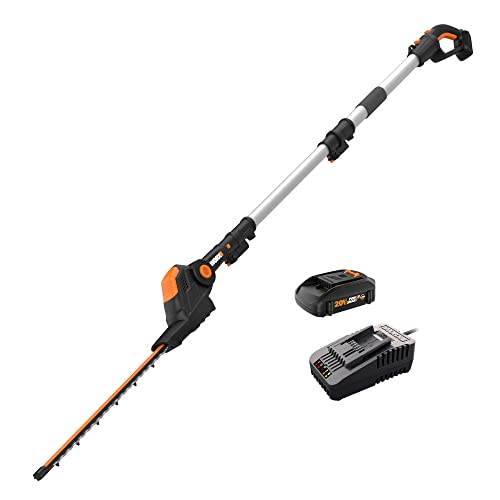


As an Amazon Associate we earn from qualifying purchases at no extra cost to you. Ratings are shown as listed on Amazon.
Best pole hedge trimmers at a glance
| Model | Power system | Blade length | Maximum tooth gap | Head adjustment | Approximate tool weight | Best for |
|---|---|---|---|---|---|---|
| STIHL HLA 56 | 36V AK battery | 45 cm / 17.7 in | 16 mm / 0.63 in | 135° working range | 3.8 kg / 8.4 lb, without battery | Light domestic trimming |
| STIHL HLA 66 | 36V AP battery | 50 cm / 19.7 in | 30 mm / 1.18 in | 145° working range | 3.8 kg / 8.4 lb, without battery | Thicker, established hedges |
| STIHL HLA 86 | 36V AP battery | 50 cm / 19.7 in | 33 mm / 1.30 in | 145° working range | 4.8 kg / 10.6 lb, without battery | Professional or very dense hedges |
| Husqvarna 120iTK4-H | 36V BLi battery | 50 cm / 19.7 in | 18 mm / 0.71 in | Adjustable cutting head | About 4.5 kg / 9.9 lb with battery, depending on setup | Flexible occasional use |
| DeWalt DCPH820 | 20V MAX battery | 56 cm / 22 in | 25 mm / 1 in | 135° head adjustment | About 3.6 kg / 7.9 lb, without battery | Users already invested in DeWalt batteries |
| EGO Power+ PH1420 | 56V ARC Lithium battery | 61 cm / 24 in | 26 mm / about 1 in | Multiple working positions | About 5 kg / 11 lb, before battery varies by configuration | Long, wide hedges and extended sessions |
Weights and operating specifications can vary by market, shaft configuration and whether a battery is included. Treat the table as a buying comparison, then confirm the exact regional specification before ordering.
Our picks by situation
Best overall for tall, thick hedges: STIHL HLA 86
The HLA 86 is the strongest choice when the hedge has woody growth that exceeds the capacity of lightweight domestic trimmers. Its 33 mm tooth gap gives more room for older stems, while the 50 cm blade covers a useful area on each pass. The telescoping shaft can be extended substantially, making it suitable for tall hedge faces without constantly working from a ladder.
The compromise is weight. At roughly 4.8 kg before the battery, it becomes demanding when the blade is held high for long periods. It makes most sense for frequent users, large gardens or contractors who will use a harness and take regular breaks.
Best lighter option: STIHL HLA 56
The HLA 56 is easier to control than high-capacity professional machines and is a sensible option for maintaining relatively young or regularly clipped hedges. Its 16 mm tooth gap is suited to leafy growth and smaller branches, not neglected hedges with thick woody stems.
Choose it when low fatigue matters more than maximum cutting force. For a hedge that is already within reach of a short step-free working position, the lower weight may save more time than a longer blade.
Best for DeWalt battery owners: DeWalt DCPH820
The DCPH820 combines a comparatively long 22-inch blade with a 25 mm cutting capacity and a 135-degree articulating head. It is attractive when you already own compatible 20V MAX batteries, because the purchase can be limited to the bare tool rather than a new battery, charger and platform.
Its reach is useful for the upper surface and far side of wide hedges, but the total working length still depends on the extension arrangement and the operator’s height. A long blade also creates more leverage at the hands, so it is not automatically less tiring than a shorter machine.
Best for maximum blade coverage: EGO Power+ PH1420
The PH1420’s 24-inch blade is useful when trimming long, broad hedge faces. Fewer passes can reduce the amount of time spent repositioning, and the 56V battery platform offers substantial energy capacity for users who already own EGO outdoor equipment.
This is a large tool rather than a lightweight one. It is best for users who can manage its balance and who value productivity over carrying comfort. For a small garden with a short hedge, the extra blade length is unnecessary bulk.
Best flexible domestic choice: Husqvarna 120iTK4-H
The 120iTK4-H is designed around a telescoping shaft and an adjustable hedge-trimmer attachment, making it practical for homeowners who need more reach than a handheld trimmer provides. Its cutting capacity is aimed at routine hedge maintenance rather than heavy renovation cutting.
It is a good fit for occasional trimming, especially when storage space and compatibility with other Husqvarna 36V tools are important. If the hedge is routinely allowed to grow thick, move up to a machine with a tooth gap of at least 25 mm.
How to compare reach and balance
Manufacturers may quote shaft length, total tool length or maximum working height, and these are not interchangeable. A working height also includes the operator’s reach and the blade angle. For a safe estimate, measure from the ground to the top of the hedge, then subtract your comfortable shoulder-level reach. That remaining distance is the approximate extension the tool must provide.
For example, if the hedge is 3.2 metres tall and your comfortable reach is 1.8 metres, you need approximately 1.4 metres of effective tool reach. Add some margin for an angled blade, but do not plan to gain the last section by stretching or standing on an unstable ladder.
Balance matters as much as the number on the scale. A rear-mounted battery can counterbalance a heavy blade, while a front-heavy design places more load on the upper arm and shoulder. Hold the assembled tool in the position you will actually use before buying if possible. The machine should remain controllable without excessive wrist bending or leaning backward.
Battery runtime: use area, not advertising minutes
Runtime depends on hedge thickness, blade pressure, battery capacity, temperature and whether the motor is repeatedly stopping in dense growth. A useful planning method is to estimate cutting time rather than relying on a claimed maximum runtime.
Suppose a hedge has two 20-metre faces and a 20-metre top, giving 60 linear metres to trim. If you average 3 metres per minute, including repositioning, the job takes about 20 minutes of motor-on and working time. Allowing 25 percent for thick sections and pauses raises that to 25 minutes. A battery advertised for 35 to 45 minutes in light work should normally cover the job, but a second battery is sensible for an overgrown hedge or a second property.
Higher-voltage systems are not automatically longer-lasting. Watt-hours provide the more useful comparison: multiply volts by amp-hours. A 36V, 5 Ah battery stores about 180 Wh, while a 56V, 5 Ah battery stores about 280 Wh. Actual cutting time will be lower than the theoretical result because of motor and load losses.
Durability and ownership costs
- Blade edges wear first. Sand, wire, fencing and hidden stones can nick the cutters. Clean sap after every session and use the manufacturer’s specified blade lubricant.
- Tooth gaps are not branch guarantees. A stated 30 mm capacity does not mean every 30 mm branch should be cut routinely. Repeated heavy cuts can overload the motor and accelerate blade wear.
- Telescoping locks need care. Keep adjustment collars free of grit and confirm that every locking mechanism is fully engaged before raising the blade.
- Battery storage affects ownership. Store batteries cool and dry, avoid leaving them fully discharged, and follow the maker’s storage-charge guidance.
- Cleaning prevents avoidable faults. Remove leaves from vents, wipe the shaft and guard, and inspect fasteners before each use. Never clean or clear a jam with the battery connected.
Expect general consumer pole hedge trimmers to cost roughly $180–$400 as kits, with professional machines and larger batteries often reaching $500–$900 or more. A bare tool can be better value when you already own that brand’s batteries; otherwise, compare the complete kit price, charger cost and the price of a spare battery.
Final buying decision
Choose the STIHL HLA 86 for thick, tall hedges and frequent work; the STIHL HLA 56 for lighter maintenance; the DeWalt DCPH820 or Husqvarna 120iTK4-H when battery-platform compatibility is decisive; and the EGO PH1420 when a long blade and high-capacity battery system justify the extra weight. For any model, prioritize a secure adjustable head, enough tooth gap for the hedge’s actual stems, and a balanced tool you can control without stretching.

Write Your Review
No reviews yet. Be the first to share your experience!