

Key takeaways
- 0.25–0.5 inch: suitable for mobility work and low-impact drills, not repeated tumbling landings.
- 1.5 inches: a practical minimum for many home cheer technique drills when the surface below is hard and the movements are controlled.
- 2 inches: better for frequent floor skills, especially where hands, knees, or hips may contact the mat.
- 4 inches or more: intended for landing or crash protection, not for running a full routine because the extra softness can change balance and takeoff mechanics.
Best Cheer Mats for Safer Practice
The best cheer mats are thick enough for the drills you actually perform, dense enough to resist bottoming out, grippy without catching shoes, and sized so the landing area—not just the athlete—fits on the mat.
For most home cheer practice, a 1.5-inch folding panel mat with a vinyl surface is the most useful compromise. Choose a 2-inch or thicker landing mat for repeated tumbling, dismounts, and partner drills; choose a thinner roll-out mat only for stretching, jumps, dance work, and basic technique.
Our top picks


As an Amazon Associate we earn from qualifying purchases at no extra cost to you. Ratings are shown as listed on Amazon.
Quick comparison: which mat fits your practice?
| Mat type | Typical thickness | Common dimensions | Best for | Main limitation |
|---|---|---|---|---|
| Stretch and exercise mat | 0.25–0.5 in | 4–6 ft × 2–4 ft | Warm-ups, flexibility, jumps, floor choreography | Insufficient impact depth for tumbling or dismounts |
| Folding panel mat | 1.5–2 in | 8–12 ft × 4–6 ft | Most home drills, walkovers, handsprings, conditioning | Panel seams can affect hand or foot placement |
| Landing mat | 4–8 in | 4–8 ft × 6–12 ft | Controlled landings, stunt exits, dismount practice | Heavy, bulky, and not a substitute for coaching |
| Cheer floor or carpet-bonded panel system | 1.25–2 in | 20–42 ft × 42–54 ft | Full routines and frequent team training | High cost and substantial storage space |
| Inflatable air track | 4–8 in inflated | 10–20 ft × 3–4 ft | Repeated tumbling lines and portable bounce training | Requires a pump and careful pressure management |
What thickness and foam density really change
Thickness is only half of impact protection. A very soft, thin mat can compress fully under a landing, allowing the athlete to feel the floor beneath it. A firmer mat may feel less plush but provide more predictable support. Look for closed-cell or high-resilience foam with a published density or firmness specification rather than relying on thickness alone.
- 0.25–0.5 inch: suitable for mobility work and low-impact drills, not repeated tumbling landings.
- 1.5 inches: a practical minimum for many home cheer technique drills when the surface below is hard and the movements are controlled.
- 2 inches: better for frequent floor skills, especially where hands, knees, or hips may contact the mat.
- 4 inches or more: intended for landing or crash protection, not for running a full routine because the extra softness can change balance and takeoff mechanics.
Density specifications vary by manufacturer, so compare like with like. If two mats have the same thickness, prefer the one that states foam density, compression recovery, or a defined intended use. Avoid choosing solely by the softest feel in a showroom or product video.
Surface grip: stable, not sticky
A cheer mat should prevent uncontrolled sliding while allowing shoes and hands to release naturally. Vinyl-coated surfaces are easy to clean and usually offer consistent traction. Carpet-bonded surfaces can feel familiar under cheer shoes but may collect dust and require more care.
Excessively sticky material can catch a shoe during a turn or prevent a hand from adjusting during a skill. Conversely, a glossy vinyl surface on a dusty floor can become slippery. Check grip with the footwear used for practice, and clean both the mat and the floor beneath it before judging performance.
Foldable designs versus roll-out mats
Folding panel mats
Panel mats fold into compact sections and are usually the best choice when storage matters. A 10-foot mat made from five 2-foot panels folds to approximately 2 feet long, although its folded thickness may be 10–14 inches. Carry handles and hook-and-loop fasteners make multiple mats easier to join.
The trade-off is the seam. Seams are rarely a problem for warm-ups or straight-line drills, but they can be noticeable beneath a hand or foot. Place the skill path along the length of the mat and inspect fasteners regularly so panels do not separate during use.
Roll-out mats
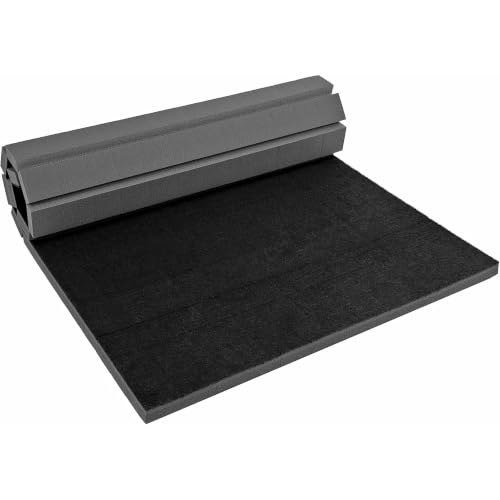
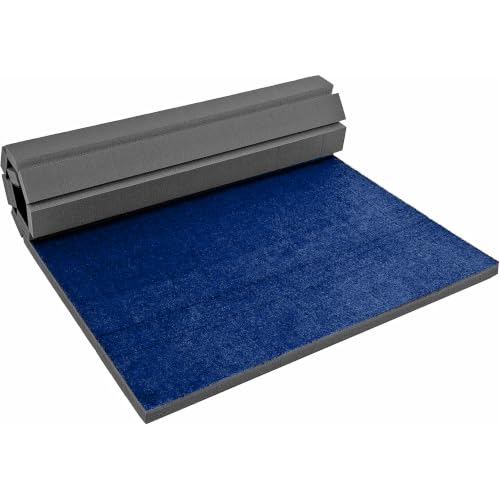
Roll-out mats provide a continuous surface and can be more comfortable for choreography. They need more open floor space during setup and should be stored flat or rolled according to the manufacturer’s instructions. A permanently curled edge is a trip hazard and should not be flattened with heavy equipment or used until it lies safely.
Air tracks
Air tracks are portable and provide springier feedback than foam mats. They are useful for repeated tumbling lines, but the bounce can change timing and technique. Use the recommended pressure, check for slow leaks, and do not assume an air track provides the same landing protection as a thick crash mat.
Size the mat around the skill, not the room
Measure the complete movement path, including the approach and a margin beyond the expected landing. For a single stationary drill, a 6-by-4-foot mat may be adequate. For a round-off or handspring progression, an 8-by-12-foot surface is more practical. A tumbling line may require 12–20 feet of usable length, depending on the drill and the coach’s instructions.
As a simple coverage check, a 10-by-4-foot mat provides 40 square feet. Two identical mats joined side by side provide 80 square feet, but only if the connectors keep the seam closed. If the available practice area is 12 by 10 feet, it has 120 square feet of floor; a 10-by-4-foot mat therefore covers one-third of the room, leaving space for the approach and safe clearance.
Never place the mat so close to furniture, walls, radiators, or low ceilings that a missed landing can make contact with them. A large mat cannot make an unsuitable practice space safe.
Decision matrix for common buyers
| Your situation | Best starting choice | Recommended specification | Why |
|---|---|---|---|
| Beginner, occasional home practice | Folding panel mat | 1.5 in thick, 8–10 ft long, 4 ft wide | Useful for basics without the weight of a landing mat |
| Frequent tumbling practice | Long panel mat or air track | 2 in foam or 6–8 in inflated, 12–16 ft long | Provides a longer skill path and more consistent repetition |
| Limited storage and small room | Multi-panel folding mat | 6–8 ft long, 2–4 ft wide when open | Fits a closet or under-bed storage more easily |
| Stunt and dismount drills | Landing mat plus instruction | 4–8 in thick, at least 6 × 8 ft | Creates a deeper landing zone for controlled progressions |
| Team or near-daily training | Modular floor system | 1.25–2 in panels with secure connectors | Offers broad coverage and replacement of individual sections |
Portability and ownership costs
Market pricing commonly ranges from about $50–$150 for basic exercise or thin folding mats, $150–$500 for larger 1.5–2-inch panel mats, and $400–$1,500 or more for long air tracks, substantial landing mats, or modular floor sections. Shipping can be significant because foam products are large even when they are not especially heavy.
Compare weight as well as folded dimensions. A 10-foot folding mat may weigh 20–40 pounds; a thick landing mat can exceed 60 pounds. If one person must set it up every day, handles, a manageable folded height, and secure panel fasteners may be more valuable than an extra foot of length.
For example, a $300 mat used three times a week for two years would receive about 312 uses. That is roughly $0.96 per use before cleaning or replacement costs. A cheaper $150 mat used only 30 times because it is awkward to carry costs $5 per use. Frequency and convenience can matter more than the initial price.
How to set up and maintain a cheer mat
- Inspect the floor. Remove gravel, moisture, and objects that could create bumps or puncture an air track.
- Unfold completely. Lock or join panels before practice, and make sure edges lie flat.
- Check the clearance. Keep furniture and hard obstacles outside the movement and landing zones.
- Use appropriate footwear. Follow the mat’s guidance; dirty soles reduce grip and can mark vinyl.
- Clean after use. Wipe vinyl with a damp cloth and mild, manufacturer-approved cleaner. Avoid solvents, abrasive pads, and excessive water.
- Dry before storage. Moisture trapped between folded panels encourages odor and surface deterioration.
- Rotate high-wear areas. If the same landing spot is used repeatedly, reposition the mat when practical to distribute compression.
The surface covering usually wears before the foam. Watch for split seams, exposed foam, permanent depressions, delamination, loose hook-and-loop strips, and air leaks. A damaged cover can catch skin or clothing, while compressed foam no longer provides the same support. Retire or repair the mat according to the manufacturer’s instructions rather than covering serious damage with tape.
Safety limits to keep in mind
A cheer mat reduces contact with the floor; it does not remove the risk of falls, awkward landings, or collisions. New tumbling skills, partner stunts, and dismounts should be learned with a qualified coach and suitable spotting. Stop using a setup if the mat slides, separates, bottoms out, or leaves too little room for the full movement.
Bottom line
For most buyers, the best cheer mat is a 1.5–2-inch folding panel mat with a durable, cleanable surface, secure connectors, and at least 8–10 feet of usable length. Choose a thicker landing mat for dismounts, a longer air track for repeated tumbling lines, and a modular floor only when frequent training justifies its cost and storage demands. Match the mat to the drill, the available clearance, and the person who must carry and maintain it.

Write Your Review
No reviews yet. Be the first to share your experience!