

Key takeaways
- Short, dense turf generally produces a quicker, smoother roll but shows dirt and directional wear more readily.
- Longer synthetic pile can feel softer and conceal minor floor imperfections, although the ball may slow more quickly.
- Foam or rubber underlay improves comfort and can reduce the effect of a slightly uneven floor.
- Printed alignment guides are useful for drills, but they do not make a mat more realistic. They are a training aid.
- Uneven breaks are uncommon in portable mats. If you want to practise breaking putts, look for a system with adjustable contours or use a permanent turf installation.
Best Indoor Putting Greens for Home Practice
The best indoor putting green for most homes is a 10-foot roll-up mat with a realistic medium-fast surface, but golfers with more floor space should choose a 12- to 13-foot mat for better distance control, while beginners and apartment dwellers may be better served by a compact 6-foot mat with a built-in return.
Your decision should come down to five practical questions: how much floor space you have, whether you need to practise straight putts or breaking putts, how quickly the surface rolls, whether the ball returns automatically, and how often you are prepared to unroll and store the mat.
Our top picks


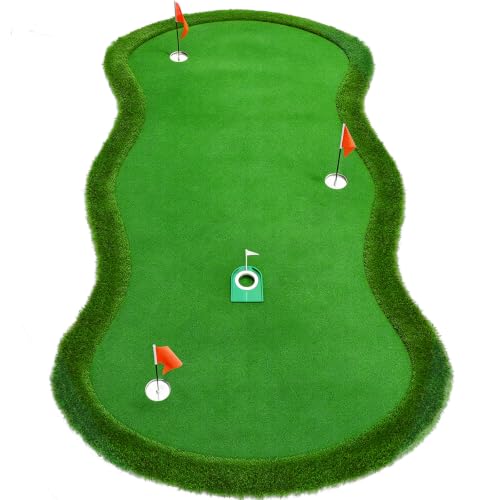
As an Amazon Associate we earn from qualifying purchases at no extra cost to you. Ratings are shown as listed on Amazon.
Quick comparison: leading home putting-green options
| Product or type | Approximate playing size | Surface and pace | Ball return | Best use | Typical market price |
|---|---|---|---|---|---|
| PuttOut Pro Putting Mat | 10 ft x 1.67 ft | Tufted synthetic surface; approximately medium-fast, around 10 on a Stimp-style comparison | Works with a separate PuttOut Pressure Putt Trainer or cup | Compact, repeatable straight-putt practice | $120–$180 |
| Wellputt 10 ft or 13 ft mat | 10 ft x 3.3 ft or 13 ft x 3.3 ft | Dense woven surface; commonly rated around 10–11 on the Stimp scale | Multiple target zones; no automatic return on the standard mat | Distance control, start-line drills and occasional breaking-putt work | $180–$350 |
| SKLZ Accelerator Pro | Approximately 8 ft x 16 in | Short synthetic mat with a raised cup area | Ball rolls back down the incline after a holed putt | Frequent short sessions in a bedroom or office | $40–$80 |
| Big Moss Competitor V2 | Approximately 12 ft x 3 ft | Indoor putting turf designed to reproduce a relatively quick green | Cut-out cup and target areas; no powered return | More realistic stance width and longer putts | $250–$400 |
| Custom-length synthetic putting turf | Usually 10–20 ft x 3–6 ft | Varies by turf, backing and underlay; often available in different pile heights | Optional cups, ramps or return channels | Dedicated golf room and multiple golfers | $300–$1,000+ |
Dimensions and playing speeds can vary with the exact model, underlay, room temperature and floor beneath the mat. Treat the figures as buying guidance rather than laboratory measurements.
Best choices by situation
| Your situation | Best choice | Why | Trade-off |
|---|---|---|---|
| Less than 10 feet of clear length | SKLZ Accelerator Pro or a 6–8 ft compact mat | Fits into a bedroom, office or hallway and encourages regular practice | Limited distance-control work and less realistic stance area |
| Regular golfer with about 12–14 feet available | Wellputt 10 ft or 13 ft | More width, visible alignment markings and useful pace-control drills | Needs to be rolled out flat and stored carefully |
| Small budget and occasional practice | SKLZ Accelerator Pro | Low entry cost and immediate ball return | The ramp and small target area make it less like a full green |
| Serious practice several times per week | PuttOut Pro or Wellputt | Better feedback on start line, pace and putter-face control | A separate return target may be required |
| Multiple golfers or a permanent golf room | 12–20 ft custom synthetic turf | Allows wider starting positions, longer putts and optional breaks | Higher cost, more installation work and less portability |
Head-to-head: compact returner versus full-length practice mat
Compact automatic-return models
A compact model such as the SKLZ Accelerator Pro wins on convenience. After a holed putt, the ball travels back toward the player, so a 10-minute session does not become a constant walk-and-collect exercise. That makes this style useful for building a daily putting habit.
Its limitation is realism. The raised cup area rewards a putt that reaches the target with enough pace, and the narrow width discourages practising different start positions. It is primarily a repetition tool for short putts, not a substitute for a wide green with multiple distances.
Longer roll-up mats
The PuttOut Pro and Wellputt mats provide more useful feedback when your miss is not simply “left or right.” You can practise a putt finishing 6, 8 or 10 feet beyond the starting point, change your target, and observe whether the ball dies at the hole or races past it.
The Wellputt format is wider than the PuttOut Pro, which matters more than it may first appear. A mat around 3.3 feet wide gives enough room to set up from slightly different angles and use alignment zones. The narrower PuttOut mat is easier to fit beside furniture, but it behaves more like a dedicated putting lane.
How much floor space do you really need?
Do not measure only the advertised mat length. Add room for your stance, backswing, walking around the mat and the club length beyond the ball. A practical calculation is:
Required room length = mat length + about 4 feet for the player and putter.
For a 10-foot mat, plan on roughly 14 feet of unobstructed length. For a 13-foot mat, allow approximately 17 feet. Width also matters: a 1.67-foot mat needs only a narrow lane, while a 3.3-foot mat is more useful but may conflict with a desk, sofa or cabinet.
For example, a 10-foot by 3.3-foot mat has 33 square feet of playing surface, but a comfortable room allowance of about 14 feet by 6 feet is closer to 84 square feet. That extra area is not wasted: it lets you stand squarely, collect balls and make a normal stroke without hitting nearby furniture.
Understanding stimp speed and surface realism
Indoor mats usually imitate a pace rather than reproducing a measured outdoor green. A surface described as 10 or 11 on the Stimp scale should feel medium-fast, but pile direction, dust and the hard floor beneath can alter the result.
- Short, dense turf generally produces a quicker, smoother roll but shows dirt and directional wear more readily.
- Longer synthetic pile can feel softer and conceal minor floor imperfections, although the ball may slow more quickly.
- Foam or rubber underlay improves comfort and can reduce the effect of a slightly uneven floor.
- Printed alignment guides are useful for drills, but they do not make a mat more realistic. They are a training aid.
- Uneven breaks are uncommon in portable mats. If you want to practise breaking putts, look for a system with adjustable contours or use a permanent turf installation.
A mat that rolls consistently is usually more valuable than one advertised as exceptionally fast. Consistency lets you compare strokes from one session to the next.
Ball-return features: useful, but not always better
Automatic return systems save time, but they can narrow your practice routine. A ramp may return only putts that enter at a suitable speed, while a cup or pressure trainer can reveal whether the ball would have stayed near the hole after a marginally fast putt.
For serious practice, a separate target such as the PuttOut Pressure Putt Trainer can be preferable to a fixed ramp. It gives feedback on putt quality and can be moved to different distances. The downside is that you must retrieve balls manually unless you add a return channel or use a mat positioned against a wall.
Ownership realities and maintenance
The first parts to show wear are normally the cup area, the high-traffic starting line and the mat edges that are repeatedly unrolled. A mat left permanently under a chair or heavy table can develop compression marks. Rolling it with the turf facing outward, following the manufacturer’s instructions, is safer than folding it.
- Vacuum or brush lightly rather than using a rotating vacuum head that can pull fibres.
- Keep food, drinks and outdoor mud away from the surface; oily residue changes ball roll.
- Allow a rolled mat to lie flat before judging its speed or straightness.
- Use a rubber or foam underlay if the floor has tile joints, deep carpet texture or visible dips.
- Rotate the mat occasionally if one starting position receives nearly all the practice.
- Store ball-return ramps separately if they can deform the mat when left underneath it.
Expect the mat itself to last for several years with moderate use, but treat that as an ownership range rather than a guarantee. Heavy daily practice, pets, sunlight and repeated dragging shorten its useful life.
Final verdict
Choose the SKLZ Accelerator Pro when convenience, low cost and automatic return matter most. Choose the PuttOut Pro when your room is narrow and you want structured, repeatable practice. Choose a Wellputt 10-foot or 13-foot mat when distance control and a wider practice area are more important than automatic ball return. For a dedicated room, a wider custom synthetic green offers the most realistic practice, but only if you can accept its cost and permanent footprint.
The best indoor putting greens are not necessarily the longest or fastest. The right one is the largest mat that fits your room without forcing you to move furniture every time you practise, and the one whose surface gives consistent feedback for the type of putts you most need to improve.

Write Your Review
No reviews yet. Be the first to share your experience!