

Key takeaways
- Adjustable wrench: flat jaws for hex nuts and square heads, such as supply-line nuts, compression nuts, shutoff valve nuts and flange nuts. The jaws grip on flats and leave chrome alone if they fit tightly.
- Pipe wrench: toothed jaws that bite into round pipe. Use these on threaded steel or iron pipe and unplated fittings. The teeth damage soft metals and chrome.
- Pliers wrench or locking pliers: smooth-jawed wrenches like the Knipex Pliers Wrench can grip hex and round chrome parts without teeth, which makes them a popular add-on for finished fixtures.
For most plumbing repairs, an 8-inch wide-jaw adjustable wrench such as the Channellock WideAzz is the single best all-rounder, a slim-headed model like the Bahco 9031 ERGO is the pick for tight spaces under sinks and behind toilets, a 12-inch Crescent-style wrench covers bigger nuts at a modest cost, and a pipe wrench such as the RIDGID 31010 is the tool for round pipe, which no ordinary adjustable wrench grips well. The right choice depends on what you are turning: hex nuts and fittings call for an adjustable wrench, while threaded pipe and rounded stock call for a pipe wrench.
Our top picks



As an Amazon Associate we earn from qualifying purchases at no extra cost to you.
At a glance: wrenches for plumbing work
| Tool | Best for | Reviewer-stated specs | Main limit |
|---|---|---|---|
| Channellock WideAzz 8 inch | All-round household and service plumbing | One roundup lists about 1.5 inch jaw capacity, laser-etched scales, a knurled adjustment screw and a rubber over-molded grip; another says it is made in the USA | Wider head than a slim wrench |
| Bahco 9031 ERGO | Tight plumbing spaces | Roundups describe a slim head with good jaw alignment and alloy steel construction | Premium tier |
| Klein Tools D507-10 | Commercial service work | Described as forged steel with precision jaw alignment and a corrosion-resistant finish | Bulkier than an 8 inch |
| Crescent 12 inch adjustable wrench | Big nuts, outdoor spigots, water-heater fittings | Chrome-finished steel with a scale on the jaw, according to a roundup | Long handle is awkward in tight spaces |
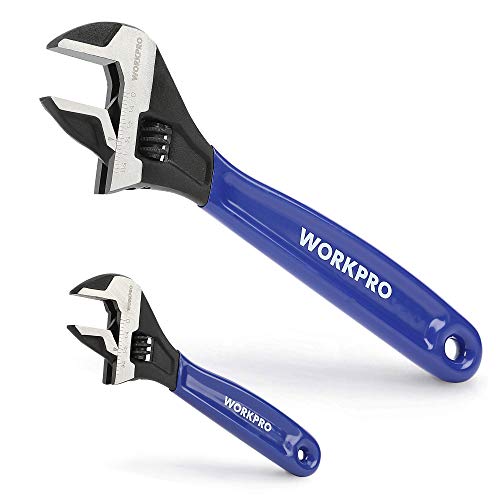
| WORKPRO 8 inch | Budget household use | Chrome-vanadium steel with a black oxide finish, per a roundup | Basic tolerance, lighter duty |
| RIDGID 31010 pipe wrench (10 inch) | Threaded pipe and rounded fittings | One roundup lists a 1/4 to 1-1/2 inch pipe range | Teeth mark soft fittings; not a hex-nut wrench |
Adjustable wrench versus pipe wrench versus pliers
New buyers often ask for one wrench to do all of it. Plumbing is a place where the distinctions matter, because a poor match of tool and fastener rounds off nuts and scars chrome.
- Adjustable wrench: flat jaws for hex nuts and square heads, such as supply-line nuts, compression nuts, shutoff valve nuts and flange nuts. The jaws grip on flats and leave chrome alone if they fit tightly.
- Pipe wrench: toothed jaws that bite into round pipe. Use these on threaded steel or iron pipe and unplated fittings. The teeth damage soft metals and chrome.
- Pliers wrench or locking pliers: smooth-jawed wrenches like the Knipex Pliers Wrench can grip hex and round chrome parts without teeth, which makes them a popular add-on for finished fixtures.
The standard approach in many plumbing jobs is to use two wrenches: one to hold the fitting or valve body still and one to turn the nut. That prevents twisting a pipe and loosening a joint further along. An adjustable wrench and a second adjustable or pipe wrench make a useful pair.
How an adjustable wrench works and how to use it
An adjustable wrench has one fixed jaw and one movable jaw driven by a worm screw. As a general reference puts it, the fixed jaw handles bending stress much better than the movable jaw, because the movable jaw is only supported by the flat sides of its guide slot. In practice, position the wrench so the force pulls toward the movable jaw side, with the fixed jaw doing the pushing work. Tighten the screw so the jaws seat snugly on the flats, and pull the handle; don’t push it. Excess force can spring the movable jaw open, round off the fastener or even break the jaw.
Several habits protect both the tool and the plumbing:
- Match the jaw to the nut so there is no wiggle. A loose fit rounds off corners.
- Pull toward you, with your body braced, and keep your knuckles clear of walls and pipes.
- Do not slide a cheater bar over the handle. That puts forces on the tool it was not built to carry.
- Do not hammer on a wrench. If a fitting is stuck, apply a suitable penetrating product and give it time, or call a professional.
- Close the water supply before loosening any fitting, and relieve pressure by opening a faucet downstream. Gas fittings and gas appliances belong to a licensed professional.
Top pick: Channellock WideAzz 8 inch
Roundups repeatedly put the WideAzz at the top for plumbing. One calls it a favorite among professional plumbers because its wide jaw opening can replace several sizes, and another lists a jaw capacity of about 1.5 inches, laser-etched SAE and metric scales, a four-thread knurled adjustment screw and a slip-resistant, over-molded handle. A third notes precision-machined jaws and U.S. manufacture. The 8 inch length is described as handling the majority of residential plumbing. It opens wide enough for large supply nuts and many drain fittings, yet still fits in the cabinet under a sink.
The trade-offs are the wider head, which may not slip behind a toilet supply or tight stud bays, and the handle coating, which can degrade if exposed to hot solvents. If you can only own one adjustable wrench for home plumbing, this is the tool reviewers most often name.
Slim-head pick: Bahco 9031 ERGO
The Bahco 9031 ERGO is the premium choice in plumbing roundups. They describe a slim head, accurate jaw alignment, high-strength alloy steel and strong corrosion resistance, which suits tight plumbing. If you work behind toilets, inside vanity cabinets or around packed fittings, a thin-headed wrench is worth the premium, because a wide head simply will not fit.
Commercial pick: Klein Tools D507-10
A roundup recommends the Klein D507-10 for commercial service work, describing forged steel, precision jaw alignment and a corrosion-resistant finish. At the 10 inch size it gives more leverage than an 8 inch, with a modest increase in bulk. It makes sense for people who turn many nuts a day and want a tool built for long service.
Value picks: Crescent and WORKPRO
A reviewer calls a Crescent 12 inch wrench the runner-up in one general guide, with a chrome finish, slip-resistant handle and rust resistance, and a plumbing roundup names a Crescent adjustable wrench as the best value, mentioning smooth screw action and a laser measurement scale. A 12 inch size gives leverage for large nuts on outdoor spigots, water heaters and old valves. The WORKPRO 8 inch is the budget pick in the same guides, with chrome-vanadium steel and a black oxide finish, suited to basic household jobs. On the cheapest wrenches, jaw tolerance and screw smoothness vary, which shows up as play at the jaws.
When you need a pipe wrench: RIDGID 31010
For round pipe, threaded galvanized or iron lines, and unplated fittings, a pipe wrench is the right tool. One guide names the RIDGID 31010 10 inch pipe wrench as best for plumbing, with a pipe range of about 1/4 to 1-1/2 inches, and another recommends the RIDGID 31400 for plumbers who do pipework frequently. These are pipe wrenches and not adjustable wrenches. The toothed jaws will mark chrome and brass, so protect finished surfaces with a rag or use a strap wrench. A 10 inch pipe wrench is common for household work; larger pipes need longer wrenches.
Sizes and what to own
A reviewer notes that most professionals carry 6, 8, 10 and 12 inch sizes, and that the 8 inch handles most residential jobs. A sensible starter set for a homeowner is one 8 inch adjustable wrench, one 10 or 12 inch adjustable wrench for larger nuts, and a 10 inch pipe wrench for threaded pipe. Add a basin wrench for faucet nuts hidden above the sink, because an adjustable wrench cannot reach them.
Care and what to look for
- Jaw play: close the jaws on a flat surface and rock; minimal movement is better.
- Adjustment screw: it should turn smoothly with a thumb and hold position under load.
- Steel and finish: forged alloy or chrome-vanadium steel with chrome or black oxide finish for corrosion resistance.
- Scale markings: laser-etched scales do not wear away like stamped ones.
- Handle: an over-molded grip is comfortable, but on all-metal handles clean off oil to keep a firm hold.
- Storage: wipe off water, dry the wrench and add a drop of light oil on the screw from time to time.
Budget tiers
- Budget: WORKPRO, DURATECH and similar imports for occasional use.
- Mid-range: Channellock WideAzz, Crescent and RIDGID pipe wrenches.
- Premium: Bahco ERGO and Klein Tools for heavy daily use.
Pick X if… decision table
| If you… | Pick | Why |
|---|---|---|
| Want one wrench for home plumbing | Channellock WideAzz 8 inch | Wide jaw, common size |
| Work in tight cabinets | Bahco 9031 ERGO | Slim head |
| Do service calls daily | Klein D507-10 | Forged build for heavy use |
| Need leverage on large nuts | Crescent 12 inch | Longer handle, low cost |
| Are on a tight budget | WORKPRO 8 inch | Basic but adequate for light jobs |
| Are turning threaded pipe | RIDGID 31010 pipe wrench | Toothed jaws bite round pipe |
Alternatives
Basin wrench
A basin wrench has a swiveling jaw on a long shaft and reaches faucet supply nuts behind a sink, where no regular wrench fits.
Strap or chain wrench
For polished or plated pipe where teeth would leave marks, a strap wrench grips without scarring.
Plumber’s pliers and tongue-and-groove pliers
Channellock-style tongue-and-groove pliers handle drain nuts and slip joints, but they are not a substitute for a wrench on hex nuts.
Frequently Asked Questions
What size adjustable wrench is best for plumbing?
The 8 inch size handles most residential jobs, according to roundups, and fits under sinks. A 10 or 12 inch wrench is useful for large nuts and outdoor fittings. Many plumbers carry several sizes.
Can I use an adjustable wrench on pipe?
It is not designed to grip round pipe, and it can slip or damage the pipe. Use a pipe wrench for threaded pipe, and use a strap wrench on polished or plated surfaces.
Why do I need two wrenches?
Use one to hold the fitting or valve body still while the other turns the nut. That prevents twisting the pipe and loosening joints elsewhere in the line.
Is a more expensive wrench worth it?
Premium wrenches generally offer tighter jaw tolerances, smoother screws and better corrosion resistance. For occasional household use, a mid-range tool is typically sufficient. Daily professional use is where a premium model pays off.
How do I stop a wrench from slipping?
Seat the jaws fully on the flats, tighten the screw so there is no play, and pull toward the movable jaw side. If it still slips, the fastener may already be rounded and may need a different tool.
When should I call a plumber?
Call a professional for gas lines, a seized main shutoff, corroded supply pipes, any leak you cannot stop, or work that involves cutting into walls. Turn off the water and avoid forcing a fitting that will not move.








Write Your Review
No reviews yet. Be the first to share your experience!