

Key takeaways
- Look for 0 degrees (flat) to 90 degrees (upright). If an easel starts at 45 or 90 degrees, it is a canvas easel, not a good watercolor easel.
- Continuous adjustment beats preset notches. One reviewer prefers continuous tilt because you can dial in just enough slope. Preset positions, like the five on the Falling in Art model, are easy to use and hold firmly, but you cannot fine-tune them.
- Lockability. A board covered in water gets heavier and a loose joint will creep downhill. Knob locks are more reliable than friction pivots.
- Edge support. Flat painting needs a lip, clips or tape to hold a board. Many watercolor painters tape paper to a board and rest the board on the easel’s ledge.
For watercolor, the best adjustable easel is one that tilts all the way from upright to nearly flat and locks there: the MEEDEN field and H-frame easels suit painters who need continuous tilt, a compact tabletop easel such as the Falling in Art five-position model or the VISWIN H-frame suits a desk or kitchen table, and a sketch-box easel such as the Creative Mark Soho Urban Artist suits plein air painters who want storage and a built-in palette. Oil and acrylic painters generally want a canvas that stands upright; watercolor painters need the opposite, because wet washes run downhill and a board that cannot lie flat will lead to drips, backruns and uneven pooling.
Our top picks



As an Amazon Associate we earn from qualifying purchases at no extra cost to you.
At a glance: adjustable easels for watercolor
| Easel | Best for | Reported specs | Main limit |
|---|---|---|---|
| MEEDEN Artist Watercolor Field Easel | Outdoor and studio flexibility | Art Ltd describes lightweight aluminum that folds to about 17 inches, tilts from flat to upright at any angle, with a built-in palette and cup holder | Lightweight frame suits smaller boards |
| MEEDEN Studio H-Frame Easel | Home studio, larger sheets | One roundup reports a tilt from vertical to flat and room for two canvases | Needs floor space; not portable |
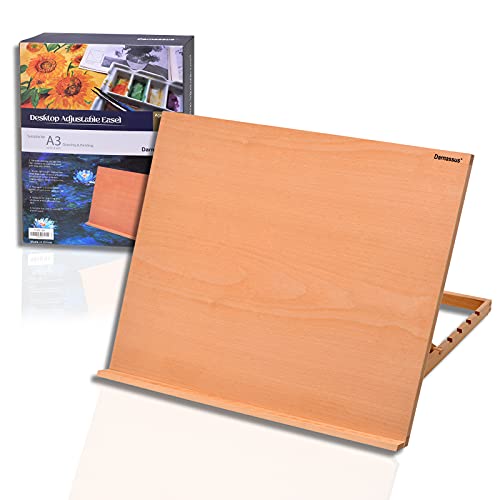
| Falling in Art 5-position table easel | Beginners and desk painters | Roundups list five preset angles from flat to 68 degrees, European beech, about 1.9 lb | Preset notches, no fine tilt |
| VISWIN 25 inch H-frame tabletop easel | Small studios | Roundups list a tilt from 0 to 90 degrees | Smaller work surface |
| US Art Supply Solana desk easel | Small sheets at a desk | Art Ltd lists four screw-free angles, a wooden palette and a storage drawer, for work up to about 14 inches | Limited size |
| Creative Mark Soho Urban Artist sketch box | Travel and plein air | Art Ltd lists hardwood construction and canvases up to 25.5 inches; the lid adjusts from flat to angled | Must sit on a table or tripod |
| T-Sign adjustable easel | Sit-down and stand-up use | One review lists 17 to 66 inch height range and about 2.15 lb | Lightweight; check stability with large boards |
| conda aluminum table easel | Light travel | Art Ltd lists a tripod design with a rear leg that sets the angle, for 15 to 30 inch supports up to 10 lb | Limited weight |
Why tilt range decides everything
A common mistake when buying an easel for watercolor is to focus on height and ignore angle. Reviewers of watercolor easels return to the same point: you need to lay down wet washes on a nearly horizontal surface so the pigment flows evenly across the paper, then raise the board to see your painting at eye level. Art Ltd’s guide recommends a slight tilt of roughly 20 to 45 degrees to keep washes from puddling while still giving control, and another roundup notes that a nearly horizontal angle lets water flow naturally across the paper during wet-in-wet work. The practical consequences are:
- Look for 0 degrees (flat) to 90 degrees (upright). If an easel starts at 45 or 90 degrees, it is a canvas easel, not a good watercolor easel.
- Continuous adjustment beats preset notches. One reviewer prefers continuous tilt because you can dial in just enough slope. Preset positions, like the five on the Falling in Art model, are easy to use and hold firmly, but you cannot fine-tune them.
- Lockability. A board covered in water gets heavier and a loose joint will creep downhill. Knob locks are more reliable than friction pivots.
- Edge support. Flat painting needs a lip, clips or tape to hold a board. Many watercolor painters tape paper to a board and rest the board on the easel’s ledge.
Best for variable tilt: MEEDEN field and studio easels
Art Ltd leads its watercolor easel guide with the MEEDEN Artist Watercolor Field Easel, describing lightweight aluminum that folds to about 17 inches, a tilt from flat to upright with any angle in between, and a built-in palette with a cup holder. Another roundup describes the MEEDEN Studio H-Frame easel as tilting from fully vertical to flat horizontal and holding two canvases at once, and names it best overall for watercolor. A beechwood MEEDEN tripod easel is also reviewed, with a reported capacity of about 44 inches and a weight of roughly 8.5 lb.
The trade-off is size and cost. A studio H-frame occupies a footprint on the floor, and the field version relies on a light frame, so avoid hanging a large, wet board far from the center of the tripod. These are the best bet for people who paint on both quarter-sheet and half-sheet paper and want one easel for both.
Best for a desk: tabletop easels
Falling in Art 5-position easel
Roundups identify the Falling in Art table easel as the best-value tabletop pick: European beech, about 1.9 lb, with five preset angles from flat to roughly 68 degrees. A reviewer notes that the positions are fixed and cannot be micro-adjusted. For beginners painting on small boards, this is generally enough, because the lowest position allows a wash and the highest holds the work up for review.
VISWIN 25-inch H-frame
Reviewers describe the VISWIN as a tabletop H-frame easel that tilts from 0 to 90 degrees. The H-frame shape holds a board more solidly than an A-frame, which is helpful when a loaded brush touches the paper.
US Art Supply desk models
The Solana desk easel is described by Art Ltd as compact, accepting works up to about 14 inches, with four angles that adjust without screws, a wooden palette and a storage drawer. Another review of a U.S. Art Supply tabletop easel says tilting the mast fully forward gives a slight downward slope suitable for washes, while a different U.S. Art Supply wooden model is listed with six angle positions from flat to 90 degrees. Because the same brand sells easels with different angle systems, read the product description for the exact range before you order.
Best for travel: sketch-box easels
The Creative Mark Soho Urban Artist Sketch, according to Art Ltd, combines a toolbox and an easel in hardwood, tilts to a range of angles, and holds canvases up to about 25.5 inches. It must sit on a table or a tripod. Other beechwood sketch-box easels, including the ARTIFY and DEAYOU models, are listed by reviewers as budget-friendly and compact, some with carrying handles and removable partitions. One roundup lists a sketch-box tilt range of 90 to 180 degrees and warns that it offers limited range for flat watercolor work, which is a good reminder to look at the lowest angle, not just the highest.
These boxes are comfortable for urban sketching, plein air outings and classroom use. They hold a palette and tubes, so there is less to carry, and they have a built-in handle. The downside is that most are designed to hold a panel at an angle, not to lay flat while you wet the paper. If you want to paint flat, check the lowest tilt in the product description.
Height-adjustable and tripod options
The T-Sign easel is described by one reviewer as adjusting from a 17 inch tabletop height to a 66 inch floor height at about 2.15 lb, which is useful if you alternate between sitting and standing. The conda aluminum table easel uses a tripod design where a rear leg sets the angle. Art Ltd lists it for supports between 15 and 30 inches and up to 10 lb. Art Ltd also notes that tripod-style easels give superior flexibility to control pigment movement but can be less stable on uneven ground. If you paint outdoors, add a weight hook or hang your bag from the center column.
US Art Supply also sells a 73 inch aluminum easel with knobs for height and angle; reviewers list adjustable legs that allow tabletop use. Check the stated maximum canvas height and weight limit.
Fit, size and care
- Match easel to paper size. A full sheet of watercolor paper is about 22 by 30 inches. A board of that size needs an easel rated for it; a 14 inch desk easel will not carry it.
- Use a board. Wet paper needs a rigid backing such as a drawing board, a block or foam core. Tape the edges so the paper stays flat as it dries.
- Protect wood. Wipe water and pigment off beech and hardwood easels, and avoid leaving them damp, which can cause swelling or staining.
- Protect the floor and table. A drip tray, a cloth or a plastic sheet under the easel catches spills.
- Keep knobs snug. Tighten tilt knobs by hand, not with pliers; over-tightening can strip wooden or plastic threads.
- Folding hardware. Brass, aluminum and steel parts are less likely to swell than wood parts, and they are easier to wipe clean.
Pick X if… decision table
| If you… | Pick | Why |
|---|---|---|
| Want any angle from flat to upright | MEEDEN field or studio easel | Continuous tilt |
| Paint small sheets at a desk | Falling in Art or US Art Supply Solana | Compact and light |
| Need a 0 to 90 degree tabletop easel | VISWIN H-frame | Full range |
| Travel and want storage | Creative Mark Soho sketch box | Palette and tubes in the box |
| Alternate sitting and standing | T-Sign adjustable easel | Wide height range |
| Paint large sheets | MEEDEN H-frame studio easel | Bigger capacity |
| Work outdoors | Aluminum tripod, weighted | Light and stable when anchored |
Alternatives
A drawing board on a table
Many watercolorists simply tape paper to a board and prop it on a book or a wedge. It costs little and gives total control of angle, but it is not as comfortable for long sessions.
Pochade or French box easel
Traditional sketch-box easels are built for travel and, while mainly designed for oil, many will serve watercolor if the lid or tray can be set at a low angle.
Frequently Asked Questions
What angle should a watercolor easel be set to?
For laying wet washes, a shallow tilt of roughly 20 to 45 degrees is a common suggestion, with some painters working almost flat. Raise the board to upright to assess the painting. An easel that moves from flat to upright covers every stage.
Can I use an oil painting easel for watercolor?
Only if it tilts far enough forward. Many canvas easels do not go anywhere near flat, so the paper stays steep and washes run. Check the lowest angle in the product description.
Do I need a tabletop or floor easel?
A tabletop easel suits sitting at a desk and small paper. A floor or H-frame easel suits larger sheets and standing work. Many painters keep one of each, a compact one for travel and a larger one at home.
How do I stop my paper from slipping or buckling?
Tape the edges to a rigid board, or use a watercolor block, then place the board on the easel. Stretching paper before use also helps with heavy washes.
Are wooden easels safe with water?
Wooden easels tolerate normal watercolor use if you wipe them dry afterward. Persistent dampness can cause swelling or staining, so avoid storing them wet, and use a tray under the easel.
Which is best for beginners?
A small tabletop easel with a flat setting, such as the Falling in Art five-position model, is a low-cost way to learn. As you buy larger paper, you can move to a continuous-tilt easel like the MEEDEN.





Write Your Review
No reviews yet. Be the first to share your experience!