

Key takeaways
- Manual hold: you press a button after the display settles.
- Automatic hold: the scale detects a stable reading and locks it automatically.
The best baby scales combine a stable cradle, 5 g measurement increments, a reliable hold function, and a tare button that lets you weigh with a blanket or towel; for most families, a 20 kg digital infant scale is the most useful balance of precision, longevity, and price.
Our top picks



As an Amazon Associate we earn from qualifying purchases at no extra cost to you. Ratings are shown as listed on Amazon.
Best baby scales by situation
| Best for | Recommended scale type or model | Why it fits | Typical market range |
|---|---|---|---|
| Occasional home growth checks | Basic 20 kg digital infant scale, such as the Beurer BY 80 | 5 g increments, tare, hold, and simple operation without an app | $40–$80 |
| Parents who want saved measurements | Connected scale such as the Beurer BY 90 or a comparable Bluetooth model | Records measurements digitally and reduces handwritten tracking | $60–$120 |
| Frequent, high-precision weighing | Professional-style scale such as the seca 354 or Tanita BD-590 | Sturdy construction, clear displays, and fine graduations designed for repeated use | $150–$350+ |
| Small homes and easy storage | Removable-cradle digital scale | The tray can be detached or the unit stored vertically, saving cupboard space | $40–$100 |
Prices are broad 2026 market ranges and vary by country, retailer, included accessories, and whether the scale is sold as a home or clinical model.
What matters most when comparing baby scales
Weight capacity
A capacity of 20 kg, or approximately 44 lb, covers most of the period in which an infant scale is useful. Some models stop at 15 kg, while professional models may support 20 kg or more. A higher capacity does not automatically mean greater accuracy, but it gives the scale a longer useful life.
Check whether the stated limit applies to the child alone or to the child plus anything placed on the tray. A blanket, changing pad, or clothing counts toward the load. Never exceed the manufacturer’s limit, and do not use an infant scale as a general household or pet scale unless the manual expressly permits it.
Measurement increments
Look for 5 g increments if you need to notice small changes. Some budget scales measure in 10 g increments, which is adequate for general growth tracking but less detailed. Connected scales may display ounces to one decimal place, but the extra digits do not necessarily represent extra accuracy.
Read the specification carefully: “resolution” or “graduation” describes the displayed step, whereas accuracy describes how close the reading is to the actual weight. A scale showing 1 g changes is not automatically more accurate than a well-made 5 g scale.
Hold and motion-stabilising functions
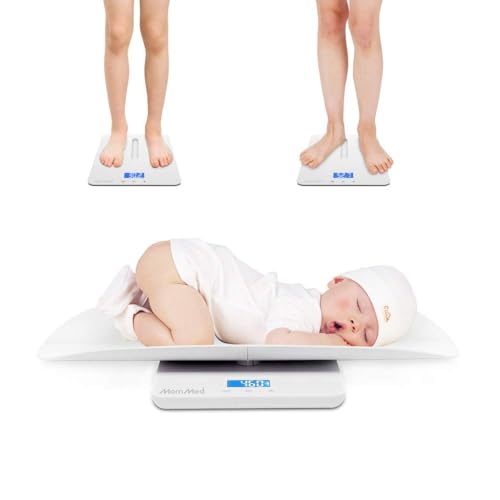
A hold function captures the weight after the baby moves, then keeps that reading on the screen after you lift the child away. This is one of the most useful features because an active infant can make an ordinary scale flicker through several numbers.
There are two common versions:
- Manual hold: you press a button after the display settles.
- Automatic hold: the scale detects a stable reading and locks it automatically.
Automatic hold is convenient, but it can lock onto a reading before the child is centred. A manual hold gives you more control. Either way, keep one hand close to the baby without pressing down on the tray.
Tare and zeroing
Tare removes the weight of a blanket, towel, or removable liner. Place the empty item on the tray, wait for the display to stabilise, press tare, and then place the baby on top. The screen should return to zero before weighing.
A zero button is slightly different: it resets the unloaded scale. If the display does not return to zero after removing the baby, switch the scale off and on, check the surface, and repeat the zeroing process. Do not repeatedly press buttons while the baby is moving; that can create confusing readings.
Head-to-head: basic, connected, and professional scales
| Feature | Basic digital scale | Connected scale | Professional-style scale |
|---|---|---|---|
| Typical capacity | 15–20 kg | 20 kg, or about 44 lb | 20–25 kg |
| Typical graduation | 5–10 g | 5 g or 0.1 oz display steps | 2–5 g, depending on load range |
| Hold function | Usually manual or automatic | Usually automatic | Often manual, with strong motion filtering |
| Tare | Usually included | Usually included | Included, often with a dedicated button |
| Power | Commonly 2–4 AA or AAA batteries | Batteries or rechargeable power, depending on model | AA batteries, mains power, or both |
| Best advantage | Low cost and simple setup | Automatic records and trend history | Durability and repeatable readings |
| Main drawback | Limited data storage | App pairing and privacy considerations | Higher cost and larger footprint |
How to get a more repeatable reading
- Put the scale on a hard, level floor. Carpet and uneven surfaces can flex under the scale and produce inconsistent readings.
- Install fresh batteries. Low power can cause sluggish displays, failed Bluetooth connections, or unstable readings.
- Turn it on and wait for zero. If a blanket or liner will be used, place it on the tray first and press tare.
- Centre the baby lengthwise. Keep hands near the child for safety, but do not touch the tray or apply downward pressure.
- Use hold only after the baby is safely settled. Record the locked result rather than trying to read a rapidly changing display.
- Repeat under similar conditions. Weighing at different times, in different clothing, or immediately after feeding can make comparisons less useful.
For everyday tracking, consistency matters more than chasing the smallest displayed increment. A reading taken on the same scale, with similar clothing and at a similar time, is easier to compare than isolated readings from several different devices.
Ownership realities: cleaning, calibration, and wear
The tray liner and the plastic buttons usually show wear before the weighing mechanism does. Use a slightly damp cloth and a mild cleaner approved by the manufacturer. Keep liquid away from the display, battery compartment, seams, and charging port. Avoid soaking the tray or using abrasive disinfectants that can cloud plastic.
Check the scale occasionally with a known object, such as a sealed 1 kg household item whose weight is clearly labelled. This is only a rough plausibility check, not laboratory calibration. If readings are repeatedly inconsistent on a hard floor, replace the batteries and contact the manufacturer rather than attempting to open or adjust the mechanism.
Remove disposable batteries during long-term storage to reduce the risk of leakage. For a connected model, confirm that the app still supports the device before buying, and consider whether you want a scale that stores infant data in a cloud account.
Which features are worth paying for?
- Worth prioritising: 20 kg capacity, 5 g increments, a wide non-slip tray, tare, hold, a readable display, and an automatic shut-off.
- Useful for frequent users: rechargeable power, a removable washable tray, a mains adaptor, and a history function.
- Often optional: Bluetooth, multiple user profiles, growth charts, and highly detailed app dashboards.
For a family weighing once every week or two, a basic 20 kg model with 5 g increments is usually the sensible choice. For repeated measurements where a small change needs to be recorded consistently, choose a sturdier professional-style scale and prioritise motion handling over app features.
A home baby scale is an information tool, not a substitute for a clinician’s assessment. If you are concerned about feeding, hydration, growth, illness, or a sudden change in weight, contact a paediatrician, midwife, health visitor, or other qualified professional and follow their recommended weighing method.

Write Your Review
No reviews yet. Be the first to share your experience!