

Key takeaways
- The cabinet’s nominal width and the actual clear opening between the side walls.
- The countertop depth and the distance from the cabinet front to the rear wall.
- The thickness and height of the cabinet’s front rail, which may need modification for the apron.
- The height available below the sink for the drain trap, disposal, water filter, and cleaning supplies.
- The existing drain-center location and whether the new sink’s drain is centered or offset.
The best fireclay farmhouse sinks depend on your cabinet width and washing habits: choose a 30-inch single bowl for the most flexible everyday setup, a 36-inch single bowl for large cookware, or a 33-inch 60/40 double bowl when separating tasks matters more than uninterrupted space.
Our top picks

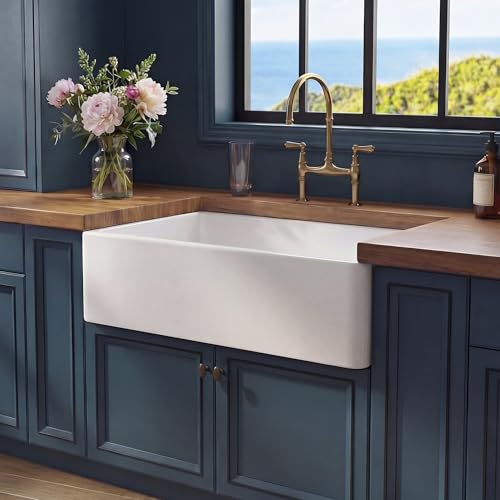

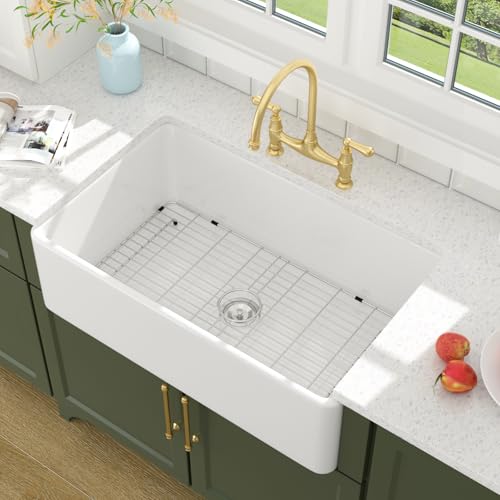
As an Amazon Associate we earn from qualifying purchases at no extra cost to you. Ratings are shown as listed on Amazon.
Quick picks by kitchen situation
| Situation | Best configuration | Practical target | Why it works |
|---|---|---|---|
| Small kitchen or 30-inch sink cabinet | Single bowl | 27–30 inches wide | Preserves usable washing space without requiring a wider cabinet |
| Frequent roasting and oversized cookware | Single bowl | 33–36 inches wide, at least 9 inches deep | Accommodates sheet pans, stockpots, and casserole dishes |
| Washing and rinsing at the same time | 60/40 double bowl | 33 inches wide | Provides separation while retaining one larger compartment |
| Traditional kitchen with occasional hand washing | 50/50 double bowl | 30–33 inches wide | Simple division for soaking and rinsing, but less room for large pans |
| Limited installation experience | Apron-front, top-mount-compatible model | Confirm the manufacturer’s cutout template | Usually reduces the risk of an exposed, imperfect cabinet cut |
Best fireclay farmhouse sinks compared
Best all-rounder: a 30-inch single-bowl fireclay sink
A 30-inch single bowl is the safest recommendation for most kitchens. It normally fits a 33-inch sink base cabinet, leaves room for cabinet framing, and offers enough width for a dinner plate, saucepan, and medium roasting dish. A typical basin is about 30 inches wide, 18 inches front to back, and 9–10 inches deep.
Brands such as Bocchi, Kraus, and Ruvati offer fireclay farmhouse models in this general format. Exact outside dimensions and cutout requirements vary, so use the product’s technical drawing rather than assuming every “30-inch” sink is interchangeable.
This layout is particularly useful when the sink is used for bulky cookware. The trade-off is that there is no separate rinsing compartment, so a removable colander or over-sink rack may be needed.
Best for maximum washing space: a 36-inch single bowl
A 36-inch single bowl is the strongest choice for a large kitchen and frequent cooking. It can make cleaning a wide roasting pan much easier than a divided sink. Villeroy & Boch and other established sink manufacturers sell large fireclay farmhouse formats, although availability, bowl geometry, and front-apron styling differ by market.
Do not treat a 36-inch sink as a simple upgrade from a 30-inch model. It commonly requires a 39-inch or wider sink cabinet, and the additional ceramic mass may demand more careful support. Measure the cabinet’s clear opening, not merely its nominal width. Plumbing space, drawer rails, and the countertop overhang can also restrict the installation.
Best for multitasking: a 33-inch 60/40 double bowl
A 60/40 configuration is more useful than a symmetrical double bowl for many households. The larger compartment can hold a saucepan or several plates, while the smaller compartment handles rinsing, produce, or a disposal. It preserves some separation without creating two cramped basins.
Choose this arrangement when washing and rinsing happen simultaneously. Avoid it if large sheet pans are a frequent part of cleanup: the center divider can prevent the pan from lying flat. A low divider may improve access, but it still does not provide the uninterrupted floor of a single bowl.
Best for traditional two-basin use: a 50/50 double bowl
A 50/50 fireclay sink suits cooks who routinely soak dishes in one side and rinse in the other. It can also be convenient when two people are working at the sink. The limitation is capacity: a 30- or 33-inch double sink may have individual bowls only about 14–15 inches wide after accounting for the divider and thick walls.
This is a good choice for everyday plates and cookware, but a poor match for oversized roasting trays. Check the usable bowl dimensions rather than relying on the sink’s overall width.
What the specifications really mean
| Specification | Useful range or example | How it affects the decision |
|---|---|---|
| Overall width | 27, 30, 33, or 36 inches | Determines minimum cabinet width and available washing area |
| Overall depth | 18–20 inches front to back | Must fit countertop depth, front rail, and plumbing clearance |
| Basin depth | 9–10 inches is common | Deeper bowls hold more but require more bending and may challenge short plumbing connections |
| Material | Vitreous china clay fired at high temperature | Gives a hard, glossy surface but creates a heavy, brittle installation component |
| Approximate sink weight | About 70–140 pounds, depending on size and wall thickness | May require cabinet reinforcement and two-person handling |
| Drain opening | Usually 3.5 inches | Typically accepts a standard basket strainer or compatible garbage disposal flange; verify before ordering |
| Drain position | Centered, rear-offset, or bowl-specific | Changes usable floor space and can determine whether existing plumbing lines up |
Cabinet fit: the measurement that prevents the most expensive mistake
Sink width and minimum cabinet width are different measurements. A sink advertised as 30 inches may require a 33-inch cabinet because the cabinet sides, front rail, and internal supports occupy the remaining space. Some models require a larger cabinet than the nominal rule suggests, particularly thick fireclay aprons or double bowls.
Before buying, record these measurements:
- The cabinet’s nominal width and the actual clear opening between the side walls.
- The countertop depth and the distance from the cabinet front to the rear wall.
- The thickness and height of the cabinet’s front rail, which may need modification for the apron.
- The height available below the sink for the drain trap, disposal, water filter, and cleaning supplies.
- The existing drain-center location and whether the new sink’s drain is centered or offset.
For example, if a 30-inch sink needs a 33-inch base cabinet and your cabinet is only 30 inches wide, the issue cannot be solved by trimming the countertop alone. The cabinet structure would need alteration or replacement. Confirm the manufacturer’s minimum cabinet size before ordering countertops or cutting the face frame.
Glaze durability and everyday ownership
Fireclay’s glossy glaze is resistant to ordinary staining, heat, and household wear, but it is not indestructible. The glaze is usually the most visible surface to protect; the apron edges and corners are especially vulnerable to impact from cast-iron cookware or dropped heavy objects. A chip may be repairable with a manufacturer-approved kit, but a repair rarely disappears completely.
Use a nonabrasive cream or mild dish soap with a soft sponge for routine cleaning. Rinse away strong cleaners rather than allowing them to sit on the surface. Avoid steel wool, harsh scouring powders, and abrasive pads that can dull the finish. A stainless or silicone bottom grid helps reduce contact between cookware and the basin floor, although it must be lifted and cleaned underneath.
Dark marks from metal pans are often transferred metal rather than a failure of the glaze. They can sometimes be removed with a cleaner specifically labeled safe for glazed ceramic. Test any product in an inconspicuous area and follow the sink manufacturer’s instructions.
Installation requirements to budget for
Farmhouse sinks are generally installed as undermount, flush-mount, or top-mount-compatible products. Undermount installation gives the cleanest countertop transition but demands precise support and a carefully finished opening. A top-mount option can be more forgiving when remodeling an existing counter, but the visible rim changes the appearance and may affect the apron design.
- Support: Build a level platform or frame rated for the sink’s full weight. Do not rely on countertop adhesive alone.
- Cabinet modification: The front rail and doors may need cutting or resizing to expose the apron.
- Countertop template: Have the fabricator cut from the current sink template, not a generic dimension.
- Drain compatibility: Check whether the drain location leaves room for the trap and disposal. A rear-offset drain can increase cabinet floor space, but it may not align with existing plumbing.
- Sealing: Use the specified silicone or sealant at the countertop and sink junction, and allow the cure time stated by the product manufacturer.
- Handling: Plan for two or more people and protect the sink from contact with hard tools during installation.
If the cabinet requires structural changes, countertop cutting, or drain relocation, hiring an experienced installer is usually less costly than repairing a cracked sink or replacing a newly cut countertop.
How much sink do you actually need?
Capacity is useful, but width often matters more than depth. A 30-inch single bowl that is 10 inches deep may hold roughly 20–25 gallons before allowing for a practical fill level, while a divided sink of similar outside width may offer substantially less usable space in each compartment. The exact capacity depends on sloped walls and the manufacturer’s internal dimensions.
For occasional cooking, a 27- or 30-inch single bowl avoids paying for cabinet and countertop changes that provide little benefit. For daily cooking and frequent hand washing, move to a 33-inch model if the cabinet allows it. Choose 36 inches only when the room, base cabinet, and installation budget support the increase.
Bottom line
For most homes, a 30-inch single-bowl fireclay farmhouse sink offers the best balance of cabinet compatibility, useful capacity, and manageable installation. Choose a 33-inch 60/40 model when separation is essential, a 36-inch single bowl for oversized cookware, and a 50/50 design only when two equal compartments outweigh the loss of uninterrupted washing space. Compare the technical drawing, minimum cabinet width, actual weight, drain placement, and care instructions before comparing finishes or apron styles.

Write Your Review
No reviews yet. Be the first to share your experience!