

Key takeaways
- Confirm the number of countertop or sink holes and their spacing.
- Measure the deck thickness and the available clearance below it.
- Check whether hot and cold supply lines reach the faucet without extensions.
- Make sure the shutoff valves are accessible and turn freely.
- Allow room for a pull-down hose, counterweight, battery pack, or control box.
- Use the supplied gasket or escutcheon rather than relying on excess plumber’s putty.
- Flush the supply lines before connecting the faucet to reduce debris in the cartridge.
The best kitchen faucets for easier everyday use are pull-down models with a 9–10-inch reach, a high-arc spout, a pause or sweep spray, and a finish that suits your water conditions and cleaning habits.
For most kitchens, a single-handle pull-down faucet is the strongest all-around choice: it leaves one hand free, reaches across a large sink, and returns neatly to its dock. A pull-out faucet is often better for a small sink or low cabinet, while a touch-control model earns its extra cost in busy kitchens where dirty hands frequently touch the faucet.
Our top picks
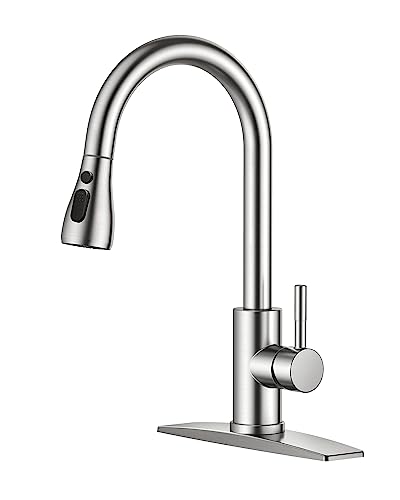
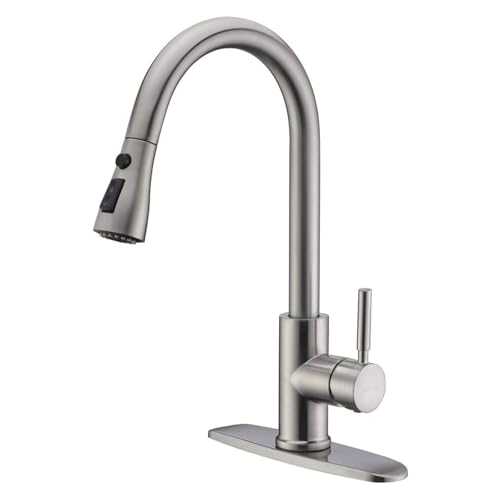

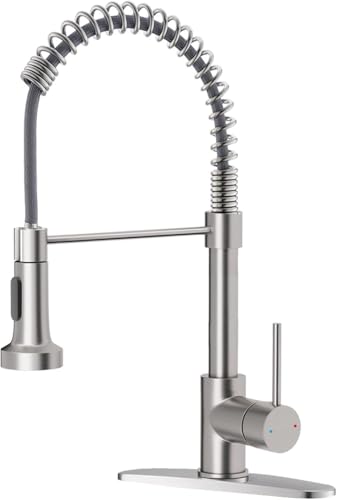
As an Amazon Associate we earn from qualifying purchases at no extra cost to you. Ratings are shown as listed on Amazon.
Best kitchen faucets by situation
| Kitchen situation | Best faucet type | Useful target specifications | Why it fits |
|---|---|---|---|
| Typical family kitchen | Pull-down, single handle | 9–10 in. reach; 8–10 in. spout height; 1.5–1.8 gpm | Good coverage for a double-bowl or medium-to-large sink |
| Small sink or shallow counter | Pull-out | 7–9 in. reach; 6–9 in. spout height | Lower profile and less chance of splashing |
| Frequent cooking and food preparation | Touch-control pull-down | Battery life commonly 1–3 years; 9–10 in. reach | Turns water on without transferring food residue to the handle |
| Hard-water area | Brushed stainless steel or spot-resistant finish | Silicone spray nozzles; removable aerator | Mineral deposits are less visually obvious and easier to clear |
| Limited DIY experience | Single-hole faucet with quick-connect lines | Flexible supply hoses; included deck plate if needed | Fewer connections and less under-sink work |
| Existing three-hole countertop | Single-handle faucet with escutcheon | Common 8-inch three-hole spread adapter | Covers unused holes without drilling or replacing the counter |
Flow rates in the table are typical targets, not guarantees. The actual rate depends on the model, local plumbing pressure, and the aerator installed.
Our top picks by design and use case
Best all-around: a pull-down faucet with a magnetic or weighted dock
A well-designed pull-down faucet offers the best balance of reach, control, and installation flexibility. Look for a spout that swivels at least 120 degrees, a hose that extends roughly 20–24 inches, and a docking system that pulls the spray head firmly back into place. Magnetic docking, used on some Delta and Kohler models, feels tidy when it works well; a properly weighted hose is also effective and can be easier to replace.
Choose a model with two useful spray modes rather than a collection of poorly differentiated buttons. A regular aerated stream is best for filling pots and rinsing dishes. A broader sweep or boosted spray is more useful for loosening food from a pan. A pause button can reduce water use while moving the head between tasks, but it should be large enough to operate with a wet hand.
Best for a compact kitchen: a pull-out faucet
Pull-out faucets generally have a shorter, lower spout and a spray head that travels toward the user rather than down from a tall arch. That makes them a sensible choice beneath shallow cabinets or over a small single-bowl sink. The trade-off is reach: the hose may not comfortably cover the far corner of a large basin.
Before buying, measure from the faucet hole to the back and front edges of the sink. A pull-out head that reaches only 8 inches may be perfectly adequate in a 20-inch sink but frustrating in a wide workstation sink.
Best for messy cooking: a touch-control model
Touch-on or touchless controls can make a real difference when preparing meat, dough, or produce. Delta Touch2O and Moen MotionSense are examples of established product systems in this category, although exact features vary by model and generation.
Touch-on faucets usually respond when you tap the metal body or spout with a wrist or forearm. Touchless versions use a sensor and normally require a battery pack or an electrical connection. Check whether the faucet can still operate manually if the batteries go flat. A manual override is more important than an extra sensor mode because it prevents a dead battery from stopping ordinary sink use.
Expect batteries to last approximately one to three years, depending on the model, battery quality, and number of activations. Place the battery holder where it can be reached without dismantling stored items under the sink.
What to compare before choosing
Reach and clearance
Reach is the horizontal distance from the center of the faucet base to the water outlet. A 9-inch reach works for many standard sinks, while 10–11 inches can better cover a wide basin. Longer is not automatically better: an oversized faucet may send water too close to the front edge, creating splash and an awkward washing position.
Also measure spout height and the distance to nearby cabinets. A high-arc faucet may provide room for a tall stockpot, but the handle or spray head can strike an upper cabinet. Leave enough clearance to remove the spray head and operate the handle comfortably.
Spray modes and hose behavior
At minimum, select a stream and a spray. A pause control is useful, but a “boost” mode can be more practical when rinsing a baking tray. Silicone nozzles are preferable to rigid rubber or metal openings because mineral deposits can often be removed by rubbing the silicone tips.
Check whether the hose retracts smoothly and whether the spray head has a check valve. Without adequate weight or guidance, the hose can snag on cleaning supplies stored below the sink. A small plastic or metal hose guide is inexpensive, but it may not be included with every faucet.
Mounting compatibility
Most kitchen faucets use a single center hole, but many older counters have three holes spaced 8 inches apart. A deck plate can cover the outer holes when installing a single-hole faucet. Confirm that the plate is included; otherwise, the faucet may fit mechanically but leave visible openings.
Stone, solid-surface, laminate, and stainless-steel counters may require different reinforcement or sealing methods. A faucet designed for a maximum deck thickness may not tighten correctly through a thick butcher-block counter. Measure the counter, sink deck, and any existing adapter before ordering.
Finish durability
Brushed stainless steel and brushed nickel are generally forgiving because they hide fingerprints and minor water marks. Polished chrome is often easy to wipe clean and can retain its appearance well, but it shows spots more readily. Matte black looks distinctive yet can reveal dried mineral residue and may require gentler cleaning.
“Spot-resistant” is a surface treatment, not a guarantee that the faucet will remain mark-free. Avoid abrasive powders, scouring pads, bleach, and acidic cleaners left on the surface. These can dull the finish or damage seals. Wipe the faucet with a soft cloth after cleaning and follow the manufacturer’s care instructions.
Installation requirements that are easy to miss
- Confirm the number of countertop or sink holes and their spacing.
- Measure the deck thickness and the available clearance below it.
- Check whether hot and cold supply lines reach the faucet without extensions.
- Make sure the shutoff valves are accessible and turn freely.
- Allow room for a pull-down hose, counterweight, battery pack, or control box.
- Use the supplied gasket or escutcheon rather than relying on excess plumber’s putty.
- Flush the supply lines before connecting the faucet to reduce debris in the cartridge.
For a straightforward single-hole replacement, an experienced homeowner may complete the job in about one to two hours. Corroded shutoff valves, cramped cabinet access, a heavy stone counter, or uncertain plumbing connections can turn a simple installation into a leak risk. If a valve will not close fully or the existing connections are damaged, hiring a licensed plumber is usually cheaper than repairing water damage.
Ownership costs and what wears first
Faucet price is only part of the ownership calculation. General market ranges are approximately $80–$180 for a basic single-handle model, $180–$400 for a more robust pull-down or premium finish, and $350–$800 or more for advanced touch or touchless systems. Replacement cartridges, aerators, hoses, and spray heads are usually less expensive than replacing the entire faucet, provided the manufacturer supplies parts.
The first problems are commonly a clogged aerator, mineral buildup in spray nozzles, a worn cartridge, a leaking hose connection, or a spray head that no longer docks securely. These issues do not always mean the faucet has reached the end of its life. A removable aerator and accessible cartridge can make a modest faucet easier to keep than a sealed design with proprietary parts.
A simple maintenance routine
- Wipe the body and handle weekly with a damp, soft cloth.
- Rub silicone spray nozzles with your fingers when the spray pattern becomes uneven.
- Remove and rinse the aerator every few months, or more often in a hard-water area.
- Inspect the hose and connections under the sink for moisture or mineral traces.
- Replace batteries as soon as a touch or sensor control becomes inconsistent.
- Do not force a stuck handle; a failing cartridge can worsen and may damage the valve body.
For the safest buying decision, prioritize fit and repairability before appearance. A well-sized pull-down faucet with dependable stream and spray controls will usually make daily work easier than a taller, more complicated model that clashes with the cabinet, misses the sink, or requires specialist parts.

Write Your Review
No reviews yet. Be the first to share your experience!