

Key takeaways
- Empty the burn pot regularly. Clinkers and ash can restrict combustion air and create a lazy, dirty flame.
- Vacuum ash only when the stove is completely cold. Use an ash-rated vacuum; warm embers can damage a household vacuum or start a fire.
- Clean heat-exchanger passages. A layer of ash acts as insulation and reduces heat transfer into the room.
- Inspect the vent at least annually. Pellet exhaust is cleaner than wood smoke but can still deposit ash and fly ash in the pipe.
- Buy and store dry pellets. Damp pellets swell, crumble, feed poorly, and may increase ash production.
- Expect wear items. Igniters, door gaskets, combustion blowers, convection blowers, auger motors, and thermocouples can eventually require replacement.
- Do not ignore unusual sounds or failed ignition. Continuing to operate with a failing blower or blocked vent can turn a small repair into a safety problem.
The best pellet stoves for efficient home heating are the ones sized to your actual heat loss, with a hopper large enough for your routine and an installation plan that suits your home—not simply the stove with the highest BTU rating. For most households, a certified automatic-feed stove producing roughly 30,000–50,000 BTU per hour, using a 40–60 lb hopper, offers the most practical balance of heat, runtime, and maintenance.
Our top picks
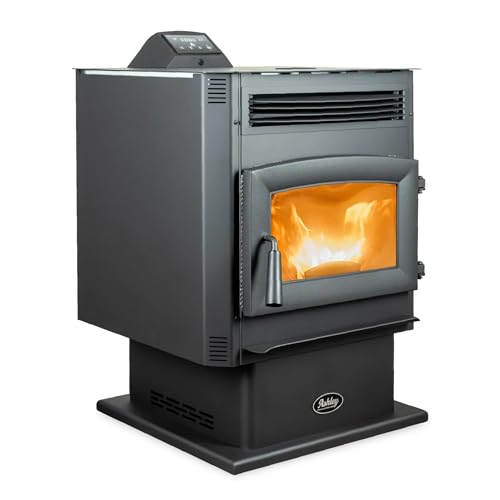


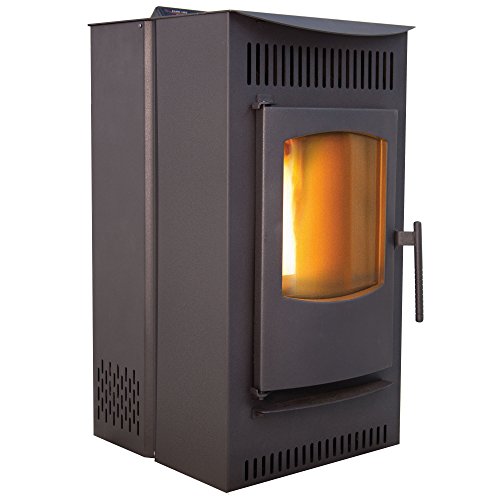
As an Amazon Associate we earn from qualifying purchases at no extra cost to you. Ratings are shown as listed on Amazon.
Best pellet stoves by heating situation
| Best for | What to prioritize | Typical specification | Suitable stove type |
|---|---|---|---|
| Small, well-insulated home or open-plan area | Low minimum output and quiet operation | 20,000–35,000 BTU/h; 800–1,500 sq ft coverage | Compact room-heating pellet stove |
| Average house needing regular winter heating | Balanced output, large hopper, automatic modulation | 35,000–50,000 BTU/h; 1,200–2,200 sq ft coverage | Medium freestanding stove or insert |
| Large, open, or poorly insulated home | High output and strong blower capacity | 45,000–70,000 BTU/h; up to about 2,500–3,000 sq ft | High-output freestanding stove |
| Existing masonry fireplace | Approved insert dimensions and liner compatibility | 35,000–55,000 BTU/h; commonly 1,500–2,500 sq ft | Pellet insert with a full-length vent liner |
| Occasional or shoulder-season use | Small hopper, low minimum heat, easy cleaning | 20,000–40,000 BTU/h; 12–40 lb hopper | Compact stove with thermostat control |
Coverage figures are manufacturer estimates rather than guarantees. Ceiling height, insulation, window area, floor plan, climate, and whether the stove is on one floor or centrally located can change real-world performance substantially.
Top choices and what distinguishes them
Best overall: a medium automatic-feed stove
A medium freestanding stove from an established manufacturer such as Harman, Quadra-Fire, Enviro, or Englander is the safest all-purpose choice for many homes. Look for approximately 35,000–50,000 BTU per hour, a 40–60 lb hopper, thermostat compatibility, and a listed efficiency around 75%–85%.
Harman pellet stoves are known for automatic feed and temperature-control systems designed to maintain a steady room temperature. Quadra-Fire offers both freestanding stoves and inserts across several output classes. Enviro is worth considering when appearance, insert dimensions, and multiple trim options matter. Englander is often considered by buyers seeking a simpler, value-focused design. Exact output, efficiency, emissions, warranty terms, and controls vary by model, so compare the current certification label rather than relying on the brand name alone.
Best for low operating cost: a high-efficiency, low-emission model
The most efficient stove is not necessarily the one with the lowest advertised fuel consumption. A good low-emission model burns pellets cleanly, modulates its feed rate instead of repeatedly cycling at full power, and retains useful heat without excessive exhaust loss. EPA-certified pellet stoves commonly list emissions below 2 grams per hour, although the exact figure depends on the model and test method.
For a frequently used primary heater, prioritize a stove with automatic low-fire operation, a dependable thermostat, and an efficiency in the upper portion of the certified range. Saving a few percentage points of fuel consumption can matter over several winters, but only if the stove is correctly sized. An oversized stove may run hot, shut down, and restart frequently, reducing comfort and increasing ash and ignition wear.
Best for a fireplace: a pellet insert
A pellet insert can turn an existing fireplace into a controllable heater while preserving floor space. Inserts from manufacturers such as Harman, Quadra-Fire, and Enviro commonly provide roughly 35,000–55,000 BTU per hour. Before choosing one, measure the fireplace opening, firebox depth, hearth height, and available electrical outlet location.
Most inserts require a stainless-steel vent liner running through the chimney, plus a chimney inspection and often a top termination kit. The insert itself may cost less than a complete central-heating system, but masonry work, liner installation, electrical work, trim, and permits can make installation substantially more expensive than the appliance price suggests.
Heat output, hopper size, and realistic burn time
Pellet stoves usually consume about 0.7–2.5 lb of pellets per hour, depending on heat setting and model. A useful runtime estimate is:
Burn time = hopper capacity ÷ pellet consumption per hour.
For example, a 50 lb hopper burning 1.5 lb per hour provides about 33 hours of theoretical runtime. At a high setting of 2.2 lb per hour, the same hopper lasts only about 23 hours. At low output, it may last considerably longer. The manufacturer’s advertised “up to” runtime generally reflects low heat, dry premium pellets, and favorable conditions.
Pellets are commonly sold in 40 lb bags. If a stove averages 1.5 lb per hour for 10 hours each day, it uses 15 lb daily, or approximately 2.6 bags per week. At a general market price of $6–$10 per bag, that is about $16–$26 per week before electricity, cleaning supplies, and maintenance.
Decision matrix: match the stove to your household
| Your situation | Recommended specification | Why | Trade-off |
|---|---|---|---|
| First-time owner with little maintenance experience | Automatic ignition, thermostat, accessible ash pan, serviceable parts | Simplifies starting, temperature control, and cleaning | More electronics and a higher purchase price |
| Lowest initial budget | Basic 30,000–45,000 BTU/h stove with manual controls | Fewer features can reduce the appliance cost | More manual adjustment and potentially less even heat |
| Daily winter use | 40–60 lb hopper, automatic modulation, strong warranty support | Fewer refills and less temperature cycling | Higher upfront cost and a larger footprint |
| Small room or highly insulated home | 20,000–35,000 BTU/h with a low minimum setting | Reduces overheating and short cycling | May not heat distant rooms effectively |
| Frequent power outages | Battery backup or generator-ready setup | Most automatic pellet stoves need electricity for the auger and fans | Extra equipment and limited backup runtime |
Venting and installation costs
Pellet stoves use a powered exhaust system, but they still require listed venting, safe clearances, and adequate combustion air. A typical installation uses 3- or 4-inch pellet vent pipe, depending on the appliance, vent length, altitude, and number of elbows. Follow the exact manual; do not substitute ordinary galvanized duct, single-wall stovepipe, or improvised fittings.
A basic through-the-wall installation may cost roughly $1,000–$2,500 for labor and vent materials. A chimney liner, long vertical run, difficult roof access, hearth construction, electrical work, or masonry modifications can raise the total to approximately $2,500–$5,000 or more. Appliance prices vary widely, with general market ranges of about $1,500–$5,000 for freestanding stoves and $2,500–$6,000 for inserts before installation.
Ask the installer to confirm clearances to combustible walls, floor protection, outside-air requirements, termination distance from windows and doors, permit requirements, and access for future servicing. The cheapest quote is not useful if it excludes a required liner, hearth protection, or inspection.
Maintenance realities and common ownership mistakes
- Empty the burn pot regularly. Clinkers and ash can restrict combustion air and create a lazy, dirty flame.
- Vacuum ash only when the stove is completely cold. Use an ash-rated vacuum; warm embers can damage a household vacuum or start a fire.
- Clean heat-exchanger passages. A layer of ash acts as insulation and reduces heat transfer into the room.
- Inspect the vent at least annually. Pellet exhaust is cleaner than wood smoke but can still deposit ash and fly ash in the pipe.
- Buy and store dry pellets. Damp pellets swell, crumble, feed poorly, and may increase ash production.
- Expect wear items. Igniters, door gaskets, combustion blowers, convection blowers, auger motors, and thermocouples can eventually require replacement.
- Do not ignore unusual sounds or failed ignition. Continuing to operate with a failing blower or blocked vent can turn a small repair into a safety problem.
During heavy winter use, many owners perform light cleaning every one to three days and a deeper cleaning weekly or according to the manual. Professional inspection and vent cleaning at least once each heating season is a sensible baseline, particularly for a new installation or a stove that operates continuously.
Final buying recommendation
For most buyers, choose a certified medium-output pellet stove with 35,000–50,000 BTU per hour, a 40–60 lb hopper, automatic thermostat control, emissions near or below 2 grams per hour, accessible cleaning points, and local service support. Choose a smaller model if your space is compact or well insulated; choose a high-output stove only after checking the home’s heat loss and floor-plan limitations. Budget for venting, permits, hearth protection, electricity, pellets, and annual maintenance—not just the stove itself.

Write Your Review
No reviews yet. Be the first to share your experience!