

Key takeaways
- Compare the best one horsepower submersible well pumps for barns, farms and rural homes, matched by voltage, head, flow and well depth from published specs.
Water is the one utility a barn cannot improvise. Horses drink ten gallons or more a day each, troughs need topping up in freezing weather and in heat waves alike, wash racks run for long stretches, and a rural house on the same well still expects showers and laundry to work while all of that is happening. When the pump at the bottom of the well starts to fade — pressure dropping at the trough filler, longer recovery times, a breaker that trips on hot afternoons — the replacement decision lands on three numbers that have to line up with your well and your wiring: horsepower, voltage, and the combination of head (lift) and flow the pump can actually deliver at your depth. One horsepower is the workhorse size for this job. It is strong enough to lift water from a moderately deep well and feed a house-plus-barn system at the same time, without the electrical demands of the bigger 1.5 and 2 HP units. The three pumps below are all 1 HP submersible models sold on Amazon, and they differ in exactly the ways that matter: one runs on 230 volts, two run on standard 110–115 volt circuits, and their published flow and lift figures span a useful range. Every pick here was selected from the manufacturer’s published listing specifications rather than from detailed research, so the specs quoted are the specs on the product page — check them against your well report before you order, because a submersible pump is the one purchase on a farm where a wrong guess means pulling the whole string back out of the ground.
As an Amazon Associate, we earn from qualifying purchases.
Quick answer
For most barn and rural-home wells, start with the iMeshbean Deep Well Submersible Pump with Control Box (B0DHVHBLZV): it is the deepest-lifting pick here at a published 305 ft of lift, moves 33 GPM, runs on an ordinary 110V circuit, and ships with an external control box and a 100 ft cord, which makes it the most forgiving choice for deeper wells and longer drops. If your well is wired for 230V and your depth is moderate, the ExploreHorizon Deep Well Submersible Pump (B0FCF8TCGW) is the cleaner installation — a stainless steel body, 27 GPM, 204 ft of maximum head, and eight impeller stages in a pump built to fit a 4-inch well casing. If flow rate is your priority and your well is comparatively shallow, the VEVOR Deep Well Submersible Pump (B0BJV2HPPH) publishes the highest flow figure of the three at 37 GPM on a 115V supply. Match the voltage first, then the lift, then the flow — in that order — and any of the three will do the job it is rated for.
Key takeaways
- Voltage is the first filter, not the last. One of these pumps needs a 230V circuit; the other two run on 110–115V. Check what is actually wired to your well head before falling in love with any spec sheet.
- Lift (head) must exceed your total dynamic head — the depth to water, plus the lift to your pressure tank, plus friction in the pipe. A pump whose maximum head only just equals your well depth will deliver a trickle, not its rated flow.
- Flow figures are maximums at low lift. A pump rated at 33 or 37 GPM delivers that near the top of its curve; at depth, real output is lower. Size for the flow you need at your actual pumping level.
- Cord length and control-box style are installation costs in disguise. A 100 ft cord and an external control box (serviceable at the surface) can save real money and downtime compared with a short cord and components sealed down the hole.
The picks
1. iMeshbean Deep Well Submersible Pump with Control Box 1HP
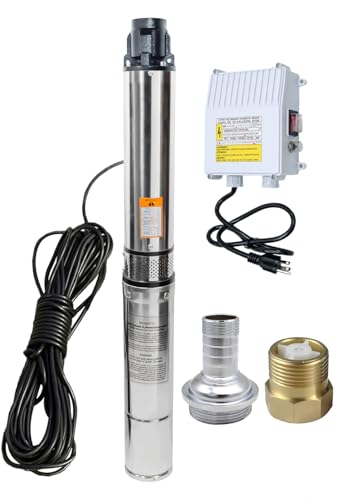
The iMeshbean is the pick for anyone whose well is on the deeper side or whose water level sits well below the surface. Its published lift of 305 ft is the highest in this group by a wide margin, and that headroom matters more than any other number on the page: a pump working comfortably inside its curve holds pressure steadier, cycles less desperately against the tank, and keeps delivering usable flow at depths where a shorter-rated pump has already fallen off. At 33 GPM of published flow, it has the capacity to supply a house and a barn simultaneously — troughs filling while someone showers — which is precisely the duty cycle a farm well actually sees.
The installation details are just as farm-friendly. It runs on 110V, so it suits properties where the well circuit was never upgraded to 230V. The external control box mounts at the surface, where the start components can be inspected and replaced without pulling the pump — anyone who has paid for a pump pull to fix a failed capacitor will appreciate that. The 100 ft cord gives you slack for deep sets without splicing, it fits a 4-inch casing, and the 1-1/2″ NPT discharge is the larger outlet of the three pumps here, which suits longer or higher-volume runs to a barn.
Specs
- Power: 1 HP
- Voltage: 110V
- Flow: 33 GPM
- Maximum lift: 305 ft
- Well fit: 4-inch casing
- Discharge: 1-1/2″ NPT
- Impellers: 9
- Control box: external (included)
- Cord length: 100 ft
- Link: https://www.amazon.com/dp/B0DHVHBLZV
2. ExploreHorizon Deep Well Submersible Pump 1HP

The ExploreHorizon is the 230V option, and if your well head already has a 230V feed — as many farm wells do, since 230V halves the current draw and eases voltage drop on long runs — it is arguably the most refined pump in this roundup. The body is stainless steel, which resists the corrosion that eats cheaper housings in mineral-heavy water, and its IP68 rating confirms it is built for permanent submersion. Eight impeller stages generate its pressure, producing a published maximum head of 204 ft with a maximum flow of 27 GPM: a combination aimed squarely at the mid-depth wells that make up the majority of rural installations.
That flow figure is the lowest of the three picks, and it is worth being honest about what that means. Twenty-seven gallons per minute still outruns the demand of a typical house and a modest barn — a few troughs, a wash rack, a hose bib or two — but a property running irrigation lines or filling a large stock tank on a timer alongside household use will feel the ceiling sooner than with the other two pumps. In exchange, you get the stainless construction, a standard 1-1/4″ NPT discharge that matches the drop pipe most 4-inch wells already use, and a compact 33 ft cord that is adequate for shallower sets (plan on a splice kit or an extension of your wiring run if your pump hangs deeper than that).
Specs
- Power: 1 HP
- Voltage: 230V / 60Hz
- Maximum flow: 27 GPM
- Maximum head: 204 ft
- Construction: stainless steel
- Well fit: 4-inch well
- Discharge: 1-1/4″ NPT
- Impeller stages: 8
- Ingress rating: IP68
- Cord length: 33 ft
- Link: https://www.amazon.com/dp/B0FCF8TCGW
3. VEVOR Deep Well Submersible Pump 1HP

The VEVOR plays a different card: flow. Its published maximum of 37 GPM is the highest figure in this group, and for a shallow-to-moderate well feeding a busy barn — multiple troughs on float valves, a wash rack that runs every evening, a small pasture irrigation line — raw delivery volume is the spec you feel every day. It runs on 115V, so like the iMeshbean it drops into properties wired for standard voltage without an electrician reworking the well circuit, and it keeps the 1 HP size that balances output against what a typical rural service can comfortably supply.
One caution, stated plainly because it affects how you should shop: VEVOR’s own listing for this pump is inconsistent about its maximum head figure, giving different lift numbers in different places on the page. For that reason this guide does not quote a head rating for it at all. If your well is deep, choose one of the two pumps above whose lift is published consistently, or confirm the correct figure with the seller before ordering. If your well is shallow and your static water level is high, the VEVOR’s flow-first profile is a sensible fit — just treat the depth question as one to verify rather than assume.
Specs
- Power: 1 HP
- Voltage: 115V
- Maximum flow: 37 GPM
- Maximum head: not quoted here — the listing publishes inconsistent figures; verify with the seller for deep wells
- Link: https://www.amazon.com/dp/B0BJV2HPPH
How to choose
Start with your well, not with the pumps. Three numbers from your well report (or your driller’s records) decide everything: the total depth, the static water level (where water stands in the casing), and the depth the old pump was set at. What the pump must overcome is the total dynamic head — roughly, the vertical distance from the pumping water level up to your pressure tank, plus friction losses in the drop pipe and any rise to a barn that sits uphill. Compare that number against each pump’s maximum head and keep a sensible margin: a pump whose maximum head is 204 ft should not be asked to lift 195 ft all day. As a working rule, your total dynamic head should sit comfortably inside the pump’s rating, not at its edge, because flow falls as head rises — the GPM on the box is measured at the easy end of the curve.
Match the voltage to the wiring you have. The ExploreHorizon needs 230V; the iMeshbean and VEVOR run on 110–115V. Neither is inherently better. A 230V pump draws half the amperage, which is gentler on long cable runs from the panel to the well head and is why so many farm wells were wired that way in the first place. But converting a 110V well to 230V means an electrician, a double-pole breaker, and possibly a new panel schedule — real money that belongs in the comparison. Buy the pump that matches the circuit at your well head unless you were already planning electrical work.
Then match flow to demand. Add up what runs at once. A house peaks around 8–12 GPM when showers, laundry, and a kitchen overlap. A barn adds trough fillers (a few GPM each while open), a wash rack hose, and hydrants. Most house-plus-barn properties land between 15 and 30 GPM of genuine simultaneous demand, which is why all three of these 1 HP pumps are plausible — the differences show up at the extremes: the VEVOR’s 37 GPM ceiling for volume-hungry shallow wells, the ExploreHorizon’s 27 GPM suiting moderate demand with better materials, and the iMeshbean splitting the difference at 33 GPM with far more lift in reserve.
Finally, sweat the installation details. Confirm your casing is 4-inch if you are considering the two pumps that publish that fit. Check the discharge size against your drop pipe — 1-1/4″ versus 1-1/2″ NPT is an adapter at best and a re-plumb at worst. Measure your pump set depth against the cord: the iMeshbean’s 100 ft cord covers deep sets outright, while the ExploreHorizon’s 33 ft cord means shallower sets or additional waterproof splicing. And consider the control box: an external box, like the iMeshbean’s, puts the start capacitor and relay at the surface where a replacement costs minutes, not a pump pull. Whatever you choose, budget for the unglamorous companions of any pump swap — a new torque arrestor, safety rope, and fresh wire splices — because reusing tired hardware down the hole is how a new pump gets pulled twice.
Who should skip
Skip the 1 HP class altogether if your well is genuinely deep — a pumping level beyond roughly 250–280 ft leaves even the strongest lifter here working at the thin edge of its curve, and a 1.5 or 2 HP pump (with the 230V circuit to feed it) is the honest answer. Skip submersibles entirely if your “well” is actually a shallow cistern, a spring box, or a surface tank: a jet pump or a booster pump is the right tool there, and a deep-well submersible will short-cycle itself to an early death. Skip the ExploreHorizon if your well is wired for 110V and you are not planning electrical work; skip the VEVOR if your well is deep, until you have a verified head figure from the seller; and skip the iMeshbean if your pressure system is a large irrigation setup whose demand dwarfs 33 GPM — that is a dedicated irrigation pump’s job. Finally, if your current pump still runs but pressure is fading, rule out the cheap culprits first — a waterlogged pressure tank, a clogged sediment filter, a failing pressure switch — before you pay to pull a pump that may have years left in it.
FAQ
How deep can a 1 HP submersible well pump lift water?
It depends on the model’s published maximum head, and the usable depth is always less than that headline number because flow drops as lift increases. In this group, the published maximums are 204 ft for the ExploreHorizon and 305 ft for the iMeshbean. As a practical matter, your total dynamic head — pumping level to tank, plus friction — should sit well inside the rating, so these pumps suit wells whose working lift is comfortably below those ceilings. For pumping levels approaching or beyond 280 ft, step up to a higher-horsepower pump.
Should I choose a 110V or 230V well pump?
Choose whichever matches the circuit already at your well head. A 230V pump like the ExploreHorizon draws half the current of an equivalent 110V unit, which reduces voltage drop on long runs and is standard on many farm wells. A 110V pump like the iMeshbean or the VEVOR avoids the cost of converting the circuit. There is no performance prize for switching voltage on its own — the penalty is paying an electrician to change a working setup.
What size well casing do these pumps fit?
The ExploreHorizon and the iMeshbean both publish a fit for 4-inch wells or casing, which is the most common residential and farm well size. If your well is an older 5- or 6-inch casing, either pump still physically fits (with more room around it), but confirm the pump’s diameter against your casing’s inside diameter before ordering, particularly if your casing has any encrustation or a liner.
Can one of these pumps run a house and a barn on the same well?
Yes — that is exactly the duty the 1 HP class exists for. The flow ratings here (27, 33, and 37 GPM at maximum) cover the simultaneous demand of a household plus troughs, a wash rack, and hydrants on most properties. What decides success is not the barn-versus-house question but the pairing of flow with lift: pick a pump whose head rating clears your total dynamic head with margin, and the same pump that fills troughs at dawn will hold shower pressure at dusk.
Final verdict
For the widest range of farm and rural-home wells, the iMeshbean (B0DHVHBLZV) is the safest buy in this group: 305 ft of published lift covers deep wells the others cannot, 33 GPM covers house-plus-barn demand, the 110V supply matches the wiring most properties already have, and the external control box plus 100 ft cord make it the easiest pump here to install and to service years later. Choose the ExploreHorizon (B0FCF8TCGW) if your well is already wired for 230V and your lift is moderate — its stainless steel body and IP68 sealing make it the durability pick, provided 27 GPM meets your demand. Choose the VEVOR (B0BJV2HPPH) if your well is shallow, your water level is high, and volume is what your barn actually needs — its 37 GPM is the strongest flow figure here — but confirm its lift rating with the seller before trusting it in anything deep. Whichever you pick, decide in the order this guide opened with: voltage first, lift second, flow third, and the pump will match the well instead of fighting it.
Product and ASIN Reference
| Product | ASIN |
|---|---|
| ExploreHorizon Deep Well Submersible Pump 1HP | B0FCF8TCGW |
| iMeshbean Deep Well Submersible Pump with Control Box 1HP | B0DHVHBLZV |
| VEVOR Deep Well Submersible Pump 1HP | B0BJV2HPPH |
More from Amazon
Programs that pair well with the guide above. Offers and eligibility are set by Amazon and may change.
Set up recurring deliveries of everyday items on eligible products. Terms and savings are set by Amazon.
Explore Subscribe & SaveFree shipping on eligible items, Prime Video and more. Eligible new members can start with a free trial.
Start a Prime free trialAudiobooks and podcasts to listen to on the go. Eligible new members can start with a free trial.
Try Audible freeRead from a large library of eBooks and audiobooks on any device. Check Amazon for current plans.
Explore Kindle UnlimitedAs an Amazon Associate we earn from qualifying purchases.






Write Your Review
No reviews yet. Be the first to share your experience!