

Key takeaways
- Board thickness: A playing surface around 3 inches thick generally offers better stability than a thin laminated panel. Thicker construction also helps resist seasonal movement.
- Surface width: Home tables commonly use playing fields around 20 to มาก? 20 to 22 inches wide. Wider is not automatically better, but consistent width helps the game feel predictable.
- Polymer finish: A thick, smooth finish protects the wood and creates a fast, even lane. It should be repaired by a specialist if deeply gouged rather than aggressively sanded at home.
- Gutters: Wide, deep gutters reduce rebounds and make retrieving pucks easier. They also matter when children or casual players are using the table.
- Climate adjusters: These supports let you make small changes beneath the board as humidity changes. They are especially valuable in basements, coastal homes, and rooms without stable heating and cooling.
The best home shuffleboard tables are the ones that fit your room with comfortable clearance, use a well-sealed hardwood playing surface, offer climate adjustment for your environment, and match your willingness to assemble and maintain them.
For most game rooms, a 12- to 14-foot table is the sensible starting point: it provides a satisfying playing lane without demanding the space, budget, and installation effort of a full tournament-length model. Choose a 9- or 12-foot table for a compact room, a 14- to 16-foot table for regular adult play, and a 18- to 22-foot table only when you have generous clearance and want the closest home experience to tournament play.
Our top picks


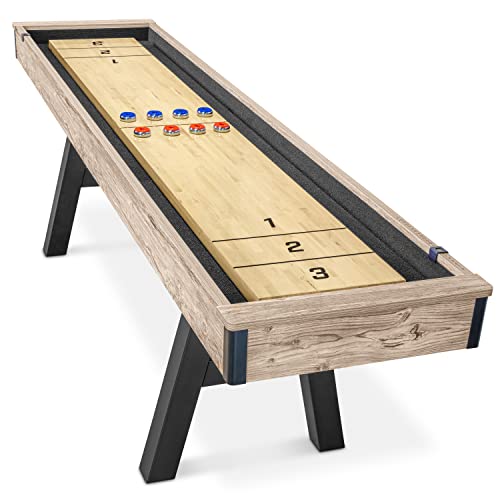

As an Amazon Associate we earn from qualifying purchases at no extra cost to you. Ratings are shown as listed on Amazon.
Quick picks by room and playing style
| Situation | Best table type | What to prioritize | Typical market range |
|---|---|---|---|
| Apartment, den, or multipurpose room | 9- to 12-foot table | Narrow cabinet, adjustable feet, reliable board seal | $900-$2,000 |
| Family game room | 12- to 14-foot table | Durable finish, simple scoring, forgiving play speed | $1,500-$3,500 |
| Frequent adult play | 14- to 16-foot table | Thick hardwood cradle, climatic adjusters, accurate scoring | $2,500-$5,500 |
| Serious practice or league-style play | 18- to 22-foot table | Regulation-style dimensions, professional finish, strong leveling system | $4,000-$10,000+ |
How much room does a shuffleboard table really need?
The advertised table length is not the floor space you need. Leave room for a player to stand at each end and swing a cue or slide a puck without hitting a wall, cabinet, or lighting fixture. A practical planning formula is:
Required room length = table length + about 8 feet.
That allowance provides approximately 4 feet at each end. A 12-foot table therefore needs roughly 20 feet of usable length. Width is usually less demanding, but allow the cabinet width plus at least 2 feet on each side for access. A table that is 32 inches wide should have about 7 feet of clear room width if players will comfortably walk around it.
Measure the route into the room as well as the final location. Long cabinets may arrive in several pieces, but stairwells, sharp turns, elevator doors, and narrow entry doors can still determine which size is practical. A 14-foot table with a 33-inch-wide cabinet may fit the room yet be impossible to maneuver through a hallway.
Playing-surface quality: what matters beyond “solid wood”
The playing surface is usually maple, sometimes another hardwood, finished with a clear coating and covered with shuffleboard wax or powder. The important specifications are not just the species of wood but the construction and finish:
- Board thickness: A playing surface around 3 inches thick generally offers better stability than a thin laminated panel. Thicker construction also helps resist seasonal movement.
- Surface width: Home tables commonly use playing fields around 20 to มาก? 20 to 22 inches wide. Wider is not automatically better, but consistent width helps the game feel predictable.
- Polymer finish: A thick, smooth finish protects the wood and creates a fast, even lane. It should be repaired by a specialist if deeply gouged rather than aggressively sanded at home.
- Gutters: Wide, deep gutters reduce rebounds and make retrieving pucks easier. They also matter when children or casual players are using the table.
- Climate adjusters: These supports let you make small changes beneath the board as humidity changes. They are especially valuable in basements, coastal homes, and rooms without stable heating and cooling.
Do not assume that a glossy surface is a better surface. A table can look impressive while playing inconsistently if it is poorly leveled, contaminated with dust, or treated with the wrong cleaner. For frequent play, a quality finish and serviceable adjustment system are more valuable than decorative inlays.
Best home shuffleboard tables by use case
Best for tight spaces: a 9- or 12-foot table
Compact tables are the right choice when the alternative is leaving a larger table unused or blocking walkways. Nine-foot models are particularly easy to place in a den, although their shorter lane makes speed control less demanding and leaves less room for strategic weight. A 12-foot model is a better compromise if the room can accommodate the approximately 20-foot total length.
Look for a cabinet under about 34 inches wide, adjustable leg levelers, and a scoring system that does not protrude into the walkway. Expect some compromises in board thickness, storage, and finish quality at the lower end of the price range.
Best all-rounder: a 14-foot table
A 14-foot table suits many dedicated game rooms. It offers more realistic shot length than a compact model while avoiding the substantial room commitment of an 18- or 22-foot table. This is the size to consider for a household that expects regular use by adults but does not need tournament dimensions.
Choose one with a hardwood playfield, a sealed polymer finish, climatic adjusters, and a leg system that can be leveled independently. Electronic scoring is convenient, but it should not replace a good mechanical scoring option if batteries, sensors, or display wiring fail.
Best for serious practice: an 18- to 22-foot table
Long tables reward careful speed control and make practice more representative of league or tournament play. They also cost more to deliver, assemble, level, and maintain. A 22-foot model needs roughly 30 feet of room length using the same clearance rule, so it belongs in a large basement, recreation room, or dedicated sports area.
At this size, prioritize structural stability over styling. A substantial cabinet, multiple climate adjusters, a dependable leveling system, and a repairable finish matter more than built-in lights or elaborate score displays.
Manual or electronic scoring?
Traditional abacus-style scoring is inexpensive, visible from either end, and almost maintenance-free. It is the safest choice for a family table or a room where the equipment may sit unused for weeks.
Electronic scoring is convenient for casual games and can track totals automatically. Check whether the display is powered by replaceable batteries or a mains adapter, whether the controls are reachable from both ends, and whether manual scoring remains possible during a power or sensor failure. Some tables include LED lighting and sound effects; these features add atmosphere but do not improve the playing surface.
Assembly and delivery: the hidden part of the purchase
Shuffleboard tables are heavy, awkward, and sensitive to leveling. Depending on the length and construction, a home table may weigh roughly 300 to more than 700 pounds. Assembly commonly involves attaching legs, installing the cradle, fitting the gutters, leveling the board, and mounting scoring equipment.
Before ordering, confirm:
- Whether room-of-choice delivery or professional assembly is available in your area.
- How many adults are required for safe positioning if assembly is self-service.
- Whether the table must acclimate indoors for 24 to 72 hours before final leveling.
- Whether the floor can support the concentrated load on the table feet.
- Whether the manufacturer supplies a long level and adjustment instructions.
For a 14-foot table, paying for professional setup can be worthwhile if the quoted service includes leveling and climate-adjuster calibration rather than simply attaching the legs. A table that is assembled quickly but not leveled correctly will feel defective even when the board itself is sound.
Ownership costs and maintenance realities
The playing finish and wax are the consumables most likely to affect ownership. Surface powders become contaminated with dirt and should be removed regularly with the manufacturer-approved cleaner. Do not use household glass cleaner, furniture polish, silicone spray, or abrasive pads unless the maker specifically permits it.
Wipe the playing surface with a clean, dry microfiber cloth before applying fresh powder. Keep drinks, food, pet hair, and grit away from the board: small particles can change puck speed and eventually create scratches. Use a fitted cover when the table is not in use, particularly in a sunny room.
Humidity is the major long-term variable. Wood can expand, contract, or cup as the room changes seasonally. Keep the room reasonably climate-controlled, avoid placing the table directly beside a radiator or exterior door, and check level periodically. Climate adjusters are for gradual correction, not for forcing a badly warped board flat. Make small, even adjustments and follow the maker’s pattern.
The cabinet, leg joints, puck edges, and scoring components can also wear. Replace damaged pucks rather than continuing to play with sharp edges. Check that leg bolts remain tight, but do not overtighten them into wood. If the finish develops a deep chip, clouding, or a pronounced ridge, seek a shuffleboard repair specialist instead of attempting a full refinish with ordinary floor products.
A practical buying decision
Start with the room, not the brand. If your clear length is under 20 feet, focus on 9- or 12-foot tables. From 20 to 24 feet, a 12- or 14-foot table is usually the most balanced choice. At 26 feet or more, consider a 16- to 18-foot model; reserve 22 feet for rooms with substantial additional clearance.
Next, match construction to use. Occasional family play can justify a simpler manual scorer and a mid-range finish. Frequent play deserves a thicker board, climate adjusters, and professional setup. Finally, budget for delivery, assembly, cover, maintenance supplies, and replacement pucks—not only the cabinet price.
In short, the best home shuffleboard tables are not necessarily the longest or most feature-packed. The strongest choice is the largest table your room can comfortably clear, with a stable hardwood surface, meaningful climate adjustment, accurate leveling, and an assembly plan you can complete safely.

Write Your Review
No reviews yet. Be the first to share your experience!