

Key takeaways
- Built-in speaker: simplest setup, but often limited in bass and volume.
- Bluetooth audio: lets the projector act as a visual companion to a separate speaker, although pairing may need to be repeated.
- Music synchronisation: changes brightness or movement in response to sound; it can be entertaining but too active for winding down.
- App audio scenes: useful when the app combines sound and light, but app permissions and account requirements can affect reliability.
The best galaxy projectors for bedroom star ceilings are the Sega Toys Homestar Flux for the most convincing star field, the BlissLights Sky Lite Evolve for colourful app-controlled ambience, and a compact RGB star projector for inexpensive occasional use.
Our top picks

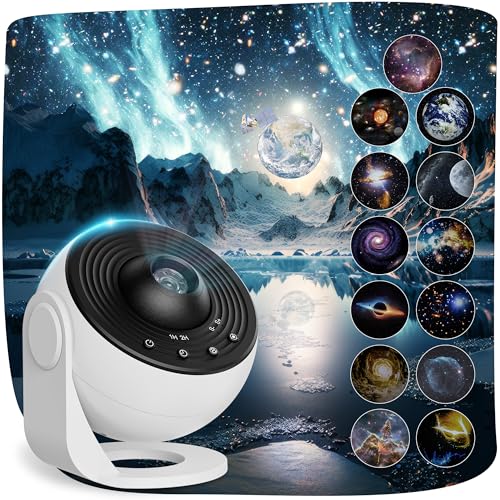


As an Amazon Associate we earn from qualifying purchases at no extra cost to you. Ratings are shown as listed on Amazon.
Quick picks by bedroom and sleep routine
| Situation | Best fit | Why it suits the room | Typical price range in 2026 |
|---|---|---|---|
| Small bedroom or bedside table | Compact RGB star projector | Usually covers 10–20 m² and takes up little space | $20–$45 |
| Large bedroom with a realistic star ceiling | Sega Toys Homestar Flux | Optical projection gives sharper, denser stars than most LED-only units | $120–$180 |
| Colourful nebula effects and phone control | BlissLights Sky Lite Evolve | Adjustable nebula colours, moving effects and app scenes | $50–$80 |
| Frequent use with music or routines | App-connected projector with speaker integration | Better scheduling and sound synchronisation than a basic remote | $45–$100 |
What matters when choosing the best galaxy projectors
Projection coverage and ceiling height
Coverage is more useful than a headline such as “millions of stars”. A projector aimed at a low, pale ceiling may look impressive across a 12 m² bedroom, while the same unit can appear faint on a high or dark ceiling. For a typical 2.4–2.7 m ceiling, look for a stated coverage of at least 15 m² for a small room and 25–35 m² for a larger bedroom.
Lens-based projectors, such as the Sega Toys Homestar Flux, generally produce defined points of light and a more natural star layout. LED nebula projectors create broader clouds of colour and moving patterns. Many inexpensive models combine both, but their “stars” may be irregular dots or laser points rather than a detailed astronomical field.
A simple fit calculation helps: measure the ceiling length and width, then multiply them. A 3 m × 4 m ceiling is 12 m². If the projector’s useful coverage is advertised as 15–20 m², it should fill the ceiling from a central bedside position; if it is rated for only 8–10 m², expect dark edges.
Brightness for viewing versus sleeping
The brightest projector is not automatically the best bedroom projector. High brightness makes nebula colours visible through ambient light, but it can be distracting when the room is dark. Prioritise independent brightness control, separate star and cloud controls, and a mode that leaves only a dim star field.
For sleep use, a projector with a genuinely low minimum setting is preferable to one that merely offers several vivid colours. Avoid placing the lens directly in your line of sight from the pillow. Aim it at the ceiling or upper wall and use the lowest setting that remains visible.
Sound integration
Built-in speakers are convenient for gentle background audio, but they are rarely a substitute for a good bedside speaker. Check whether sound is played from the projector itself, through Bluetooth, or through a phone app. These are different experiences:
- Built-in speaker: simplest setup, but often limited in bass and volume.
- Bluetooth audio: lets the projector act as a visual companion to a separate speaker, although pairing may need to be repeated.
- Music synchronisation: changes brightness or movement in response to sound; it can be entertaining but too active for winding down.
- App audio scenes: useful when the app combines sound and light, but app permissions and account requirements can affect reliability.
For bedtime, choose a static or slowly moving scene and disable sound reactivity. Rapid colour changes can be more stimulating than relaxing, particularly in a dark room.
Timer controls and overnight behaviour
A useful sleep timer should turn the light off without requiring a phone. Common options are 15, 30, 60 and 120 minutes; some smart models also support schedules. Confirm whether the timer starts from the remote, from the app, or only after selecting a particular scene.
Also check what happens after power is interrupted. Some projectors resume their last mode, while others return to a bright default setting. A model that remembers low brightness and a 30-minute timer is much less annoying for nightly use than one that must be reconfigured every evening.
Head-to-head: the strongest choices
Sega Toys Homestar Flux: best for realistic stars
The Homestar Flux is the strongest choice when the star field matters more than colourful nebula effects. Its optical disc system is designed to project numerous defined stars rather than relying only on random LED points. Interchangeable discs can add variety, while a rotating mode creates a slow sky movement.
Its limitations are equally important: it is a mains-powered projector, not a portable battery unit, and it is less focused on app ecosystems, built-in music and animated colour clouds. It also costs more than generic bedroom models. Choose it for a large or frequently used room where crisp stars justify the higher price.
BlissLights Sky Lite Evolve: best for colourful atmosphere
The Sky Lite Evolve is a better match for someone who wants a vivid nebula, adjustable colours and app-based control. It can create a dramatic ceiling effect in a small or medium bedroom and is more flexible for mood lighting than a dedicated optical star projector.
It is not the ideal choice if your priority is a scientifically convincing star map. Its clouds and points are primarily decorative, and the strongest settings may be too bright for sleep. Use the app to lower intensity, select a slower scene and schedule an automatic shutoff.
Compact RGB projectors: best on a strict budget
Small RGB units commonly include a remote, several colours, rotating motion, a USB power cable and a 15–120-minute timer. They are the sensible choice for occasional use, children’s rooms or renters who do not want to spend much.
Quality varies sharply. Some use a noisy mechanical motor, have weak remotes, or project a small bright circle rather than covering the whole ceiling. Look for independent controls for stars and nebula, a published coverage area, a timer that works without an app, and ventilation openings that can be cleaned.
Decision matrix: match the projector to your habits
| Your priority | Recommended type | Minimum specification to seek | Trade-off |
|---|---|---|---|
| Use every night for 30–60 minutes | Optical or well-built app projector | Independent dimming, quiet operation, 30-minute timer | Higher purchase cost, but better control and durability |
| Large ceiling over 20 m² | High-coverage optical or LED model | At least 25 m² stated coverage and central placement | Edges may still fade on dark or textured ceilings |
| Occasional decorative use | Compact RGB model | USB power, remote, 15–120-minute timer | Less realistic stars and more variable build quality |
| Music-led relaxation | App-connected model or projector plus Bluetooth speaker | Bluetooth or audio scenes, plus non-reactive mode | More setup and possible app dependence |
Setup for better coverage and quieter sleep
- Measure the ceiling. Compare its area with the manufacturer’s useful coverage, not just the maximum projection distance.
- Place the projector near the centre of the room. This reduces uneven brightness. If that is impractical, aim diagonally across the ceiling rather than straight up from a corner.
- Keep the lens clear. Dust or fingerprints soften star points and reduce contrast. Wipe the lens gently with a clean microfiber cloth; do not spray cleaner directly onto it.
- Test the lowest comfortable brightness. Start with the lights off, then reduce intensity until the stars remain visible without lighting the whole room.
- Set the timer before getting into bed. A 30-minute setting is a practical starting point; choose 60 minutes if you prefer a longer wind-down period.
- Listen for mechanical noise. Rotating discs and internal fans can become more noticeable at night. A static mode may be preferable for light sleepers.
Durability and ownership costs
The parts most likely to cause trouble are the small cooling fan, rotating motor, remote control and power connector—not usually the LEDs themselves. Keep the projector on a hard, ventilated surface, leave space around its vents and avoid covering it with fabric. A projector used for one 30-minute session daily runs for about 183 hours per year; dust buildup can matter more than occasional long sessions.
For models using projection discs, store unused discs in a sleeve and handle them by the edges. Scratches and fingerprints reduce clarity. Rechargeable models may gradually lose runtime, while USB and mains-powered units avoid battery replacement but need a nearby outlet. Before buying, check whether replacement discs, remotes or power adapters are available separately.
Final recommendation
Choose the Sega Toys Homestar Flux for sharp, star-focused projection across a larger bedroom. Choose the BlissLights Sky Lite Evolve for colourful nebula effects, app control and occasional music-linked ambience. For a small room, modest budget or infrequent use, a compact RGB projector with independent dimming and a physical timer is the better value. Whichever model you choose, coverage, low brightness and dependable shutoff matter more for a bedroom than the maximum number of colours or animated effects.

Write Your Review
No reviews yet. Be the first to share your experience!