

Key takeaways
- Best for draping: a firm, evenly padded pinnable surface.
- Acceptable for basic fitting: a fabric-covered form with moderate padding.
- Poor for pinning: bare plastic, rigid foam, or a very thin cover over a hard shell.
Best Dress Forms for Sewing and Fitting
The best dress forms are the ones that match your working body measurements, accept pins securely, adjust without distorting the shape, and reach the correct shoulder, waist, hip, and overall height for the garments you make.
A dress form is not automatically accurate because its size label matches yours. Two people who both wear a size 10 can have different bust-to-waist proportions, torso lengths, hip depths, and shoulder heights. Use your tape-measured body dimensions as the deciding factor, then choose the form type that suits your sewing habits.
Our top picks

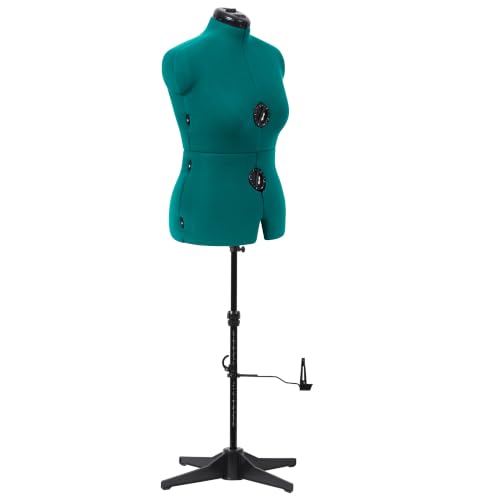


As an Amazon Associate we earn from qualifying purchases at no extra cost to you. Ratings are shown as listed on Amazon.
Quick picks by sewing situation
| Your situation | Best choice | Why it fits the situation | Typical market range |
|---|---|---|---|
| Occasional sewing and limited budget | Entry-level adjustable form | Offers several dial adjustments and a compact tripod base | $90–$180 |
| Frequent garment sewing | Well-padded adjustable form with a sturdy stand | More stable for pinning, draping, and repeated fitting | $180–$350 |
| Close-fitting clothing or pattern drafting | Professional pinnable form or custom dress form | More reliable surface depth and fewer shape changes while fitting | $350–$1,000+ |
| Small sewing room | Collapsible or lightweight adjustable form | Easier to move and store, though usually less stable | $90–$250 |
| One person’s exact body shape | Custom form or carefully padded standard form | Best route when bust, waist, hip, or torso proportions fall between sizes | $250–$1,000+ |
What to compare before buying
1. Size adjustability
Adjustable forms are useful when your measurements fall between commercial sizes or when you sew for more than one person. Common household models use hand-operated dials at the bust, waist, and hips. Many provide roughly 8–13 adjustment points, depending on the model and size range.
Adjustment range is not the same as accurate fit. Expanding the form can create visible gaps, ridges, or an exaggerated hourglass shape. Check whether the manufacturer publishes separate minimum and maximum measurements for bust, waist, and hip. A form advertised as covering sizes 6–14 may still be unsuitable if its smallest waist is too large or its hip expansion does not reach yours.
Models from brands such as Dritz and Singer are commonly sold in adjustable household ranges. Their convenience is greatest for general garment construction, costume work, and fitting multiple sizes. For precision draping, a professional pinnable form from a specialist manufacturer such as Wolf is usually more consistent, but it may not provide the same size adjustability.
2. Pin-ability of the cover
Look for a cover made from woven fabric over a compressible foam or fiber layer. You should be able to insert a standard dressmaking pin at a shallow angle and have it stay securely without hitting hard plastic immediately underneath.
A smooth decorative mannequin, molded plastic form, or thin fabric shell may look attractive but is frustrating for pattern work. It can be useful for displaying finished garments, not for marking seam lines or holding muslin in place.
- Best for draping: a firm, evenly padded pinnable surface.
- Acceptable for basic fitting: a fabric-covered form with moderate padding.
- Poor for pinning: bare plastic, rigid foam, or a very thin cover over a hard shell.
Pin depth also matters. A form that accepts pins too easily may be soft enough for pins to lean or pull out when fabric is under tension. Test the cover at the bust, side seam, waist, and hip rather than judging it from one location.
3. Height, torso length, and hip measurements
Most buyers focus on bust, waist, and hip circumference, but vertical measurements often determine whether a form is genuinely useful. Compare your body with the form’s:
- Shoulder-to-waist length
- Waist-to-hip length
- Shoulder height from the floor
- Back waist length
- Hip height and fullest-hip level
- Neck, bust, waist, and hip circumference
The hip line is especially important for skirts, trousers, fitted dresses, and jackets. If the form’s fullest hip sits 3 inches lower than yours, a side seam or dart can appear correctly placed on the mannequin but wrong on your body.
For height, measure from the floor to a fixed landmark such as your shoulder or natural waist while standing normally. Choose a form with an adjustable pole that can place its waist at your waist height. A raised or lowered form cannot fully correct a torso that is the wrong length, but it can make hems and shoulder lines easier to evaluate.
Adjustable versus professional pinnable forms
| Feature | Adjustable household form | Professional pinnable form | Custom or padded form |
|---|---|---|---|
| Typical size range | About 4–6 adjacent ready-to-wear sizes | Usually one fixed size | One individual body shape |
| Adjustment points | Approximately 8–13 dials or panels | Usually none | Created through padding or custom construction |
| Pinning quality | Moderate to good, depending on padding | Good to excellent | Good if covered with suitable fabric |
| Stability | Light to moderate | Moderate to heavy | Varies by base and construction |
| Best use | General sewing and several sizes | Pattern drafting and repeated draping | Close fitting for one body |
| Common limitation | Expansion can create uneven contours | Limited size flexibility | Higher cost and storage commitment |
How to size a dress form to your body
- Take six measurements. Record full bust, natural waist, fullest hip, shoulder-to-waist length, waist-to-hip length, and total working height.
- Compare the smallest settings first. An adjustable form should be able to reach your smallest relevant measurement without forcing other areas out of proportion.
- Prioritize the largest measurement. The form should accommodate your bust and hip without compression. Excess space can be padded; a form that is too small cannot be expanded accurately everywhere.
- Set the natural waist. Tie a firm but comfortable elastic around your waist and adjust the pole until the form’s waistline aligns with it.
- Check vertical landmarks. Mark bust level, waist, and hip level with removable tape. If they do not align with your measurements, expect to add padding or choose another form.
For example, suppose your measurements are 38-inch bust, 31-inch waist, and 41-inch hip, while a form adjusts to 36–40 inches at the bust, 28–34 inches at the waist, and 38–42 inches at the hip. The circumferences fit within range. If the form’s waist-to-hip distance is 8 inches and yours is 9 inches, however, the hip line will sit 1 inch too high. That difference is significant on a fitted skirt or dress and should be corrected with padding or a different form.
Ownership realities: what wears out first
The cover and adjustment hardware usually show wear before the main body. Repeated pinning can leave small holes, while frequent tightening can loosen dial mechanisms or make plastic adjustment panels creak. Lightweight bases may also wobble when you pull fabric firmly during draping.
- Use fine, sharp pins to reduce cover damage.
- Do not force a dial past its adjustment stop.
- Keep the form covered when not in use to reduce dust and sunlight fading.
- Spot-clean fabric with a barely damp cloth rather than soaking the body.
- Inspect the tripod screws and height-locking mechanism periodically.
- Use a separate sleeve or padded cover if you frequently pin in the same areas.
A practical cost comparison can clarify a purchase. A $120 form used 12 times costs $10 per use in its first year. If you use it 60 times over three years, the cost falls to $2 per use. A $450 professional form used 300 times costs $1.50 per use, but only if its better stability and pinning quality actually support that much sewing. The cheapest form is not necessarily the lowest-cost option when poor fit causes repeated alterations.
Final buying recommendation
Choose an adjustable form such as a Dritz or Singer household model when flexibility, moderate price, and storage are your priorities. Choose a professional pinnable form such as a Wolf-style model when you draft, drape, or fit garments frequently and can work within one fixed size. Choose a custom or heavily padded form when your body proportions differ substantially from standard size charts.
Before ordering any of the best dress forms, compare the actual bust, waist, hip, torso, and height measurements—not just the size number. A stable base and pin-friendly cover make the form pleasant to use, but accurate vertical landmarks and a believable hip shape are what make fitting results transfer to a real body.

Write Your Review
No reviews yet. Be the first to share your experience!