

Key takeaways
- 2.1: Two main speakers and a subwoofer. Excellent for music and television dialogue, but no discrete surround effects.
- 3.1: Adds a center speaker, which makes dialogue clearer and keeps voices anchored to the screen. This is often a better upgrade than adding rear speakers first.
- 5.1: The practical starting point for genuine surround sound. Place the surrounds to the sides or slightly behind the seating position.
- 5.1.2: Adds two ceiling or upward-firing height channels for Dolby Atmos. It suits medium-sized rooms with a reasonably flat ceiling.
- 7.1.2: Adds rear surrounds to a 5.1.2 arrangement. It needs enough space behind the seats to avoid placing speakers immediately beside listeners.
- 7.1.4: Uses four height speakers and is the strongest choice for a large, dedicated room, but it requires a receiver with sufficient processing and amplification.
The best home theater systems depend on your room and priorities: choose a compact soundbar for a small room, a 5.1 receiver system for the best value and upgrade potential, or a Dolby Atmos 7.1.4 setup when you have the space and want convincing overhead effects.
Our top picks
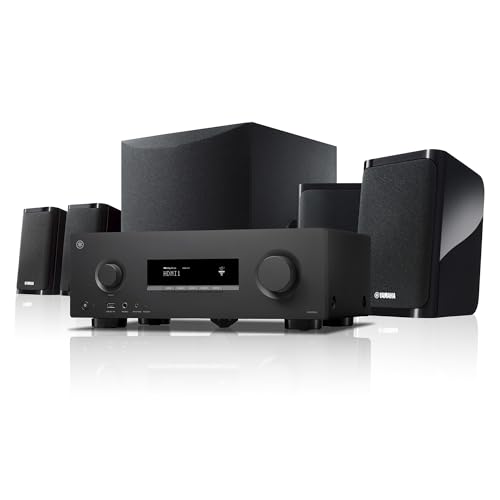


As an Amazon Associate we earn from qualifying purchases at no extra cost to you. Ratings are shown as listed on Amazon.
Quick picks by room and situation
| Situation | Best setup type | Suitable room | Typical equipment budget | Installation difficulty |
|---|---|---|---|---|
| Simple TV upgrade | All-in-one soundbar with wireless subwoofer | Up to 180 sq. ft. | $250–$900 | Low |
| Small dedicated movie room | 5.1 speaker package and AV receiver | 150–250 sq. ft. | $700–$1,800 | Moderate |
| Large living room | 5.1.2 or 7.1.2 Dolby Atmos system | 250–400 sq. ft. | $1,200–$3,000 | Moderate to high |
| Dedicated home theater | 7.1.4 receiver-based system | 300–600 sq. ft. | $2,500–$8,000+ | High |
These ranges cover the main components rather than furniture, projector equipment, acoustic treatment, wiring labor, or décor. A more expensive system is not automatically better if the speakers are too large for the room or the seating is badly positioned.
Soundbar versus receiver: the important choice
Choose a soundbar when convenience matters most
A soundbar is the right choice for a television in a bedroom, apartment, open-plan lounge, or rented home. It combines several channels into one enclosure and usually connects through HDMI eARC. Models such as the Sonos Arc Ultra and Bose Smart Ultra Soundbar offer wireless networking, streaming, and optional wireless subwoofers. A complete package such as the Samsung Q990D adds a subwoofer and rear speakers without requiring speaker wire across the room.
The advantages are clear: setup may take less than 30 minutes, the system occupies little floor space, and volume control usually integrates with the television. The compromises are equally important. A soundbar cannot spread the front-left and front-right channels as widely as separate speakers, and simulated surround effects are sensitive to wall shape, seating position, and ceiling height. Wireless rear speakers also need power outlets.
Choose an AV receiver when sound quality and flexibility matter most
A receiver-based system separates the amplifier, processing, and speakers. A receiver such as the Denon AVR-X1800H or Onkyo TX-NR6100 can provide HDMI switching, room correction, Dolby Atmos processing, and a route to add better speakers or another subwoofer later. A conventional 5.1 system uses three front speakers, two surrounds, and one subwoofer. A 5.1.2 system adds two height channels, while 7.1.4 uses seven ear-level speakers, one subwoofer, and four height speakers.
Separate speakers normally create a larger, more precise soundstage, but they require cable management and careful positioning. They also make the system more visually prominent. For a household that watches films several nights a week, the extra setup is often worthwhile; for occasional television viewing, a soundbar may deliver the better ownership experience.
Speaker layouts compared
- 2.1: Two main speakers and a subwoofer. Excellent for music and television dialogue, but no discrete surround effects.
- 3.1: Adds a center speaker, which makes dialogue clearer and keeps voices anchored to the screen. This is often a better upgrade than adding rear speakers first.
- 5.1: The practical starting point for genuine surround sound. Place the surrounds to the sides or slightly behind the seating position.
- 5.1.2: Adds two ceiling or upward-firing height channels for Dolby Atmos. It suits medium-sized rooms with a reasonably flat ceiling.
- 7.1.2: Adds rear surrounds to a 5.1.2 arrangement. It needs enough space behind the seats to avoid placing speakers immediately beside listeners.
- 7.1.4: Uses four height speakers and is the strongest choice for a large, dedicated room, but it requires a receiver with sufficient processing and amplification.
Do not select a layout solely by counting channels. A correctly positioned 5.1 system will usually outperform a poorly placed 7.1.4 system. If the sofa is against the back wall, a 7.1 arrangement may be impractical because rear speakers cannot create useful front-to-back separation.
Connectivity and compatibility checklist
HDMI eARC is the most useful connection for a modern television because it can carry high-quality audio from built-in streaming apps to a soundbar or receiver. A receiver should also offer enough HDMI inputs for a game console, disc player, streaming box, and set-top box. Look for support for 4K video at 120Hz if you use a current games console and want high-frame-rate gaming.
Wi-Fi and Bluetooth are convenient, but they serve different purposes. Wi-Fi is generally better for multiroom audio and higher-quality streaming, while Bluetooth is useful for quick playback from a phone. Optical digital audio remains compatible with many older televisions, but it lacks the bandwidth and control features of HDMI eARC.
Check speaker impedance and amplifier requirements before mixing components. Most home speakers are designed for typical AV receivers, but unusually demanding speakers may need more power. Also confirm whether a receiver supports the number of amplified channels required by your planned upgrade. Buying a seven-channel receiver does not guarantee that it can power a full 7.1.4 arrangement without additional amplification.
Room-size buying guide
Small rooms: up to 180 square feet
Use a compact soundbar, 2.1 system, or small 3.1 setup. Large tower speakers can dominate a small room and may produce excessive bass near walls. A soundbar with a modest wireless subwoofer is usually sufficient. If you choose separate speakers, prioritize a center channel and keep the left and right speakers close to the screen’s width.
Medium rooms: 180–300 square feet
This is the ideal range for a 5.1 or 5.1.2 system. Bookshelf speakers on sturdy stands can provide excellent results without crowding the room. Keep the subwoofer away from a corner if bass sounds boomy; moving it even 12–24 inches can make a noticeable difference.
Large rooms: more than 300 square feet
Consider larger bookshelf or floorstanding speakers, a receiver with strong power reserves, and one or two subwoofers. Dual subwoofers can smooth bass across multiple seats more effectively than simply buying one much larger subwoofer. A 7.1.4 layout becomes worthwhile when there is clear space around and behind the seating.
Installation steps that prevent common problems
- Measure before buying. Record the distance from the television to the main seats, the ceiling height, and the available space beside and behind the sofa.
- Place the center speaker correctly. Put it directly above or below the screen and angle it toward ear level. Hiding it inside a cabinet can make dialogue sound muffled.
- Keep the left and right speakers symmetrical. Unequal distances create an unstable stereo image that room correction cannot fully fix.
- Run the receiver’s calibration routine. Place the supplied microphone at the main listening position and follow the instructions. Do not hold it in your hand or place it on a soft sofa cushion.
- Set the crossover sensibly. A starting point around 80Hz works for many compact speakers, but larger speakers may suit a lower setting. The correct value depends on the speaker’s usable bass response.
- Test at a normal volume. Excessive volume during setup can expose room rattles and listener fatigue without improving performance.
Durability and ownership realities
Speaker drivers can last for decades when they are not overdriven, but foam surrounds, grille fabric, remote controls, and wireless modules are more likely to fail first. Keep ventilation openings on receivers clear; heat is a major cause of premature electronic failure. Do not place a receiver in a sealed cabinet unless it has adequate airflow.
Dust speaker grilles with a soft brush or vacuum on low power, and avoid spraying cleaner directly onto cones or amplifier controls. Subwoofers are especially vulnerable to being placed behind furniture where the driver or port is obstructed. Wireless systems can also experience interference or dropouts if the router, subwoofer, and rear speakers are crowded together.
The most common buying mistake is spending the entire budget on the front speakers and leaving no money for a suitable receiver, speaker stands, cables, or a subwoofer. The second is buying too many channels for a room that cannot position them properly. Plan the layout first, then select equipment that fits it.
Best upgrade path for most buyers
Start with a 3.1 system if dialogue is the priority, then add matching surrounds to create 5.1. After that, add two height channels if the ceiling and receiver support them. A second subwoofer should come after the main speaker layout is correct, especially in a wide room with several seats.
For the lowest installation effort, buy a soundbar that supports optional rear speakers and a subwoofer. For the longest useful life, choose an AV receiver with HDMI eARC, enough inputs for your devices, room correction, and processing for the layout you expect to use within the next few years. That approach avoids replacing the entire system when your room, television, or listening habits change.

Write Your Review
No reviews yet. Be the first to share your experience!