

Key takeaways
- For a pan base of 10–14 cm, choose a diffuser about 13–16 cm wide.
- For a pan base of 15–19 cm, choose a diffuser about 17–21 cm wide.
- For a pan base of 20–24 cm, choose a diffuser about 21–25 cm wide.
- For a pan base larger than 24 cm, consider an 8–10 inch plate, provided the stove manufacturer permits its use.
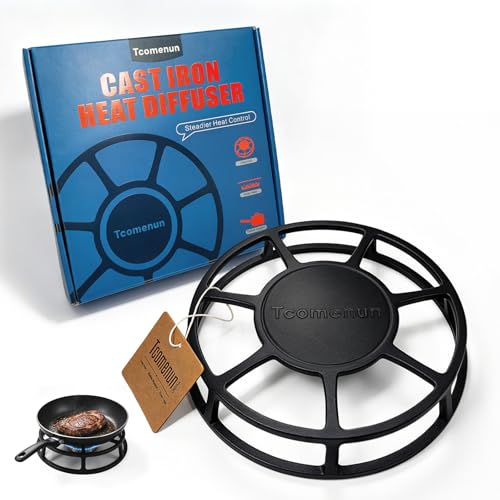
The best flame tamer for gas stoves is usually a 7–8 inch cast-iron diffuser plate for frequent simmering and delicate sauces, while a thinner stainless-steel plate is the better choice when you need quick heat response, lower weight, and easier storage.
A flame tamer—also called a flame diffuser, heat diffuser, simmer plate, or burner diffuser—sits between the gas flame and the pan. It spreads heat across a wider area and reduces direct hot spots, helping prevent scorching in custards, chocolate, rice, milk-based sauces, and long-cooked stews. The right choice depends less on the name and more on material, diameter, burner size, pan base, and how often you simmer.
Our top picks



As an Amazon Associate we earn from qualifying purchases at no extra cost to you. Ratings are shown as listed on Amazon.
Quick picks by cooking situation
| Situation | Best choice | Why | Watch out for |
|---|---|---|---|
| Frequent low simmering | Cast iron, 7–8 inches | High thermal mass smooths temperature fluctuations | Slow to heat and heavy |
| Occasional sauce making | Stainless steel, 6–7 inches | Light, corrosion-resistant, and easier to store | Can develop hot zones if very thin |
| Small saucepan on a small burner | 5–6 inch steel diffuser | Better proportional coverage without overhanging | Less useful for large pans |
| Large Dutch oven or stockpot | 8–10 inch cast iron | Supports broad, steady heat under a wide base | May not fit safely on compact stovetops |
| Limited storage or weak pan supports | Thin stainless steel | Often weighs about 0.5–1.5 kg, compared with roughly 1.5–3 kg for cast iron | Must sit flat and securely |
Steel versus cast iron flame tamers
Stainless-steel diffuser plates
Steel flame tamers generally heat faster and cool faster than cast iron. That responsiveness is useful when a recipe moves from medium heat to low heat and back again. Stainless steel also resists rust, does not require seasoning, and can usually be wiped clean after the plate has cooled.
The main weakness is lower thermal mass. A thin steel plate may reduce the intensity of a flame without eliminating uneven heating. If the metal is only around 1–2 mm thick, the area directly above the burner can remain hotter than the outer edge. This matters with thick sauces that sit undisturbed for several minutes.
Look for a steel plate with a raised rim, stable feet, or a textured underside designed to create a small air gap. A completely flat, lightweight disc can slide more easily and may transfer heat less evenly if the burner cap is not level.
Cast-iron diffuser plates
Cast iron takes longer to warm, but once hot it stores more energy and releases it gradually. That buffering effect is its main advantage for gentle simmering. It can reduce the sharp temperature swings caused by a gas flame cycling between too hot and too low, particularly when the pan is wide and contains a thick mixture.
Cast iron is also more rigid and less likely to warp. Its drawbacks are weight, slower adjustment, and possible rust if it is left wet. Some cast-iron plates have a seasoned surface; others have an enamel coating. Uncoated iron should be dried promptly and may benefit from a very thin film of cooking oil, following the maker’s care instructions.
A cast-iron plate is not automatically more even than steel. A poorly shaped, very thin iron disc can still create a warmer centre. Thickness, contact with the pan, and the relationship between the plate diameter and burner size matter as much as the material.
How to choose the correct diameter
Measure the diameter of the pan’s flat cooking base rather than the diameter across its rim. The diffuser should be large enough to cover most of that base, but it should not extend so far that it interferes with adjacent burners or becomes unstable on the pan supports.
- For a pan base of 10–14 cm, choose a diffuser about 13–16 cm wide.
- For a pan base of 15–19 cm, choose a diffuser about 17–21 cm wide.
- For a pan base of 20–24 cm, choose a diffuser about 21–25 cm wide.
- For a pan base larger than 24 cm, consider an 8–10 inch plate, provided the stove manufacturer permits its use.
As a practical fit rule, aim for a diffuser diameter at least 1–2 cm wider than the pan’s flat base, but avoid a plate more than about 3–4 cm wider than the burner support area. A plate that is too small concentrates heat under the centre. A plate that is too large can block airflow, overhang the grate, or transfer heat to controls and nearby surfaces.
For example, if a saucepan has a 16 cm flat base, a 20 cm diffuser gives approximately 2 cm of coverage beyond the base on each side. That is usually a useful match. A 12 cm plate would leave much of the base outside the diffuser’s heat-spreading area, while a 28 cm plate may be unnecessarily difficult to balance.
Heat distribution: what actually prevents scorching?
Scorching occurs when the pan base becomes hotter than the food can absorb or circulate. A diffuser helps by increasing the heated area and reducing the flame’s direct intensity, but it cannot replace stirring, sufficient liquid, or correct burner adjustment.
For delicate sauces, a thick cast-iron plate often gives the most forgiving result because it slows changes in heat. Steel can work just as well when it is broad enough, reasonably thick, and used with a low flame. A diffuser with holes is not necessarily better: openings can allow concentrated flame jets through, whereas a solid plate provides a more continuous barrier.
Do not turn the burner to high heat to “charge” the diffuser and then leave it unattended. High heat can overheat the plate, discolour stainless steel, damage coatings, and make the pan dangerously hot even after the flame is lowered. Start with a moderate setting, allow the plate and pan to warm gradually, then reduce the flame before the sauce reaches a vigorous simmer.
Decision matrix for buying
| Your priority | Recommended specification | Typical trade-off |
|---|---|---|
| Lowest purchase cost | Basic 6–7 inch steel disc, approximately 1–2 mm thick | May distribute heat less evenly and wear sooner |
| Best control for an inexperienced cook | 7–8 inch cast iron with stable feet or a broad flat underside | Slow response requires patience |
| Small kitchen | 5–6 inch steel model with a hanging hole or compact storage profile | Limited coverage for wide pans |
| Daily simmering | Cast iron around 2–4 kg, matched to the main pan size | Heavy to lift and needs careful drying |
| Cooking acidic sauces | Stainless steel or enamelled cast iron | Some enamelled models cost more |
| Multiple burner sizes | Medium steel plate or two different diameters | A single plate rarely fits every pan well |
Safe setup and maintenance
- Check the stove manual. Some manufacturers advise against diffuser plates because they can reflect heat toward burner components or obstruct ventilation.
- Place the plate centrally. It should sit flat on the pan supports, with no rocking or contact with knobs.
- Use a compatible pan. A flat-bottomed pan gives better contact than a rounded wok or warped saucepan.
- Begin below the diffuser’s maximum recommended heat. Use the lowest flame that maintains the desired simmer; do not allow flames to lick around the plate.
- Stir thick mixtures. A diffuser reduces hot spots but cannot prevent a dense sauce from settling and catching at the edges or base.
- Cool before cleaning. Never put a hot cast-iron plate under cold water, as thermal shock can crack or distort cookware and cause burns from steam.
- Dry thoroughly. Stainless steel needs little care, while bare cast iron should be dried immediately and lightly oiled if its instructions recommend it.
Ownership realities and common mistakes
The first parts likely to deteriorate are thin steel edges, welded feet, surface coatings, and handles or hanging loops. Warping is more common when a lightweight plate is repeatedly heated at maximum output or cooled rapidly. Rust on uncoated cast iron is usually a maintenance problem rather than a reason to discard the plate, but deep pitting, cracks, or persistent instability are signs to replace it.
Do not use a diffuser as a substitute for a proper low-output burner if the flame is still too strong. Do not cover the entire cooktop with an oversized plate, place a diffuser over two burners, or leave it heating without a pan unless the manufacturer specifically permits that use. A diffuser can remain hot long after the flame is turned off, so treat it like a cast-iron skillet.
Final recommendation
Choose a cast-iron plate around 7–8 inches if your main goal is steady, low-temperature cooking and you regularly prepare delicate sauces or long simmers. Choose a stainless-steel plate around 6–7 inches if you value light weight, fast response, easy cleaning, and occasional use. Before buying the best flame tamer for gas stoves, measure the flat base of your most-used pan, compare it with the plate’s usable diameter, and confirm that the stove manufacturer allows a diffuser on your burner.

Write Your Review
No reviews yet. Be the first to share your experience!