

Key takeaways
- Wicks: Soot, rainwater, and overlarge flames shorten wick life. Replace a wick when it becomes frayed, hard, heavily blackened, or difficult to light evenly.
- Caps and snuffers: These are often lost or bent, leaving the wick exposed to rain. A fitted cap is important for keeping water out and extinguishing the flame safely.
- Finish: Powder coating can chip at joints and around threaded caps. Touch up only with a product suitable for the torch material, and never paint a wick, fuel reservoir interior, burner opening, or hot surface.
- Reservoir seals: O-rings and gaskets can harden. Any seepage, fuel odor, or dampness around a cap means the torch should remain unused until the seal is replaced or the unit is retired.
- Solar batteries: LED models may gradually lose runtime after repeated charging cycles. Replacing the battery is practical only when the housing is designed to open safely.
The best tiki torches for a backyard are weather-resistant, stable models with a wide base, a controllable wick, and a fuel reservoir sized for how often you entertain—not simply the tallest or cheapest torches.
Our top picks
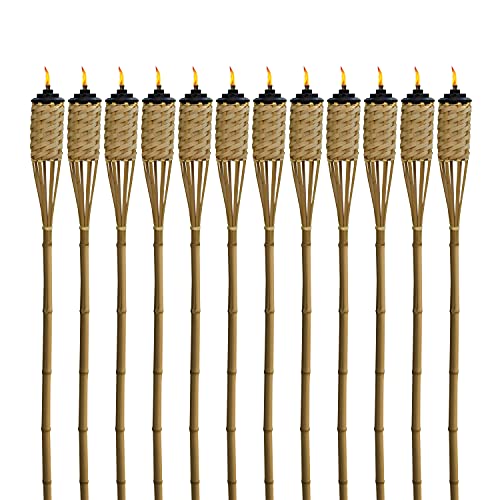

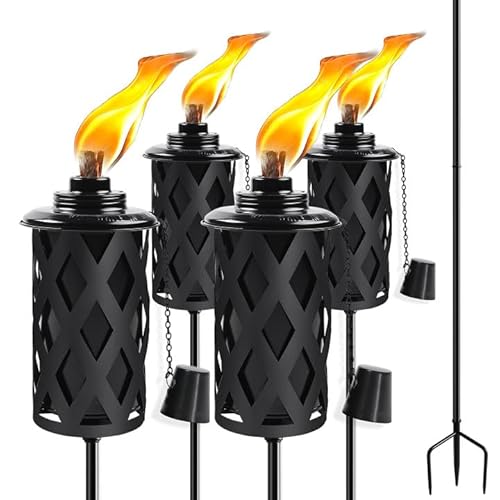

As an Amazon Associate we earn from qualifying purchases at no extra cost to you. Ratings are shown as listed on Amazon.
Best tiki torches for backyard use: quick picks by situation
| Backyard need | Best choice | Why it fits | Main compromise |
|---|---|---|---|
| Lowest upfront cost | Steel or bamboo-style stake torch | Usually about $15–$35 per torch and easy to space around a patio | More corrosion, leaning, and replacement risk over time |
| Frequent entertaining | Powder-coated metal torch with a large reservoir | Better weather resistance and fewer refills | Often $35–$90 each and heavier to move |
| Deck or paved patio | Weighted tabletop torch or freestanding base | No digging; can be positioned on a noncombustible surface | Must be protected from tipping and strong wind |
| Children, pets, or horses nearby | Enclosed LED flame-style torch | No open fuel flame, hot oil reservoir, or exposed wick | Less authentic flame appearance and batteries require charging or replacement |
| Small seating area | Short 36–48 inch torch or tabletop pair | Produces useful accent lighting without overwhelming the space | Less visible over tall planting or furniture |
Fuel types compared
Paraffin-based torch fuel
Liquid torch fuel is the traditional choice for a bright, steady flame. It is commonly sold in one-gallon containers and is generally suitable for reusable cotton or fiberglass wicks when the torch manufacturer permits it. A practical planning figure is roughly 4–8 hours of burn time per 12–16 fluid ounces, although wind, wick height, reservoir design, and fuel formulation can change the result.
The disadvantages are storage and handling. Fuel must remain in its original, clearly labeled container, away from flames, children, animal access, and direct sun. Never fill a hot torch, mix fuels, or leave a fuel container beside a lit torch.
Citronella fuel
Citronella-scented fuel can add a recognizable outdoor fragrance, but it should not be treated as a complete insect-control system. Wind direction, nearby vegetation, standing water, and the number of people in the area matter more than scent alone. Choose citronella fuel only if the torch manufacturer approves it, and expect the same fire and spill precautions as standard liquid fuel.
Propane
Propane patio torches avoid liquid-fuel spills and can offer longer, more predictable operation when fitted with a proper regulator and approved cylinder. They are usually heavier and more expensive, and their hardware must be inspected for damaged hoses, loose connections, and regulator problems. A propane torch is not automatically safer: it still has an open flame, hot surfaces, and tipping hazards.
Solar and rechargeable LED
LED torches are the simplest option for routine accent lighting. Typical solar models provide about 6–12 hours after a full day of strong sunlight, while rechargeable units commonly provide about 8–20 hours depending on brightness and battery size. They do not provide the heat or flame of fuel torches, making them useful near hay, dry landscaping, children, pets, and horse areas.
Height, stability, and placement
For most seated patios, a flame height of 48–60 inches above the ground gives visible light without placing the flame directly at face level. Taller 60–72 inch torches can work along a path or perimeter, but they have more leverage in wind and are more likely to lean if the stake is shallow. Tabletop torches are typically 10–24 inches tall and are best used on broad, level, noncombustible surfaces.
Base design matters as much as torch height. A narrow ground stake is suitable for firm soil but performs poorly in loose mulch or sandy ground. For a stake torch, push the support into undisturbed soil and check that the reservoir remains vertical. Do not use a thin decorative stake as a substitute for a proper ground anchor. On paving, choose a broad weighted base rather than balancing a stake in a planter.
Place torches at least 3 feet from buildings, fences, overhanging branches, awnings, umbrellas, dry grass, hay, and stored bedding unless the manufacturer specifies a greater clearance. Keep them away from walkways where clothing or reins could brush the flame. Around horses, locate open-flame torches outside turnout and tying areas, well away from hay, shavings, feed storage, and startled-animal traffic. LED units are the more sensible option near barns and paddocks.
How the main features compare
| Torch type | Typical height | Typical reservoir or battery | Approximate runtime | Stability and weather notes |
|---|---|---|---|---|
| Bamboo-style liquid torch | 48–60 in | 10–16 fl oz | 4–8 hours | Lightweight; needs firm soil and frequent inspection for splitting |
| Powder-coated metal liquid torch | 48–72 in | 12–24 fl oz | 6–12 hours | Heavier and more rust-resistant; coating can eventually chip |
| Weighted tabletop liquid torch | 10–24 in | 6–12 fl oz | 3–7 hours | Convenient on paving; vulnerable to knocks and gusts at table height |
| Propane torch | 36–72 in | 1–20 lb cylinder | Approximately 8–40 hours | Stable models are heavy; inspect hose, regulator, and cylinder connections |
| Solar or rechargeable LED torch | 36–60 in | Built-in rechargeable battery | 6–20 hours | No flame; solar performance falls after cloudy days and in shaded locations |
These are planning ranges rather than guarantees. A taller flame, exposed location, dirty wick, or gusty evening can reduce liquid-fuel runtime substantially.
Ownership costs and the refill calculation
Liquid fuel often appears inexpensive until refill frequency is included. Suppose four torches each hold 16 fluid ounces and burn through that amount in six hours. One six-hour evening uses 64 fluid ounces, or half a gallon. If fuel costs roughly $12–$25 per gallon, the fuel cost is about $6–$12.50 per event, before replacing wicks.
For weekly use over a 20-week outdoor season, that is approximately $120–$250 in fuel. A more expensive metal torch can therefore be worthwhile if it prevents repeated replacement of cracked bamboo, corroded caps, or bent stakes. For occasional use, inexpensive stake torches or LED units may provide better value.
What wears out first
- Wicks: Soot, rainwater, and overlarge flames shorten wick life. Replace a wick when it becomes frayed, hard, heavily blackened, or difficult to light evenly.
- Caps and snuffers: These are often lost or bent, leaving the wick exposed to rain. A fitted cap is important for keeping water out and extinguishing the flame safely.
- Finish: Powder coating can chip at joints and around threaded caps. Touch up only with a product suitable for the torch material, and never paint a wick, fuel reservoir interior, burner opening, or hot surface.
- Reservoir seals: O-rings and gaskets can harden. Any seepage, fuel odor, or dampness around a cap means the torch should remain unused until the seal is replaced or the unit is retired.
- Solar batteries: LED models may gradually lose runtime after repeated charging cycles. Replacing the battery is practical only when the housing is designed to open safely.
Safer setup and maintenance routine
- Inspect the torch, wick, reservoir, base, and fasteners before every use. Reject any unit that leaks, wobbles, or has cracked material.
- Set the torch on firm, level ground with the required clearance from combustible materials. Check stability by applying gentle pressure before adding fuel.
- Fill only when the torch is completely cool, using a small funnel if needed. Wipe spills immediately and allow vapors to disperse before lighting.
- Let a new or dry wick absorb fuel for at least 20–30 minutes. Lighting it too soon can burn the wick rather than the fuel.
- Keep the flame modest and steady. A very tall, smoky flame wastes fuel and increases heat without providing proportionally better light.
- Extinguish with the supplied snuffer or cap, never by carrying a lit torch or pouring water into a fuel reservoir.
- After cooling, remove rainwater and wipe soot from the burner. Store liquid fuel separately and store torches upright in a dry place.
Bottom line
Choose a powder-coated metal liquid torch with a broad or well-anchored base for frequent backyard entertaining. Choose a lower-cost stake torch for occasional use in firm soil, a weighted tabletop model for paved spaces, and solar or rechargeable LED torches where fire, fuel, animals, or dry materials make an open flame a poor fit. The best choice is the one whose height, stability, weather resistance, and maintenance requirements match the exact place where it will be used.

Write Your Review
No reviews yet. Be the first to share your experience!