

Key takeaways
- For a typical household: Start with a standard box around 1,500–1,800 cubic inches on a corrosion-resistant metal post. It offers useful capacity without making the assembly unnecessarily bulky.
- For frequent catalogs or small parcels: Look for a large-capacity box, checking the interior dimensions and opening size rather than relying on “large” in the product name. A parcel may fit inside the box but still be too wide to pass through its door.
- For added mail privacy: Consider a locking model, but check its mail slot dimensions, key access, and how the carrier deposits mail. A lock can secure deposited mail; it does not guarantee that every package can be delivered inside.
- For a windy, wet, or coastal location: Favor powder-coated aluminum or well-finished galvanized steel, stainless hardware, and a post designed for outdoor exposure. Near salt air, inspect finish and fasteners more often because corrosion can start at scratches and joints.
- For a sloped or narrow verge: Measure the usable space and check the door’s swing, roadside approach, and snow-clearing path. A big box is a poor fit if it projects into a walkway or cannot be reached safely from the delivery vehicle.
Best Mailboxes With Posts for Every Home
The best mailbox-and-post setup is a medium-capacity, weather-resistant box on a post rated for outdoor use, sized to fit your mail and installed at the curbside position required by your local postal authority. For most homes, a post-mounted box with about 1,500–1,800 cubic inches of interior space is a practical starting point; choose a larger locking model for frequent deliveries or a low-maintenance composite or vinyl post if you want to avoid repainting.
Compare complete setups at a glance
| Setup | Typical box capacity | Post material | Typical post height* | Best fit | Main trade-off |
|---|---|---|---|---|---|
| Standard single box | 1,500–1,800 cu in | Powder-coated steel or aluminum | Approximately 4 ft above ground | Everyday letters and small parcels | Can be too small for bulky deliveries |
| Large-capacity box | 1,800–2,400 cu in | Steel, aluminum, or composite | Approximately 4 ft above ground | Households receiving catalogs and packages | Larger box needs a suitably sturdy post |
| Locking curbside box | About 1,000–2,000 cu in | Steel box on steel, aluminum, or composite post | Set to local postal requirements | People seeking added mail privacy | Mail slot and retrieval opening limit what fits |
| Decorative low-maintenance setup | 1,500–2,000 cu in | Vinyl or composite post with metal box | Approximately 4 ft above ground | Homes where reduced repainting matters | Check that the post is reinforced for the box’s weight |
*These are planning figures, not universal installation instructions. Postal placement rules and product dimensions vary. Confirm the required height and setback with your local postal service before digging.
Our top picks


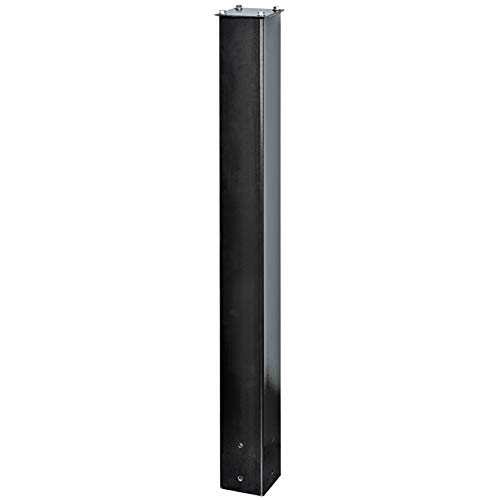
As an Amazon Associate we earn from qualifying purchases at no extra cost to you. Ratings are shown as listed on Amazon.
Choose by household and curbside conditions
- For a typical household: Start with a standard box around 1,500–1,800 cubic inches on a corrosion-resistant metal post. It offers useful capacity without making the assembly unnecessarily bulky.
- For frequent catalogs or small parcels: Look for a large-capacity box, checking the interior dimensions and opening size rather than relying on “large” in the product name. A parcel may fit inside the box but still be too wide to pass through its door.
- For added mail privacy: Consider a locking model, but check its mail slot dimensions, key access, and how the carrier deposits mail. A lock can secure deposited mail; it does not guarantee that every package can be delivered inside.
- For a windy, wet, or coastal location: Favor powder-coated aluminum or well-finished galvanized steel, stainless hardware, and a post designed for outdoor exposure. Near salt air, inspect finish and fasteners more often because corrosion can start at scratches and joints.
- For a sloped or narrow verge: Measure the usable space and check the door’s swing, roadside approach, and snow-clearing path. A big box is a poor fit if it projects into a walkway or cannot be reached safely from the delivery vehicle.
Box capacity matters less than usable opening
Published capacity is usually an estimate of internal volume, not a promise about the size of an item the mailbox will accept. Before choosing, compare the interior length, width, and height with the largest mail you commonly receive. Then check the door opening or deposit slot: that is often the limiting dimension, especially on locking boxes.
For a quick fit check, measure a typical bulky delivery and add roughly an inch of clearance in each relevant direction. If it still cannot pass through the opening, the stated capacity will not solve the problem. Packages that exceed the box’s opening may need another delivery arrangement.
Post materials: what holds up and what needs attention
| Material | Strengths | Ownership considerations |
|---|---|---|
| Powder-coated steel | Rigid, widely available, and suited to heavier boxes | Touch up chips promptly; exposed steel can rust, especially around fasteners and cut edges |
| Aluminum | Lightweight and naturally resistant to many forms of corrosion | Can dent or flex more easily than a heavier steel post; check stiffness and mounting design |
| Vinyl or composite | Low-maintenance appearance and no routine repainting | May need a reinforcing insert or a compatible mounting plate; confirm the post’s load rating |
| Wood | Easy to customize, cut, and paint | Needs periodic finish checks; ground contact and trapped moisture can lead to rot |
In many setups, the first trouble spots are not the middle of the post but the mounting screws, post base, door hinge, and finish around edges. A post that looks sturdy can still loosen if the box is mounted with undersized hardware or the post is inadequately anchored. Match the box’s weight and mounting pattern to the post, and use the fasteners specified by the manufacturer.
Installation: verify the site before you buy
- Confirm placement rules. Ask the local postal service about required height, road setback, and access. Do not assume a neighbor’s setup is the current standard for your route.
- Check for buried utilities. Contact the local utility-marking service before digging. This is important even for a shallow post hole.
- Measure the full footprint. Account for the box door opening, vehicle approach, driveway edge, sidewalk, drainage, and seasonal snow storage.
- Set a stable post. Follow the post maker’s instructions for burial depth, footing, and backfill. Soil, frost, and local conditions affect what support is appropriate; keep the assembly plumb while it sets.
- Mount and align the box. Use the intended mounting plate and corrosion-resistant hardware. Check that the door opens freely and that the box is accessible from the delivery side.
A preassembled post-and-box kit can simplify matching the parts, but it does not remove the need to confirm site measurements and local rules. A separate box and post offer more choice, provided their mounting holes, weight limits, and materials are compatible.
Budget for the whole setup
As a broad market guide, basic mailbox-and-post combinations often fall around $40–$100, while heavier, decorative, or locking setups may run roughly $100–$300 or more. Installation materials, a mounting plate, replacement hardware, and professional help can add to the total. Compare complete configurations rather than box prices alone: a low-cost box paired with an incompatible post can create extra work or an unstable installation.
Keep the setup working through the seasons
- Open and close the door periodically to catch a stiff hinge or loose latch before it fails.
- Clear leaves, grit, and standing water; clean the box with mild soap and water, then dry it.
- Inspect paint, powder coating, and fasteners after winter. Repair small chips before corrosion spreads.
- Check the post for movement after strong winds or ground freeze-thaw cycles. Tighten only compatible hardware and replace corroded fasteners rather than painting over them.
- Keep snow, branches, and parked vehicles from blocking the carrier’s approach.
For most homes, a medium-capacity box on a properly rated, corrosion-resistant post is the balanced choice. Go larger when your regular mail actually needs the space, choose a locking model when its access limits suit your deliveries, and let local placement requirements and site conditions decide the final dimensions.

Write Your Review
No reviews yet. Be the first to share your experience!