

Key takeaways
- Ten solar fence chargers for horse pastures compared from listing specs: 2 to 45 mile ratings, joule outputs from 0.11 to 1.5J and one plug-in alternative.
For a horse pasture with a moderate fence line, the best-value picks here are the larger-output solar units: the FarmNix 1.5J, the Epoify 1.2J and the ANDMON 0.76J, all of which state mile ratings of 30 to 45. For a small paddock or a temporary strip, the Zareba 5 Mile or 10 Mile models are the best-known brand names on the list, though they are lower output. The most important rule is to buy for the length and condition of your fence, not for acres. This roundup uses listing titles and published specifications only.
Which charger for which job
Our top picks


As an Amazon Associate we earn from qualifying purchases at no extra cost to you.
- Small paddock or rotational strip: Zareba 5 Mile, Zareba 10 Mile
- Long perimeter or weedy lines: FarmNix 1.5J, Epoify 1.2J, ANDMON 0.76J
- Tight budget, short fence: EVIORTER 0.11J, COVECO 0.33J
- Barn with a plug nearby: Zareba 25 Mile AC (not solar)
At a glance
| Model | Key point from title | Best for |
|---|---|---|
| Zareba 5 Mile | Solar, low impedance, T-post bracket | Small paddocks |
| Epoify 1.2J | 45 mile, solar plus AC backup | Large fence lines |
| EVIORTER 0.11J | 10 miles, 8100V | Short fences |
| Zareba ESP10M-Z | 10 mile, 0.15J, solar | Medium paddocks |
| Gorhope 0.32J | 20 miles, tempered glass panel | Mid-size pastures |
| ANDMON S700 | 35 miles, 0.76J, dual input | Long runs |
| FarmNix SEF-02 | 30 miles, 1.5J, 15W panel | Remote pastures |
| COVECO 0.33J | 20 miles, portable, adjustable | Temporary fences |
| Gallagher S20 | 0.2J, 2 mile, lithium battery | Small areas |
| Zareba EAC25M-Z | 25 mile, AC plug-in | Barn-side fields |
The ten chargers, one at a time
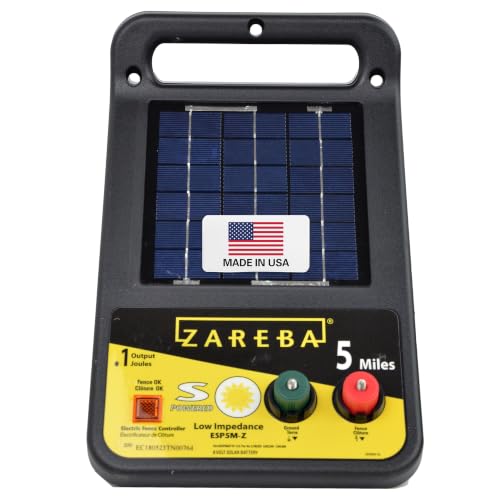
Zareba Solar Electric Fence Charger, 5 Mile Range
A low-impedance solar energizer rated for 5 miles, with 360-degree rotation and a T-post mounting bracket. The title names rotational grazing, which suits moving a horse between small strips. No joule figure is given, so check the listing for output before using it on a long or weedy line.
- Pros: Low impedance; T-post bracket; rotates to track the sun
- Cons: Short range; joules not in title
Who it’s for: Small paddocks and strip grazing.
Epoify Solar Electric Fence Charger, 1.2J, 45 Mile
The title lists 1.2J output, a 45-mile rating, a short-circuit alarm, an 8W panel, solar plus AC backup and a 10,000mAh battery. The AC backup is a useful safety net if the weather turns dull. The sizeable panel and battery claims are worth checking against the listing photos, and read the warranty terms before buying.
- Pros: High output; AC backup; alarm for short circuits
- Cons: Newer brand; large panel claims need checking
Who it’s for: Big pastures where you want a mains fallback.
EVIORTER Solar Electric Fence Charger, 0.11J, 10 Miles
One of the lowest-priced listings. The title gives 0.11J, 10 miles and a maximum output of 8100V. The mile rating is high for such a low joule figure, which is a reason to treat the range as a best-case number. Use it only on short, clean lines.
- Pros: Low price; 8100V stated
- Cons: Lowest joules here; range claim looks optimistic
Who it’s for: Short fences and shared garden or yard boundaries.
Zareba 10 Mile Solar Charger, ESP10M-Z
Described as low impedance with 0.15 output joules and a built-in mounting bracket for posts. The title names horses and cattle. It offers twice the stated range of the 5 Mile model, though it costs more than several higher-output units here, so weigh brand familiarity against raw joules. A middle option for paddocks of modest size.
- Pros: Horses named in title; built-in bracket; model number easy to look up
- Cons: Modest joules
Who it’s for: Medium paddocks with a tidy fence line.
Gorhope 20 Miles Solar Electric Fence Charger, 0.32J
A 0.32J unit with a tempered glass panel and a claim of 14 days of protection without sunlight. Price is on the low side. The 14-day figure is the seller’s claim, so treat it as an upper bound, not a promise.
- Pros: Glass panel; long no-sun claim
- Cons: Unfamiliar brand; claim unverified
Who it’s for: Mid-size pastures with a clean fence line and a modest budget.
ANDMON S700 35 Miles Solar Fence Charger, 0.76J
The title names horses, cattle and sheep, 0.76J output and dual input, meaning it can take solar and another source. It sits between the budget models and the 1.2J and 1.5J units. It is priced below the Zareba 10 Mile despite a much longer rating and higher joules. Read the dual-input details on the listing to see what the second source is.
- Pros: Dual input; horses named; mid-range joules
- Cons: Mile rating assumes ideal conditions
Who it’s for: Long runs where a budget model would be too weak.
FarmNix SEF-02, 30 Miles, 1.5J, Adjustable 6-12KV
The highest joule figure on the list, with a 15W panel, a 12V 7Ah battery and adjustable output from 6 to 12KV. The adjustable voltage helps if you want to dial the fence back near the barn. The 12V 7Ah battery and 15W panel are the kind of hardware worth having where power is far away.
- Pros: 1.5J; adjustable output; larger panel and battery
- Cons: Heavier setup; brand support uncertain
Who it’s for: Big or weedy pastures far from power.
COVECO 20 Miles Solar Powered Charger, 0.33J, Portable
The lowest price in the group. The title says portable, adjustable voltage and 0.33J. It is aimed at gardens and farms, so check that the listing supports horse use before buying.
- Pros: Portable; adjustable voltage; very low price
- Cons: Low joules; horse suitability not stated in title
Who it’s for: Temporary or secondary fences.
Gallagher S20 0.2J Solar Electric Fence Charger, 2 Mile
The most expensive listing and the shortest range: 0.2J, 2 miles, a lithium battery and a weather-resistant case. The title names poultry, livestock, gardens and pets, not horses. It pays the most for the least range, so choose it only if the compact lithium design suits your site.
- Pros: Lithium battery; weather-resistant design per the title
- Cons: Highest price for the lowest range
Who it’s for: Small areas such as a paddock corner or a poultry run beside the pasture.
Zareba 25 Mile AC Powered Charger, EAC25M-Z (not solar)
This is a plug-in unit. The title says low impedance, 25 miles, and lists bulls, cattle and horses among the animals it can contain. Include it only if you have a safe power point near the fence and want to skip panels.
- Pros: No panel or battery; names horses
- Cons: Needs mains power; not solar
Who it’s for: Fields beside the barn.
How these were picked
The editorial team read listing titles, published specifications, manufacturer documentation and buyer reviews and kept chargers that state a range, an output or a clear use. We flagged the AC unit and the small garden-type models instead of hiding them, and noted every place where a title leaves out joules, panel size or battery detail. Range figures are quoted as the sellers state them. Nobody on the team used or measured these units, so none of the numbers here are our own readings.
Sizing a charger for your fence
Count wire miles, not acres
A charger drives every strand at once. Multiply fence length by strand count to get wire length, then convert to miles. Worked example: a square 10-acre pasture is about 660 feet on a side, so the perimeter is 2,640 feet, or half a mile. With three strands of tape that is 1.5 miles of wire. Add a cross-fence and you pass 2 miles quickly. A 5-mile rating leaves little spare capacity once weeds are touching the line.
Treat mile ratings as a ceiling
Rated range assumes bare, clean wire. Vegetation, poor grounding and loose connections reduce what reaches the end. Joules are a better guide to stamina, so pair mile and joule figures when comparing. Do not assume you will get anything close to the stated range once grass is touching the wire; leave a wide margin.
Panel and battery placement
Solar chargers lose power when the panel is shaded by trees, a barn roof or tall grass. Face the panel toward the midday sun, tilt it for winter, and keep it out of the horses’ reach, because they will rub on anything within reach. Batteries last longer if the line is kept clear, since a shorted line drains the pack faster than a long one.
Make the fence visible
Horses respect what they can see. Thin wire is hard to see, so many owners use tape or rope, and a charger rated for livestock still depends on the animal noticing the line before it leans on it. Hang flagging on a new fence for the first few weeks, use warning signs and keep the line away from public access.
Matching charger to fence type
Tape and rope carry less current over distance than bare wire, so add margin if you use them. A single hot strand at nose height for a small paddock is a lighter load than a three-strand perimeter. Pick the charger for the heaviest section of your plan, not the lightest.
Grounding and safety
Follow the maker’s manual for earth rods and spacing. Keep wire away from people and do not run an energized line along a road or footpath. Disconnect before working on the fence. Children should never touch an energized fence, and warning signs should be posted wherever people might reach it.
Season-start checklist
- Walk the fence and trim anything growing into the wires
- Check connections and insulators for cracks
- Confirm the panel is clean and unshaded
- Test the charger’s indicator light against the manual
- Re-check earth rod connections after dry spells
Mistakes buyers make
Buying on the mile figure alone is the most common one, since a 0.11J unit and a 1.5J unit both claim big ranges. Others include skimping on earth rods, mounting the panel in shade, letting grass grow into the bottom wire and ignoring the animal named in the title. A related error is buying a poultry or garden unit for a horse pasture because the price looks right. If the listing does not name horses, read the maker’s guidance first, and when in doubt, ask the seller or a fencing supplier.
Verdict
For most horse pastures, choose from the 0.76J to 1.5J group: the ANDMON, Epoify or FarmNix. For small strip-grazing, a Zareba 5 or 10 Mile is simpler. Use the budget models only on short, clean lines and always follow the manual for installation and grounding. If a plug is near the fence, the AC Zareba is the simplest answer of all.
Questions readers ask
How big a solar charger does a horse pasture need?
Start with the total length of wire in the fence, not the acreage. A square 10-acre field has a perimeter of about half a mile, and three strands of tape triples the wire length. Mile ratings on listings are maximums under ideal conditions, so choose a charger rated several times higher than your actual run, especially if weeds will touch the line.
What do joules mean on a fence charger?
Joules describe how much energy each pulse can carry. This list runs from 0.11J on the smallest listing up to 1.5J on the FarmNix, with Epoify at 1.2J and ANDMON at 0.76J. Higher output generally pushes a stronger pulse down longer or weedier lines. Compare joules alongside the mile rating, because different brands rate range in different ways.
Will a solar charger keep working during cloudy weeks?
It depends on the battery. Listings mention things like 14-day protection without sunlight, a 10,000mAh battery or a 12V 7Ah battery, but these are manufacturer claims. Panel size, season, shade and fence load all change the result. Mount the panel facing the sun with no shade, and keep the fence line clear of weeds so less power drains away.
Can a small garden or poultry charger be used on horses?
Be careful. Some listings mention poultry, gardens or yards alongside livestock. Horses are large and may push through a weak pulse, particularly if the fence is not very visible to them. The titles for the Zareba 10 Mile, Zareba 25 Mile and ANDMON units name horses specifically; for the others, check the listing and the maker’s guidance before relying on them.
Why is the Zareba 25 Mile charger on a solar list?
It is not solar. The title says AC powered and plug-in, so it needs a mains outlet near the fence. We include it as a comparison point for pastures close to a barn with power. If your fence line is far from an outlet, a solar unit is the more practical choice. Always follow the manual for grounding.
Related guides
- Fly Masks For Horses With Sensitive Eyes
- Saddle Pads For Horses With High Withers
- Horse Turnout Blankets For Cold Winters





Write Your Review
No reviews yet. Be the first to share your experience!