

Key takeaways
- Shopping for the best riding helmets for beginners? Compare six Troxel and kids' options by size range, coverage and certification, plus sizing tips.
For most new riders, the best beginner riding helmet is the Troxel Spirit: a low-profile, full-coverage design that fits a wide range of head shapes, is offered in a broad range of sizes and carries the equestrian certification you should look for on any helmet. Riders who prefer a lighter, vented look should start with the Troxel Sport 2.0, and young children can look at the ventilated kids’ model with an adjustable range. A riding helmet is protective headgear designed for horseback use, so it needs an equestrian safety rating (ASTM F1163 with SEI certification in the United States), not just a cycling or general sports label.
Quick List
- Kids Ventilated Adjustable Helmet (53-58 cm) – best for growing children who need an adjustable fit and a washable liner
- Troxel Sport 2.0, Large (7-1/4 to 7-1/2) – best for adult beginners who want a lightweight, vented helmet
- Troxel Spirit, Medium (7 to 7-3/8), Black – best for riders who want full coverage and a low-profile shape
- Troxel Spirit, Small (6-1/2 to 6-7/8), Raspberry – best for teens and smaller adult heads who want color
- Troxel Sport 2.0 Injection Molded – best for a second Sport 2.0 size or color option (confirm on listing)
- Troxel Full Coverage, Large (7-3/8 to 7-3/4) – best for larger heads who ride trails and lessons
Which One Is Right for You?
| If you… | Choose |
|---|---|
| want deep, full-coverage protection and a classic fit | Troxel Spirit, Medium |
| are a teenager or have a smaller head | Troxel Spirit, Small (Raspberry) |
| prefer a light, vented, visored schooling helmet | Troxel Sport 2.0, Large |
| need a different Sport 2.0 size or color | Troxel Sport 2.0 Injection Molded listing |
| have a larger head that falls near 7-3/8 to 7-3/4 | Troxel Full Coverage, Large |
| are fitting a child who will grow | Kids Ventilated Adjustable Helmet |
Fit comes before everything else. A helmet that is the wrong size will not sit correctly in a fall, whatever the badge on the box says. Measure your head, pick the size range that includes it, and try adjusting the harness and dial or pads before you decide the helmet is not comfortable. Because several listings below are the same helmet in different sizes, compare size ranges first, then style.
All 6 Picks in Detail
1. Kids Ventilated Adjustable Helmet – Best for Growing Children
As an Amazon Associate we earn from qualifying purchases at no extra cost to you.

This kids’ helmet is the only non-Troxel option here, and it is aimed squarely at young riders. The listing gives an adjustable range of 20.8 to 22.8 inches (53 to 58 cm), says it is ASTM and CPSIA certified, and mentions breathable vents and a washable liner. That adjustability is valuable for children whose heads change quickly, but it also means you must verify the exact standard on the product page. For equestrian use, look for ASTM F1163 and SEI certification, and treat a bare ASTM mention as something to confirm.
- Adjustable range of 53 to 58 cm (20.8 to 22.8 inches)
- ASTM and CPSIA certified per the listing name
- Ventilated shell with breathable vents
- Washable liner per the listing
- Specific ASTM standard number and SEI status: confirm on listing
For a child, the real measure of a helmet is whether it gets worn without complaint. A washable liner helps with hygiene after hot lessons, and an adjustable range means the same helmet can follow a child through a growth spurt. Whatever the listing says, check the inside label when the helmet arrives and confirm the certification before the first ride. If the markings do not match what you expected, return it and choose a model with clear ASTM F1163 and SEI labeling.
Pros:
- Adjustable sizing covers a typical child’s growth range
- Washable liner is a practical feature for sweaty summer lessons
Cons:
- Certification wording needs to be checked for the equestrian standard
- Less brand history than the Troxel models
If the listing confirms ASTM F1163 and SEI, it is a flexible choice for a child; if you are unsure, the Troxel Spirit Small is the better-documented alternative for smaller heads.
2. Troxel Sport 2.0, Large (7-1/4 to 7-1/2) – Best for Lightweight, Vented Schooling

The Sport 2.0 is Troxel’s lightweight, injection-molded schooling helmet. Manufacturer information describes an integrated visor, large vents and a removable, washable headliner, and lists certification to ASTM F1163 with SEI. In black, it looks neutral enough for lessons, trail rides and casual shows. This listing is the Large size for hat sizes 7-1/4 to 7-1/2, so it suits adult riders with medium-to-larger heads who want less weight on the head during long rides.
- Size: Large (7-1/4 to 7-1/2)
- Injection-molded, lightweight design
- Black finish
- Adjustable fit system per the product family
- Number of vents and exact weight: confirm on listing
New riders often start in the summer, and a vented, lightweight shell is easier to tolerate during a forty-five-minute lesson in the sun. The visor-style front on this family also helps keep glare down on an outdoor arena. Because the Large listing covers only a narrow band of head sizes, take the tape measure to your head before ordering, and look at the adjustment mechanism once the helmet arrives to make sure it tightens evenly.
Pros:
- Light feel and ventilation for warm weather
- Black is neutral for most disciplines
Cons:
- Shape is less deep than the Spirit, so some riders feel less coverage at the back
- Large only fits a specific head range, so measure first
It is the lighter, more ventilated counterpart to the Spirit Medium, which offers deeper coverage.
3. Troxel Spirit, Medium (7 to 7-3/8), Black – Best for Full Coverage and Low Profile

The Spirit is Troxel’s classic, deep-fitting helmet with a low profile and adjustable fit system. The listing names it Full Coverage, Low-Profile Adjustable Design, in Medium (7 to 7-3/8) with a Black Duratec finish. Duratec is the shell finish named in the listing. For a beginner, the Spirit’s appeal is its balance: it looks refined enough for a lesson barn, stays put on a bouncing trot, and offers wide adjustability. Medium covers many average adult and older teen heads.
- Size: Medium (7 to 7-3/8)
- Full-coverage, low-profile design
- Black Duratec finish per the listing
- Adjustable fit per the listing name
- Vent count and visor details: confirm on listing
The Spirit is the model many lesson barns keep on loan, which says something about how widely it fits. Its deeper shape can make it feel more secure when a horse trots or spooks, and a low profile keeps it from looking bulky. Adjustment features let you fine-tune the fit around the back of the head, so spend time on that step rather than leaving it at the factory setting.
Pros:
- Deep, secure shape that stays in place
- Black looks neat for lessons and shows
Cons:
- A fuller shape may feel warmer on very hot days than a heavily vented design
- Fit is size-specific, so check the head range
Choose this over the Sport 2.0 Large when you want deeper coverage, and over the Spirit Small only if your head falls in the Medium range.
4. Troxel Spirit, Small (6-1/2 to 6-7/8), Raspberry – Best for Teens and Smaller Heads
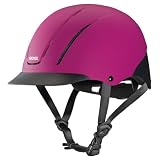
This is the same Spirit design in Small, covering hat sizes 6-1/2 to 6-7/8, finished in raspberry. It suits teens, riders with petite heads and anyone who wants a helmet that expresses some personality without leaving the safety standard behind. Color matters for kids and teens: a rider who likes the way a helmet looks is more likely to wear it every time, and every ride is the point of owning one.
- Size: Small (6-1/2 to 6-7/8)
- Full-coverage, low-profile adjustable design
- Raspberry color
- Same Spirit family as the Medium and Large listings
- Precise weight and harness details: confirm on listing
Teens often outgrow children’s helmets before they are ready for adult styling, and the Small Spirit fills that gap. If your rider sits near the top of the range, at about 6-7/8, consider whether the next size up would give a better fit with the harness loosened or tightened, because a helmet that is barely adequate today will not last the season. Keep the receipt and the fitting guide for returns or exchanges.
Pros:
- Color choice appeals to younger riders
- Same shape as the Spirit Medium
Cons:
- Narrow size range: if your child is between sizes, check the next size up
- Bright color shows dirt and sun fade over time
It is the small-head sibling of item 3 and a more established-brand alternative to the adjustable kids’ model.
5. Troxel Sport 2.0 Injection Molded – Best for an Alternate Sport 2.0 Size or Color
This listing is also a Sport 2.0, described as injection molded with a lightweight, adjustable design. The listing name does not state a size or color, so you must pick both on the product page. Treat it as the entry point for riders whose size is not covered by the Large listing above. The Sport 2.0 range reaches from extra-small through extra-large according to the manufacturer, so it is worth checking the size chart carefully before choosing.
- Injection-molded construction
- Lightweight, adjustable design
- Same family as the Sport 2.0 Large listing
- Size and color are not stated in the name: confirm on listing
- Number of vents and weight: confirm on listing
The most important step here is selecting the correct size on the product page and confirming it matches your measurement. Because the title does not name a size, read the selector twice, and compare the size range against the Troxel size chart before you add it to your cart. If you cannot find your size here, the Large listing in item 2 and the Spirit listings cover the main adult ranges.
Pros:
- Wide size availability across the Sport 2.0 family
- Easy-care, lightweight shell
Cons:
- Easy to order the wrong size if you do not read the size selector
- Less coverage depth than the Spirit
It is effectively the other size of item 2, and you should treat both as one helmet line.
6. Troxel Full Coverage, Large (7-3/8 to 7-3/4) – Best for Larger Heads on Trails and Lessons
The listing calls this a Full Coverage helmet with an adjustable fit in Large (7-3/8 to 7-3/4) and cooling vents that help riders stay comfortable on trails, lessons and in the arena. It sits in the same family as the Spirit, so you get the deeper shape and the adjustable harness with a size aimed at larger heads. For adult beginners with bigger hat sizes, a helmet that fits correctly is far more important than which discipline it is marketed for.
- Size: Large (7-3/8 to 7-3/4)
- Full-coverage shape
- Cooling vents mentioned in the listing
- Adjustable fit
- Color and exact model name: confirm on listing
Riders with larger heads have fewer choices, and beginners with larger heads sometimes end up in a helmet that is too small because it was the one on the shelf. A Large range that reaches 7-3/4 helps avoid that. Check that the helmet sits level and that the harness reaches a snug fit without maxing out the adjustment, which would suggest the size is wrong.
Pros:
- One of few options here for heads above 7-3/8
- Ventilation helps on warm days
Cons:
- Size range is narrow, so very large heads may need an extra-large model
- Details such as color are not in the name
It is the larger-size counterpart to the Spirit Medium in item 3.
Specs Compared
| Helmet | Size range | Style | Certification | Color |
|---|---|---|---|---|
| Kids Ventilated Adjustable | 53-58 cm (20.8-22.8 in) | Ventilated, adjustable | ASTM and CPSIA per listing; confirm F1163 and SEI | Confirm on listing |
| Troxel Sport 2.0, Large | 7-1/4 to 7-1/2 | Injection molded, lightweight | ASTM/SEI per manufacturer; confirm on listing | Black |
| Troxel Spirit, Medium | 7 to 7-3/8 | Full coverage, low profile | ASTM/SEI per manufacturer; confirm on listing | Black |
| Troxel Spirit, Small | 6-1/2 to 6-7/8 | Full coverage, low profile | ASTM/SEI per manufacturer; confirm on listing | Raspberry |
| Troxel Sport 2.0 Injection Molded | Confirm on listing | Injection molded, lightweight | ASTM/SEI per manufacturer; confirm on listing | Confirm on listing |
| Troxel Full Coverage, Large | 7-3/8 to 7-3/4 | Full coverage, cooling vents | ASTM/SEI per manufacturer; confirm on listing | Confirm on listing |
How We Chose These
This guide comes from research on the six listed helmets, not from handling them. We read each listing, compared it with manufacturer product pages and size charts, and weighed four things: equestrian certification, size range and adjustability, ventilation and coverage, and how clearly the listing states these details. Helmets are safety equipment, so we flag anything the listing does not state and ask you to confirm it on the product page. We do not rank by protection, since fit matters more than model name. Sections follow the product list, and each ends by naming the closest alternative.
What to Look For
Certification: ASTM F1163 and SEI
In the United States, an equestrian helmet should meet ASTM F1163 and carry the SEI certification mark. Cycling, skateboarding or general sports helmets are built for different impacts and are not a substitute. Check for the sticker inside the helmet and the wording on the product page. If a listing only says ASTM, ask which standard. Certification does not make any helmet injury-proof, but it confirms the helmet passed the impact and retention tests the standard defines.
Measuring and Fitting
Measure the circumference of your head about one inch above your eyebrows with a soft tape, and match it to the manufacturer’s chart. Hat sizes and centimeters are both used: for example, 53 to 58 cm is roughly 6-5/8 to 7-1/4 in hat sizing. The helmet should sit level, with the front edge about one inch above the eyebrows. It should feel snug all around without pressure points, and it should not slide forward or back when you shake your head with the harness fastened. The chin strap should be snug, with room for about one finger beneath the chin. Wear the helmet for a few minutes in the store or at home before your first ride, and note any red marks or sore spots afterward, which suggest the shape does not suit your head. If the helmet fits well only when the harness is fully tightened or fully loosened, try a different size.
Coverage, Vents and Weight
Full-coverage helmets extend lower at the back of the head and often feel more secure. Vented designs are lighter and cooler in hot weather but can feel less enclosed. A removable, washable liner is a practical feature since helmets get sweaty. Do not add stickers or paint to the shell unless the manufacturer allows it, since solvents can weaken the material. Beginners often overlook ponytails, too: a low ponytail or braid sits comfortably under the back of the helmet, while a high ponytail can push the helmet forward. Choose a style that lets the helmet sit level, and keep hair and hairpins from creating pressure points. Finally, always fasten the chin strap before mounting, every time, even for a short ride or a walk to the arena.
When to Replace a Helmet
Replace any helmet after a significant impact, even if it looks fine, because the foam inside may be compressed and unable to absorb another blow. Many manufacturers also recommend replacement after about five years, since materials age. Always follow the instructions that come with your helmet. Never buy a used helmet, since you cannot know its history. If the shell cracks, the harness frays or the buckle breaks, replace it.
Worked Example: Choosing a Size
Imagine your head measures 22.5 inches around. That is about 57 cm and roughly a 7-1/8 hat size. Looking at the ranges above, the Troxel Spirit Medium (7 to 7-3/8) includes it, while the Sport 2.0 Large (7-1/4 to 7-1/2) does not, and the Spirit Small tops out at 6-7/8. If you land between two sizes, try both and choose the one that fits snugly without pressure points. Then do a shake check: fasten the harness, tilt your head forward and back, and turn side to side. The helmet should move with your head instead of sliding over it. Finally, check that the brim or front edge does not block your upward view when you look ahead from a riding position, since beginners often tip their chin down to compensate for a poorly sitting helmet. For a child who is growing, choose an adjustable range such as 53 to 58 cm and recheck the fit every few months.
Questions
Do beginners really need a certified riding helmet?
Yes. Falls are a normal part of learning to ride, and an equestrian-certified helmet is designed for the heights and impacts of horseback riding. Many lesson barns and shows require ASTM F1163 and SEI helmets.
Can I use a bike helmet for riding?
It is not recommended. Bike helmets are designed for different impacts, usually have less coverage at the back of the head, and are not usually certified to the equestrian standard. Choose a helmet that states ASTM F1163 and SEI.
How tight should a riding helmet be?
Snug but comfortable, with no pressure points. The helmet should not move independently of your head when you shake it, and the chin strap should be snug enough that you can fit about one finger under it.
How long does a riding helmet last?
Most manufacturers recommend replacement after about five years of regular use, and immediately after any serious impact. Check the manufacturer’s guidance for your model and replace the helmet if it is damaged.
What size helmet does my child need?
Measure the circumference of the head above the eyebrows and match it to the size chart. Adjustable models cover a range, but recheck the fit regularly as the child grows.
Is a more expensive helmet safer?
Not necessarily. A certified helmet that fits properly offers the protection the standard requires. Higher-end helmets usually add comfort features, so choose based on fit and certification first.
Update History
- October 20, 2026 – Initial publication; product set drawn from current catalog listings.
- Check the product page for current specifications and availability before buying.
Sources
- Manufacturer product and size-chart pages for Troxel helmets (Spirit and Sport 2.0)
- Retailer listing titles and specification fields for each listed helmet
- ASTM F1163 and SEI certification as described in manufacturer and retailer materials


Write Your Review
No reviews yet. Be the first to share your experience!