

Key takeaways
- Best budget choice: a 20V MAX two-tool kit with a drill/driver, impact driver, two compact batteries and a soft bag.
- Best all-round DIY choice: a 20V MAX brushless four-tool kit with two 2.0Ah or 5.0Ah batteries.
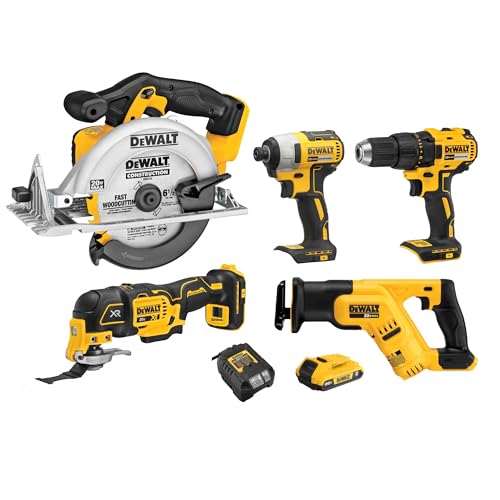
- Best for regular property maintenance: a 20V MAX brushless five-tool kit with a reciprocating saw, oscillating tool or circular saw included.
- Best for heavy cutting: a FLEXVOLT 60V kit, provided you can accept higher cost, weight and fewer compact tools.
- Best value for an existing DeWalt owner: a tool-only kit or bare tool, since your current 20V MAX batteries may already fit.
The best DeWalt combo kits for most buyers are 20V MAX brushless sets with two 2.0Ah batteries: they offer the strongest balance of price, portability and capability for household repairs, workshop projects and light barn maintenance. Choose a larger 4.0Ah or 5.0Ah kit for frequent use, and choose FLEXVOLT 60V only when you need high-power saws or outdoor equipment.
Our top picks


As an Amazon Associate we earn from qualifying purchases at no extra cost to you. Ratings are shown as listed on Amazon.
Best DeWalt combo kits by workload
- Best budget choice: a 20V MAX two-tool kit with a drill/driver, impact driver, two compact batteries and a soft bag.
- Best all-round DIY choice: a 20V MAX brushless four-tool kit with two 2.0Ah or 5.0Ah batteries.
- Best for regular property maintenance: a 20V MAX brushless five-tool kit with a reciprocating saw, oscillating tool or circular saw included.
- Best for heavy cutting: a FLEXVOLT 60V kit, provided you can accept higher cost, weight and fewer compact tools.
- Best value for an existing DeWalt owner: a tool-only kit or bare tool, since your current 20V MAX batteries may already fit.
For horse owners, the useful dividing line is not the number printed on the box. A two-tool kit can be enough for stall hardware, gates and shelving, while fence repairs, lumber cutting and repeated construction work quickly justify a four- or five-tool set.
What the voltage labels actually mean
DeWalt 20V MAX tools are commonly described as 20-volt tools, but their nominal operating voltage is approximately 18V; “20V MAX” refers to the battery’s maximum initial voltage. This is normal for the platform and does not make it equivalent to a 24V or 36V system.
FLEXVOLT batteries automatically switch between 20V MAX and 60V MAX operation when used with compatible tools. That makes the system versatile, but FLEXVOLT tools are generally larger and more expensive. A 60V circular saw or grinder is useful for demanding cuts; it is unnecessary overkill for assembling cabinets or driving screws.
Head-to-head comparison
| Kit type | Typical tool count | Battery capacity | Typical loaded weight | Case type | Best use |
|---|---|---|---|---|---|
| 20V MAX compact brushed | 2 | Two 1.5Ah or 2.0Ah | About 5–8 lb for drill and impact driver | Soft contractor bag | Occasional DIY and basic repairs |
| 20V MAX brushless | 2–3 | Two 2.0Ah or 4.0Ah | About 8–14 lb depending on tools | Soft bag or compact case | Frequent home and workshop use |
| 20V MAX brushless multi-tool | 4–6 | Two 2.0Ah, 4.0Ah or 5.0Ah | About 18–30 lb | Soft bag; some sets use modular storage | Property maintenance and remodeling |
| FLEXVOLT 60V | 2–4 | Two 6.0Ah FLEXVOLT or similar | About 20–35 lb | Heavy-duty bag or molded case | Heavy cutting, demolition and outdoor work |
Weights are practical ranges rather than fixed specifications because the same kit category may include different tools and batteries. A 5.0Ah battery can weigh roughly twice as much as a compact 2.0Ah battery, which matters when working overhead or carrying tools around a pasture.
How many tools do you really need?
Two-tool kits: the sensible starting point
A drill/driver and impact driver cover most fastening jobs. Use the drill for controlled holes and delicate screws; use the impact driver for long structural screws, lag bolts and repeated fastening. A compact two-tool kit is often the cheapest route into the platform, with general market pricing commonly around $150–$250 depending on battery size and promotions.
The limitation is cutting. If you expect to build fence sections, trim boards or remove damaged lumber, buying a saw separately can erase the initial saving.
Four-tool kits: the value sweet spot
A typical four-tool package adds a circular saw and reciprocating saw, or substitutes an oscillating multi-tool for one of them. This combination is more useful than a kit that simply adds several light-duty tools you rarely use.
For a small stable or workshop, the circular saw handles dimensional lumber and sheet goods, while the reciprocating saw is useful for rough demolition and cutting branches or old fasteners with the correct blade. An oscillating tool is better for precise trim cuts, grout removal and flush-cutting in confined spaces.
Five- and six-tool kits: buy for frequency, not the headline number
Larger kits can include a hammer drill, impact driver, circular saw, reciprocating saw, oscillating tool, work light or compact blower. They are economical when you would buy at least three included tools individually. They are less attractive when the extra items duplicate tools you already own or consume storage space without reducing future purchases.
A work light is convenient, but it should not be valued like a power tool. Likewise, a compact blower may be useful for clearing sawdust from a workshop, yet it does not replace a dedicated outdoor blower for large areas.
Battery amp-hours: runtime versus handling
Amp-hours indicate stored electrical capacity, not a guaranteed number of minutes. In broad terms, a 4.0Ah battery stores twice the charge of a 2.0Ah battery at the same voltage, although tool load, material, temperature and battery age change the result.
A useful planning calculation is:
Approximate energy = nominal voltage × amp-hours. A 20V MAX 2.0Ah battery is roughly 36 watt-hours using the platform’s nominal 18V value, while a 5.0Ah battery is roughly 90 watt-hours. If a tool averages 300 watts under load, those figures suggest about 7 minutes and 18 minutes of continuous heavy-load operation respectively. Real work includes pauses, trigger release and changing positions, so intermittent fastening can last much longer.
Choose 2.0Ah batteries for drills, impact drivers and overhead work. Choose 4.0Ah or 5.0Ah batteries for circular saws, grinders, reciprocating saws and repeated outdoor use. More capacity does not increase a tool’s maximum voltage, and it adds weight even when the extra energy is not needed.
Decision matrix for budget, space and experience
| Your situation | Recommended configuration | Why |
|---|---|---|
| New DIY user, fewer than five projects per year | 20V MAX two-tool brushed or compact kit, 1.5Ah–2.0Ah batteries | Lower entry cost and enough capability for assembly and repairs |
| Homeowner with limited storage | 20V MAX brushless two- or three-tool kit, two 2.0Ah batteries | Small battery footprint and less duplicated equipment |
| Horse property with monthly repairs | 20V MAX brushless four- or five-tool kit, at least one 4.0Ah battery | Handles fastening, cutting and rough repair work without 60V weight |
| Frequent remodeling or construction | 20V MAX brushless kit with two 5.0Ah batteries | Longer work cycles and better durability under repeated loads |
| Professional or heavy demolition user | FLEXVOLT 60V tools plus 20V MAX-compatible equipment as needed | Higher output for demanding saws and grinders, with greater cost and bulk |
Brushless versus brushed motors
Brushless tools usually cost more, but they are the better choice for frequent work. Electronic control improves efficiency and removes replaceable carbon brushes, which are a wear item in brushed motors. Brushless tools can also offer better runtime and more sophisticated overload protection.
Brushed tools remain reasonable for occasional drilling, assembling furniture or keeping as a backup. Do not pay a brushless premium solely for the label if the tool will be used for ten minutes a year. Pay it when the tool will regularly cut, grind, drive long fasteners or operate in dusty conditions.
Case type and ownership details people overlook
Most DeWalt combo kits use a soft contractor bag because it costs less and accommodates tools of different shapes. A bag is light and easy to carry, but tools can shift together, and it offers limited protection from rain, dust and impact. A molded case or modular storage box is better when tools ride in a truck or are stored in a busy tack room.
- Keep batteries out of direct sun and freezing conditions during storage.
- Remove dust from vents with a soft brush or low-pressure air; do not force debris deeper into the tool.
- Use the correct blade, bit or driver accessory. Dull accessories increase heat, battery drain and motor stress.
- Do not leave a battery on the charger indefinitely in extreme temperatures.
- Inspect circular-saw cords, guards, reciprocating-saw shoes and chuck jaws before demanding work.
- Keep power tools away from loose bedding, manure and moisture; clean contamination before it reaches switches or cooling vents.
The parts that commonly wear first are cutting blades, driver bits, chuck jaws, saw shoes and battery packs. Budget for consumables rather than judging a kit only by its initial price. A cheap kit with inadequate batteries can cost more in interruptions than a slightly larger brushless kit.
Final buying recommendation
For the widest range of DIY and equestrian-property tasks, choose a 20V MAX brushless kit with four tools, two batteries and at least one 4.0Ah pack. Choose a compact two-tool kit if your work is mostly fastening and your budget or storage is tight. Move to a five- or six-tool kit when you can name three additional tools you will use within the next year. Reserve FLEXVOLT 60V for genuinely heavy cutting and demolition, where its extra output justifies the additional weight and expense.

Write Your Review
No reviews yet. Be the first to share your experience!