

Key takeaways
- Compact cars and occasional roadside use: a 2-ton or 3-ton bottle jack with a low starting height and a compact carry case.
- Full-size pickups and SUVs: a 4-ton to 6-ton jack, preferably with a wide welded base and at least 7 inches of usable lift.
- Heavy-duty pickups, vans, and trailers: an 8-ton to 12-ton jack with a long extension screw and a substantial base.
- Frequent garage work: choose a rebuildable professional model from Hein-Werner, OTC, or a comparable heavy-duty range rather than the cheapest sealed jack.
- Very tight storage: select a short-body jack, but check its minimum height carefully; compact dimensions often reduce lifting range.
The best bottle jacks are the ones that combine enough rated capacity with a lift range that fits your vehicle, a broad stable base, and a hydraulic system that will not lose pressure after a few uses; for most home garages, a 4-ton or 6-ton serviceable jack is the most useful middle ground.
Our top picks
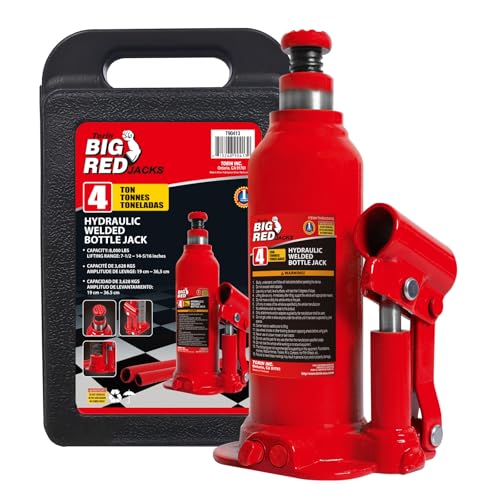
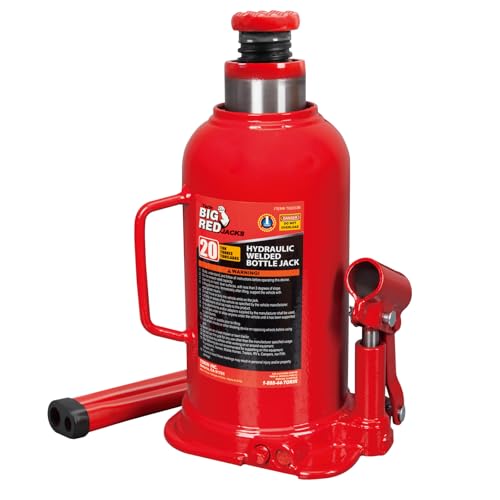

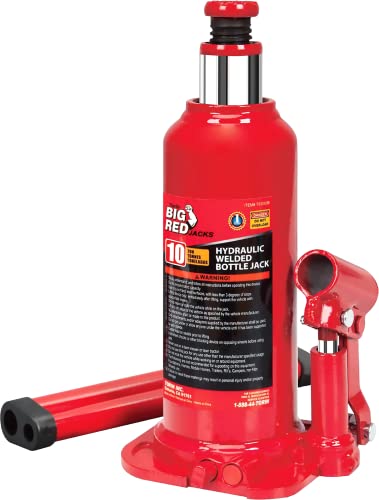
As an Amazon Associate we earn from qualifying purchases at no extra cost to you. Ratings are shown as listed on Amazon.
Quick picks by vehicle and situation
- Compact cars and occasional roadside use: a 2-ton or 3-ton bottle jack with a low starting height and a compact carry case.
- Full-size pickups and SUVs: a 4-ton to 6-ton jack, preferably with a wide welded base and at least 7 inches of usable lift.
- Heavy-duty pickups, vans, and trailers: an 8-ton to 12-ton jack with a long extension screw and a substantial base.
- Frequent garage work: choose a rebuildable professional model from Hein-Werner, OTC, or a comparable heavy-duty range rather than the cheapest sealed jack.
- Very tight storage: select a short-body jack, but check its minimum height carefully; compact dimensions often reduce lifting range.
Best bottle jacks: comparison at a glance
| Type or example | Rated capacity | Typical lift range | Approximate weight | Best use |
|---|---|---|---|---|
| Torin Big Red compact bottle jack | 2 tons | About 6.5–11 inches | 5–7 lb | Small cars and emergency storage |
| Torin Big Red service bottle jack | 4 tons | About 7.5–14 inches | 10–13 lb | Cars, crossovers, and light pickups |
| Blackhawk B6350-style jack | 3.5 tons | About 5.5–12 inches | 9–12 lb | Low-clearance vehicles needing moderate capacity |
| Hein-Werner professional bottle jack | 6–12 tons, depending on model | About 8–18 inches | 20–40 lb | Regular workshop and commercial use |
| OTC heavy-duty bottle jack | 8–20 tons, depending on model | About 9–20 inches | 25–60 lb | Heavy trucks, trailers, and industrial work |
Published dimensions vary by model and production revision, so use these figures as selection ranges rather than a substitute for the individual specification sheet. Capacity is not the same as suitability: a 12-ton jack that starts too tall is the wrong jack for a low sedan.
How much capacity do you actually need?
A bottle jack does not lift the entire vehicle. It normally lifts one corner or one end, but the load can be uneven and may shift as suspension components move. A useful sizing calculation is:
Estimated corner load = vehicle curb weight × 0.30 to 0.40.
For example, a 5,000-pound pickup may place roughly 1,500 to 2,000 pounds on the corner being lifted. A 2-ton jack has a 4,000-pound nominal capacity, but a 4-ton jack provides more reserve for tools, cargo, uneven loading, and real-world positioning. The reserve also reduces the temptation to operate a jack at its limit.
For ordinary cars up to about 4,000 pounds, a 2-ton or 3-ton model may be adequate when the lifting point is clearly specified by the vehicle manufacturer. For large pickups and SUVs, 4 tons is a practical minimum, while 6 tons gives a more comfortable margin. Heavy-duty trucks and commercial trailers require a separate calculation based on axle and corner loads; do not select a jack solely from the vehicle’s gross weight.
Lift range matters more than the headline tonnage
Check three measurements before buying: the jack’s minimum height, maximum height, and the height of the vehicle’s approved lifting point. Subtract the minimum jack height from the lifting-point height to see whether the jack can make contact while the tire is still on the ground.
For example, if a pickup’s frame lifting point is 9.5 inches above the ground and a jack begins at 8.5 inches, there is only 1 inch of initial clearance. A slight slope, tire compression, or a recessed frame section could make positioning difficult. A lower-profile floor jack is often better for low cars; bottle jacks are strongest where there is a tall, accessible frame or axle point.
The extension screw is valuable because it lets you close a small gap before using the hydraulic piston. However, do not wind the screw so far out that only a small amount remains engaged. The owner’s manual should specify the safe extension limit.
Base stability and hydraulic durability
A bottle jack’s small footprint is convenient but inherently less forgiving than a floor jack. Prefer a welded steel base that is broad relative to the cylinder, with a flat lower surface. A base roughly 4 by 4 inches is common on smaller models; heavy-duty designs may use substantially larger bases. A separate flat steel plate can improve ground contact, but it must not interfere with the jack’s stability or violate the manufacturer’s instructions.
Hydraulic durability depends on seal quality, clean oil, protection from contamination, and how the jack is stored. The parts that commonly wear first are the pump seals, release-valve seal, extension-screw threads, and saddle contact surface. A jack that slowly sinks under load may have worn seals, trapped air, an incompletely closed release valve, or an overloaded mechanism. It should be removed from service until the cause is identified.
Professional models such as Hein-Werner and OTC commonly justify their higher cost with stronger components, better machining, and serviceable or rebuildable designs. Budget models from established consumer brands such as Torin Big Red and Pro-Lift can be sensible for occasional use, but replacement parts and rebuild kits may be less readily available. A sealed budget jack can still be useful; it is simply less attractive for a shop that expects years of frequent lifting.
Decision matrix for choosing a bottle jack
| Your situation | Recommended specification | Why |
|---|---|---|
| Lowest cost, two or three uses per year | 2–3 tons, 6.5–12-inch range | Enough for many cars without excessive size or price |
| New DIY mechanic | 4 tons, wide base, clear overload and release controls | Provides capacity reserve and is easier to position confidently |
| Small garage with limited shelf space | Compact 3–4-ton model under about 14 lb | Stores easily, but verify the minimum height first |
| Weekly repairs or fleet maintenance | 6–12 tons, serviceable hydraulic assembly | Better durability and more practical long-term maintenance |
| Roadside emergency kit | 2–4 tons, low weight, corrosion-resistant storage case | Portability matters, but the jack must still fit the vehicle |
Safe setup: the steps that prevent most failures
- Park on firm, level ground. Engage the parking brake, place the transmission in Park or in gear, and chock wheels that remain on the ground.
- Find the approved lifting point. Use the vehicle handbook or factory markings. Avoid thin floor pans, suspension arms not designed for lifting, fuel tanks, and body panels.
- Check the fit before applying load. The saddle should be centered under the lifting point, and the jack should remain vertical throughout its travel.
- Raise only as high as necessary. Once the tire clears the ground, place a correctly rated jack stand under a manufacturer-approved support point.
- Lower onto the stand. Never work beneath a vehicle supported only by a hydraulic jack, even if the jack is new.
- Test stability before starting work. Apply a careful push to the vehicle from outside the danger zone. If it moves, lower it and correct the setup.
Maintenance and ownership costs
Wipe the ram and extension screw after use, especially after roadside work in rain, dust, or salt. Store the jack retracted and upright in a dry location. Inspect for oil around the pump body, bent components, damaged threads, and a saddle that no longer swivels or sits flat. Do not substitute brake fluid, motor oil, or random hydraulic fluid; use the fluid specified by the manufacturer.
Suppose a $45 consumer jack is used twice a year for five years. Its approximate cost is $4.50 per use before considering storage or replacement. A $180 serviceable jack used weekly for five years would cost about $0.69 per use over 260 uses. That does not make the professional jack automatically better for an occasional driver, but it shows why durability and repairability matter when lifting becomes routine.
Final recommendation
For most home garages, choose a 4-ton bottle jack with a minimum height that fits your vehicle, at least 5 inches of useful hydraulic travel, a broad steel base, and an extension screw. Move to 6 tons for full-size pickups and SUVs, and choose a professional 8- to 12-ton model for frequent heavy-duty work. Capacity alone should never decide the purchase: correct fit, stable ground contact, and mandatory jack-stand use matter more than the largest number printed on the label.

Write Your Review
No reviews yet. Be the first to share your experience!