

Key takeaways
- Best value: a molded-plastic, six-caster creeper with a 300-pound-or-higher rating and washable surface.
- Best for frequent repairs: a padded steel-frame model with replaceable 3-inch casters and a capacity of at least 350 pounds.
- Best for small garages: a locking convertible creeper that becomes a mechanic’s seat and stores vertically.
- Best for lowered vehicles: a rigid 3- to 4-inch-high creeper, provided its width still fits beneath the car’s side structure.
- Best for imperfect floors: a heavier frame with large swivel casters and reinforced mounting brackets.
Best Car Creepers for Garage Repairs
The best car creeper for most home garages is a low-profile, padded model with six swivel casters, a 350- to 450-pound capacity, and a folding or convertible frame; choose a plastic creeper for easy cleaning, a steel creeper for maximum rigidity, or a padded mechanic’s seat-and-creeper combination if you alternate between work under the car and work beside it.
A good creeper is more than a board with wheels. Its clearance determines whether you can slide under a lowered vehicle, its padding affects how long you can work comfortably, and its wheel layout decides whether you can position yourself accurately around a transmission, exhaust, or suspension component. The right choice depends on your vehicle, garage floor, storage space, and how often you repair cars.
Our top picks



As an Amazon Associate we earn from qualifying purchases at no extra cost to you. Ratings are shown as listed on Amazon.
Best car creepers by garage situation
| Garage situation | Best creeper type | Why it fits | Typical market range |
|---|---|---|---|
| Occasional oil changes and brake work | Basic molded-plastic creeper | Light, washable, inexpensive, and usually low to the ground | $35–$80 |
| Frequent repairs on several vehicles | Steel-frame padded creeper | Better rigidity, thicker upholstery, and more stable rolling | $80–$180 |
| Limited storage space | Folding or convertible creeper | Stores vertically or changes into a mechanic’s seat | $60–$150 |
| Lowered car or very restricted clearance | Ultra-low rigid creeper | Typically 3 to 4 inches high, reducing the chance of underbody interference | $70–$170 |
| Rough concrete or expansion joints | Large-wheel steel creeper | Wheels around 3 inches or larger roll over floor imperfections more easily | $100–$220 |
Head-to-head: what separates the leading designs?
Low-profile plastic creepers
Molded-plastic creepers, including models sold under brands such as Torin Big Red and Pro-Lift, are often the best value for occasional garage repairs. Their curved shells are commonly about 40 to 42 inches long, 17 to 19 inches wide, and roughly 4 to 5 inches high. The one-piece body resists oil and coolant better than fabric upholstery, and cleaning usually requires only degreaser and a hose or cloth.
The trade-off is comfort and rigidity. A thin plastic shell can flex under a heavier user, especially when the floor is uneven. The small casters supplied with budget models may also snag on cracks. Choose one with a molded headrest, at least six casters, and a published capacity of 300 pounds or more. Treat the capacity as a working limit, not a target: tools, clothing, and the force used while turning a stubborn fastener all add stress.
Padded steel creepers
A steel-frame creeper is the better choice for frequent use or heavier vehicles. Lisle and Omega-style professional creepers typically use a tubular or formed-steel frame, a vinyl-covered pad, and six or more casters. The frame stays flatter under load, and a padded surface is more comfortable during longer jobs.
Padding does create ownership work. Vinyl can split where it bends around the headrest, and foam can compress permanently. Wipe off brake cleaner, fuel, and penetrating oil quickly because solvents can harden or discolor the cover. A steel frame also needs occasional inspection for chipped paint and surface rust, particularly if the creeper is stored in a damp garage.
Folding and convertible creepers
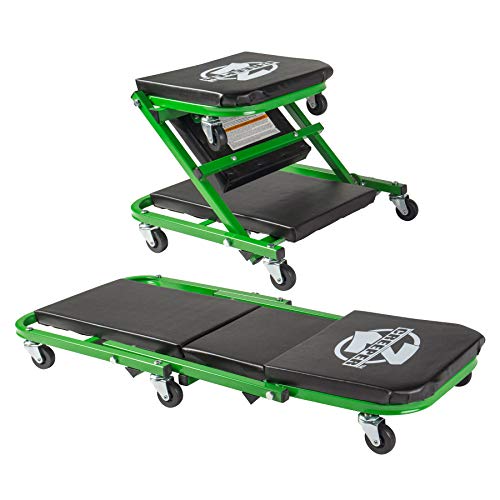
Folding designs solve a real problem: a full-length creeper can occupy a surprising amount of wall or floor space. A convertible model can fold into a low seat, which is useful when moving between work underneath the car and work at the wheel hub or engine bay. Traxion’s convertible mechanic-seat-and-creeper designs are a well-known example of this format.
However, every hinge adds potential movement, weight, and maintenance. Check that the locking mechanism engages fully before sliding underneath a vehicle. Avoid using a convertible creeper with a partially folded backrest, and do not assume its seat capacity and creeper capacity are identical. The manufacturer’s lower rating applies.
Specifications that matter more than the headline capacity
| Feature | Good minimum | Preferred for frequent work | Why it matters |
|---|---|---|---|
| Overall length | 38 inches | 40–43 inches | Fits most adults without excessive overhang |
| Body width | 16 inches | 17–19 inches | Balances shoulder room with clearance between tires and stands |
| Ground clearance | 5 inches | 3–4 inches for lowered cars | Determines whether the creeper can pass beneath rocker panels and subframes |
| Casters | Six swivel casters | Six to eight, 3-inch wheels | Improves tracking and reduces snagging on small cracks |
| Rated capacity | 300 pounds | 350–450 pounds | Provides useful margin for the user and working forces |
| Product weight | 10–15 pounds | 15–25 pounds | Light models are easier to store; heavier ones tend to feel more planted |
Measure the lowest obstacle before buying. If your car’s lowest accessible path is 5.25 inches from the floor, a creeper listed at 5 inches may still fail because the casters, frame, or your shoulders need additional clearance. A simple test is to place a straight board across two ramps or stands at the working height, then measure the available opening at its narrowest point.
Wheel maneuverability: the overlooked deciding factor
Six swivel casters are usually the best arrangement for a standard creeper. Four-wheel designs can be lighter and cheaper, but they tend to pivot around a smaller footprint and may feel unstable when you push sideways. Eight casters can distribute weight well, although extra wheels do not automatically mean better rolling if they are poorly aligned.
Wheel diameter matters on concrete. A 2-inch caster may roll acceptably on a smooth epoxy floor but stop abruptly at an expansion joint. Three-inch wheels generally cross small cracks more smoothly. Look for steel or reinforced caster brackets, ball-bearing swivels, and wheels that do not rub against the frame. Locking casters are not essential for sliding under a vehicle, but a wheel lock can help when you need a stable seat beside the car.
Durability and ownership realities
The first parts to wear are usually casters, caster fasteners, upholstery edges, and folding hinges—not the main frame. Before every extended job, turn each wheel by hand and look for wobble, seized bearings, or a loose mounting nut. Replace damaged casters rather than continuing to use a creeper that pulls sharply to one side.
Keep the wheels free of wire, hair, and shop rags. On a steel model, tighten fasteners periodically because repeated rolling and twisting can loosen them. Do not lubricate casters with a heavy grease that attracts grit; a light manufacturer-approved lubricant is usually more suitable.
Never use a creeper as a substitute for properly rated jack stands. Raise and support the vehicle on stable, level ground, chock the wheels that remain on the floor, and confirm that the stands are positioned at the vehicle maker’s approved support points. Slide the creeper underneath only after the vehicle is secure, and keep your arms and torso clear while lifting or lowering the vehicle.
How to choose without overspending
For one or two repairs a year, a $40–$80 molded-plastic creeper is normally sufficient if its dimensions fit your car and its casters roll smoothly. For weekly use, paying $100–$180 for stronger padding, a steel frame, and replaceable casters can be economical. For example, a $140 creeper used 70 times costs $2 per use before maintenance; a $60 creeper used 10 times costs $6 per use. The more important saving is avoiding a replacement caused by a flexing shell or failed wheel.
Choose the lowest model only when you need the clearance. An ultra-low creeper may be uncomfortable on a standard-height vehicle because it leaves less room for your shoulders and elbows. Conversely, a wide padded model may be comfortable but impossible to position between a tire and a pinch weld. Match the creeper to the vehicle you actually service, not just to its advertised load rating.
Final recommendations
- Best value: a molded-plastic, six-caster creeper with a 300-pound-or-higher rating and washable surface.
- Best for frequent repairs: a padded steel-frame model with replaceable 3-inch casters and a capacity of at least 350 pounds.
- Best for small garages: a locking convertible creeper that becomes a mechanic’s seat and stores vertically.
- Best for lowered vehicles: a rigid 3- to 4-inch-high creeper, provided its width still fits beneath the car’s side structure.
- Best for imperfect floors: a heavier frame with large swivel casters and reinforced mounting brackets.
The best car creepers are not necessarily the most padded or the cheapest. Prioritize the clearance your vehicle requires, six smooth-swiveling wheels, a capacity with margin, and a frame that can be maintained. Those details determine whether the creeper remains useful after its first messy repair.



Write Your Review
No reviews yet. Be the first to share your experience!