

Key takeaways
- Best all-round dual charger: SkyRC T200 for straightforward AC-powered charging of common LiPo, LiHV, LiFe, Li-ion, NiMH, and lead-acid packs.
- Best for advanced users: HOTA D6 Pro, particularly when you need two independent channels, greater control, and both AC and DC input flexibility.
- Best compact high-power option: ToolkitRC M7 when portability and a DC power source matter more than having two charging channels.
- Best simple smart charging system: Spektrum Smart chargers such as the S155, but mainly if your batteries use compatible IC-series Smart connectors.
- Best budget category: A 50–80W balance charger with a built-in AC power supply and selectable LiPo balance mode. Choose one with a display, adjustable current, and a temperature sensor input rather than a fixed-output USB charger.
The best RC car chargers are programmable balance chargers with the correct connector adapters, adjustable current, and built-in protections—not simply the chargers with the highest wattage.
For most drivers, a dual-channel charger rated around 100–200W per channel is the most useful choice. A beginner with one 2S LiPo can save money with a 50–80W single-channel charger, while racers and large-scale RC owners benefit from a 300W-or-higher dual charger and a suitable DC power supply.
Our top picks


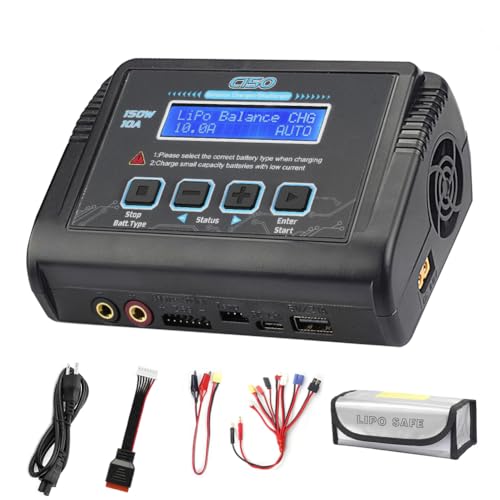
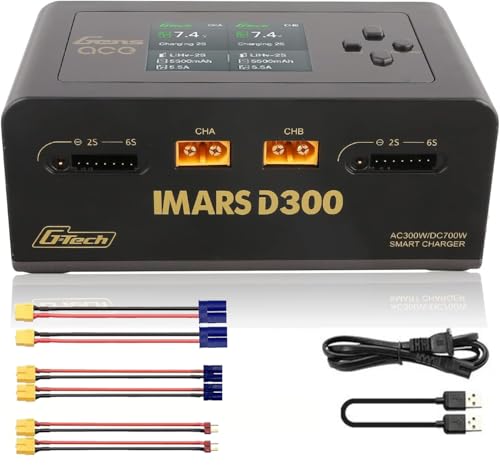
As an Amazon Associate we earn from qualifying purchases at no extra cost to you. Ratings are shown as listed on Amazon.
Quick picks by RC setup
- Best all-round dual charger: SkyRC T200 for straightforward AC-powered charging of common LiPo, LiHV, LiFe, Li-ion, NiMH, and lead-acid packs.
- Best for advanced users: HOTA D6 Pro, particularly when you need two independent channels, greater control, and both AC and DC input flexibility.
- Best compact high-power option: ToolkitRC M7 when portability and a DC power source matter more than having two charging channels.
- Best simple smart charging system: Spektrum Smart chargers such as the S155, but mainly if your batteries use compatible IC-series Smart connectors.
- Best budget category: A 50–80W balance charger with a built-in AC power supply and selectable LiPo balance mode. Choose one with a display, adjustable current, and a temperature sensor input rather than a fixed-output USB charger.
What matters when choosing an RC car charger
Charging rate: watts matter as much as amps
Charger output is limited by both its current rating and its wattage. The basic calculation is:
Charging power = battery voltage × charging current
A 2S LiPo has a nominal voltage of 7.4V and charges to 8.4V. Charging a 5,000mAh pack at 1C means selecting 5A. At the nominal voltage, that requires about 37W, so a 50W charger is adequate. A 4S 5,000mAh pack charged at 5A requires roughly 74W nominally and closer to 84W at full voltage. A 50W charger therefore cannot deliver a true 5A charge throughout the cycle.
For routine battery care, 1C is the conservative default: 5A for a 5,000mAh pack, 3A for a 3,000mAh pack, and 2.2A for a 2,200mAh pack. Some manufacturers permit faster charging, but the battery label and manual should take priority. Higher current also creates more heat and increases the consequences of a damaged or incorrectly configured pack.
Connector compatibility is not the same as electrical compatibility
The charger must connect to both the battery’s main power lead and its balance lead. Common main connectors include the Traxxas High Current Connector, Spektrum IC3 and IC5, EC3 and EC5, XT30, XT60, XT90, Deans or T-plug, and various bullet-connector arrangements. Balance plugs are commonly JST-XH, although some packs use proprietary systems.
An adapter can change the physical connector, but it cannot correct reversed polarity, an unsuitable wire gauge, or a battery with a different cell count. A 2S JST-XH balance lead cannot be treated as a 3S lead simply because an adapter fits. Check the pin order and polarity before connecting an unfamiliar pack.
Spektrum Smart chargers add battery identification and data features when paired with compatible Smart batteries. With a conventional pack, however, a Smart charger may require a separate adapter or may not provide the same automatic information.
Battery chemistry support
- LiPo: The standard choice for many hobby-grade cars. It requires a balance charge unless the battery manufacturer specifically provides another approved procedure.
- LiHV: High-voltage lithium polymer, normally charged to 4.35V per cell rather than 4.20V. Select LiHV only for a battery labeled LiHV.
- LiFe: A lithium iron phosphate chemistry with a lower full-charge voltage, generally 3.60V per cell.
- Li-ion: Often used in custom or endurance applications. Its charging profile differs from LiPo despite both being lithium-based.
- NiMH: Common in entry-level cars and transmitters. It uses a different termination method from lithium packs and should not be charged in LiPo mode.
- Lead-acid: Supported by some multifunction chargers, though it is more relevant to accessories and larger equipment than typical 1/10-scale cars.
Charger comparison for common RC cars
| Charger or type | Output and channels | Input | Useful chemistry support | Best fit |
|---|---|---|---|---|
| SkyRC T200 | Up to 12A per channel; 200W total class; 2 channels | Built-in AC input | LiPo, LiHV, LiFe, Li-ion, NiMH, NiCd, Pb | One or two everyday 1/10 and 1/8 packs |
| HOTA D6 Pro | Dual-channel; up to 15A per channel in suitable conditions; high-power DC operation | AC and DC input | LiPo, LiHV, LiFe, Li-ion, NiMH, NiCd, Pb | Racers and users who want independent control |
| ToolkitRC M7 | Single channel; up to 200W class; current dependent on input voltage | DC input, typically 7–28V | LiPo, LiHV, LiFe, Li-ion, NiMH, NiCd, Pb | Portable charging from a field supply or battery |
| Spektrum S155 Smart charger | 55W class; single channel | AC input | Primarily Smart lithium packs and compatible conventional packs, depending on adapter | Simple charging for compatible Spektrum setups |
| Basic 50–80W balance charger | Usually 5–8A; single channel | Built-in AC or USB/DC input | Usually LiPo, LiHV, LiFe, NiMH; verify before buying | Beginners with one 2S or moderate 3S pack |
Output figures vary with input voltage, cooling, and whether another channel is operating. Treat the wattage as a ceiling rather than a guaranteed charging rate at every battery voltage.
Decision matrix: which charger suits your situation?
| Your situation | Recommended specification | Why |
|---|---|---|
| New driver, one 2S pack, occasional use | 50–80W single-channel AC balance charger | Enough power for a 5,000mAh pack at approximately 1C without paying for unused capacity |
| Two cars or frequent weekend driving | Dual-channel charger, 100–200W per channel class | Charges two packs independently and reduces waiting between runs |
| 3S or 4S racing packs | At least 100W on the active channel, adjustable current, balance monitoring | Higher-voltage packs quickly exceed the practical limit of small chargers |
| Portable field charging | DC charger accepting roughly 12–28V, plus a correctly rated power source | Works from a field battery or DC supply, but requires attention to input polarity and capacity |
| Spektrum Smart ecosystem | Compatible Smart charger and IC3 or IC5 leads | Automatic pack data and simpler settings, provided the battery and charger communicate |
Balancing and safety features worth paying for
A balance charger monitors individual cell voltages through the balance connector and adjusts the charge so cells finish at similar voltages. This is especially important for multi-cell LiPo packs. A charger that only connects to the main leads may show the total voltage while missing a weak or overcharged individual cell.
Look for a charger with selectable cell count, adjustable current, cell-voltage display, balance-charge mode, and a charge-time limit. Useful additional protections include input-voltage monitoring, output short-circuit protection, reverse-polarity protection, over-temperature shutdown, over-current protection, and a maximum-capacity or safety-timer cutoff.
A temperature sensor is helpful for older packs, repeated charging, and high-current use. Stop charging if a battery becomes unusually hot, swells, leaks, smells sweet or solvent-like, or shows physical damage. Never charge a damaged lithium pack simply because its measured voltage appears normal.
How to charge an RC battery safely
- Inspect the pack. Check the casing, wires, connector, and balance lead for damage or swelling.
- Identify the chemistry and cell count. Read the label; do not infer LiPo, LiHV, or cell count from connector shape.
- Connect the main lead and balance lead. Use the correct adapter and confirm polarity.
- Select the matching program. Choose LiPo balance, LiHV balance, NiMH, or another exact chemistry mode.
- Set the current. Start with 1C unless the battery maker specifies a different rate. A 5,000mAh pack equals 5A at 1C.
- Confirm the cell count. The charger’s detected count should match the label before pressing start.
- Stay nearby. Charge on a nonflammable surface and use a suitable LiPo safety bag or fire-resistant charging container where appropriate. Do not charge unattended or inside a vehicle.
- Store correctly. For lithium packs that will not be used soon, use the charger’s storage program rather than leaving them full or empty for weeks.
Ownership realities and common mistakes
The first items to wear are usually connector adapters, balance leads, cooling fans, and the charger’s power supply—not the screen or programming buttons. Repeatedly bending a balance lead at the plug can break its fine wires. Keep connectors clean and dry, avoid pulling on cables, and replace loose or heat-damaged plugs rather than continuing to use them.
Do not choose a charger solely by its maximum amp figure. A high-current charger is only useful if its power supply, cables, connectors, and battery can safely support that output. For example, charging two 4S 5,000mAh batteries at 8A requires approximately 268W near full voltage before accounting for losses. A small 100W supply cannot provide that demand reliably.
For most RC owners, a quality dual-channel balance charger in the 100–200W-per-channel class offers the best balance of speed, compatibility, and room to grow. If your setup is only one 2S pack, a smaller 50–80W charger is sufficient; if you use Smart batteries, staying within that ecosystem may be worth more than buying the most flexible universal charger.

Write Your Review
No reviews yet. Be the first to share your experience!