

Key takeaways
- Choose your dominant need: If your shots routinely land short, begin with more weight or a slightly head-heavy balance. If you are late to fast balls, begin with a head-light frame.
- Set the head-size range: Select 105–110 square inches for forgiveness; select 100–105 square inches when precision is more important.
- Check balance, not only grams: Ask whether the racquet is head-light, even, or head-heavy. This often predicts feel better than weight alone.
- Review the stringing details: Confirm the pattern, recommended tension range, and whether replacement grommets are available.
- Inspect the handle: Make sure the grip is comfortable with the thickness you normally use, including an overgrip if applicable.
- Budget for ownership: Include restringing, replacement grips, protective tape, and possibly a bumper or grommet kit.
The best racquetball racquets for most players are 165–170 grams, moderately head-light, and built with graphite or graphite composite; choose a heavier, head-heavy frame for maximum power or a lighter, head-light frame for faster control and reaction shots.
Our top picks


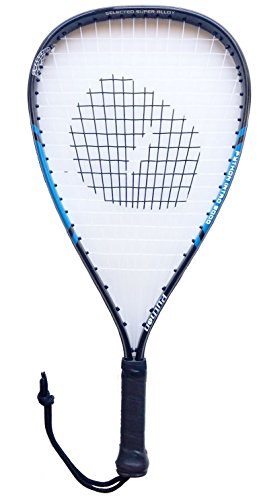
As an Amazon Associate we earn from qualifying purchases at no extra cost to you. Ratings are shown as listed on Amazon.
Best racquetball racquets by playing priority
| Player or situation | Recommended specification | Why it fits | Typical market range |
|---|---|---|---|
| Power-focused singles player | 170–185 g; even to slightly head-heavy; 105–107 in² head | More mass and swing weight transfer energy into drives and passing shots | $90–$220 |
| Control-focused competitor | 160–170 g; head-light; 100–105 in² head | Quicker preparation, easier angle changes, and less resistance on defensive swings | $120–$250 |
| Beginner or casual player | 170–185 g; balanced; 105–110 in² head | A forgiving sweet spot helps compensate for inconsistent contact | $50–$130 |
| Doubles specialist | 165–175 g; head-light; 100–105 in² head | Fast handling is useful when reacting at close range and covering the front court | $90–$200 |
| Frequent league or tournament player | 165–175 g; graphite or graphite composite; replaceable bumper and grommets | Balances maneuverability with a frame that can tolerate regular wall and floor contact | $150–$300 |
What separates a power racquet from a control racquet?
Racquet weight is the first useful dividing line, but static weight is not the whole story. A 175-gram racquet can feel quicker than a 165-gram model if its mass is concentrated near the handle. Conversely, a light frame with a head-heavy balance can feel demanding because the head resists rapid changes of direction.
Power players generally benefit from a 170–185 gram frame with an even or slightly head-heavy balance. The extra mass stabilizes the racquet against off-center hits and helps produce deep drives without requiring an extreme swing. The trade-off is slower preparation, particularly on back-wall shots and quick exchanges.
Control-oriented players usually prefer 160–170 grams with a head-light balance. These racquets accelerate easily, making it simpler to take the ball early, disguise a pinch shot, or redirect a hard drive. They reward clean technique but can feel less stable when a shot is struck near the frame.
Head size: forgiveness versus precision
Most adult racquetball frames fall roughly between 100 and 110 square inches. A larger head provides a broader effective hitting area and is helpful for beginners, defensive players, and anyone who regularly contacts the ball outside the center. It can also add a little power through a longer string bed.
A 100–105 square-inch head usually suits advanced control players. The smaller area gives a more precise response and can make touch shots feel predictable. A 105–110 square-inch head is the safer choice if you are still developing swing timing or want a racquet that remains useful when your footwork breaks down.
Do not select head size in isolation. A large head on a very light frame may feel unstable, while a smaller head on a stiff, heavier frame can be exceptionally solid. Compare the head size with the racquet’s balance and total weight.
String pattern and tension: the overlooked power-control adjustment
String pattern affects how the ball leaves the racquet. An open pattern, such as 14 by 15 or 16 by 18, allows the strings to move more and generally produces easier depth and a livelier response. It can also offer more bite on cut shots, although string movement and notching may require more frequent restringing.
A denser pattern, such as 16 by 19 or 18 by 20, tends to provide a firmer, more controlled response. It is a sensible match for players who already generate ample racquet-head speed and want their drives and ceiling balls to launch on a more repeatable trajectory.
Within the racquet’s recommended range, lower tension usually adds power and comfort, while higher tension improves directional control. A practical starting point is 2–3 pounds below the midpoint for a power-oriented setup, or 2–3 pounds above the midpoint for a control-oriented setup. Adjust in small increments rather than making a dramatic change after one session.
Multifilament nylon is a comfortable, forgiving choice for many recreational players. Synthetic gut is economical and provides a familiar, balanced response. Durable monofilament strings can suit hard hitters, but they feel firmer and may be less forgiving on mishits. Racquetball-specific strings and approved stringing recommendations should take priority over copying a tennis setup.
Grip comfort is a performance specification
A racquet that fits your hand poorly can undermine an otherwise excellent frame. A grip that is too small encourages excessive squeezing and unwanted racquet rotation. One that is too large can slow wrist changes and make it difficult to maintain a relaxed swing.
Start with the manufacturer’s grip size, then assess the finished circumference with the replacement grip installed. You should be able to hold the racquet firmly without clenching. If you use an overgrip, remember that each layer increases circumference and slightly changes the balance toward the handle.
Choose a tacky grip for sweaty conditions and a more absorbent, cushioned grip if vibration and pressure in the palm are your main concerns. Replace the grip when it becomes glossy, compressed, or slippery; waiting until it tears can cause late, tense swings and accidental drops.
Head-to-head: the main racquet categories
Heavy, head-heavy power frame
This is the best match for a strong singles player who attacks from the back court. It produces stable contact and easy depth, especially on a full forehand. Its disadvantages are slower reaction speed and greater fatigue during long matches. It is less suitable if your game depends on rapid wrist changes or frequent front-court interceptions.
Midweight, even-balance all-rounder
A 170–175 gram balanced racquet is the safest choice for many club players. It offers enough mass for competent power while remaining manageable during defensive rallies. If you are replacing a first racquet and have not yet settled on a defined style, this category is usually more useful than an extreme power or ultralight design.
Light, head-light control frame
This category favors quick hands, precise placement, and doubles play. It is excellent for players who create pace themselves and value maneuverability over effortless depth. The main mistake is choosing a frame that is too light: if it twists on ordinary off-center contact, the apparent speed advantage may disappear.
A simple decision process before buying
- Choose your dominant need: If your shots routinely land short, begin with more weight or a slightly head-heavy balance. If you are late to fast balls, begin with a head-light frame.
- Set the head-size range: Select 105–110 square inches for forgiveness; select 100–105 square inches when precision is more important.
- Check balance, not only grams: Ask whether the racquet is head-light, even, or head-heavy. This often predicts feel better than weight alone.
- Review the stringing details: Confirm the pattern, recommended tension range, and whether replacement grommets are available.
- Inspect the handle: Make sure the grip is comfortable with the thickness you normally use, including an overgrip if applicable.
- Budget for ownership: Include restringing, replacement grips, protective tape, and possibly a bumper or grommet kit.
Durability and maintenance realities
The bumper guard and grommets usually show wear before the graphite frame fails. Repeated scraping against the floor or wall can thin the bumper and expose the frame edge. A worn grommet may allow the string to cut into the frame, so replace damaged parts before restringing.
Wipe the frame and grip after play, particularly in humid conditions. Do not leave the racquet in a hot car, where heat can soften adhesives and accelerate string-tension loss. Store it in a padded cover and avoid placing heavy equipment on top of it.
Inspect the frame for cracks around the throat, head corners, and bumper line. A cosmetic paint chip is not automatically structural damage, but a spreading crack, unusual rattle, or sudden change in feel is a reason to stop using the racquet and have it examined by a qualified racquet technician.
For a simple ownership calculation, a player using a racquet twice weekly plays about 100 sessions per year. Spending $180 on a frame works out to about $1.80 per session in the first year, before strings and grips. That makes durability and replaceable parts more important than a small difference in the initial price.
Bottom line
For the broadest range of players, start with a 165–175 gram graphite or graphite-composite racquet, a 105–107 square-inch head, and an even-to-head-light balance. Move heavier and slightly head-heavy if you need effortless power; move lighter and more head-light if quick handling and precise placement define your game. The best racquetball racquet is the one whose weight, balance, string response, and grip let you swing freely throughout an entire match rather than only during the first few rallies.

Write Your Review
No reviews yet. Be the first to share your experience!