

Key takeaways
- Outside corners: Use a matching L-shaped metal trim or corner profile rather than leaving a raw cut edge exposed.
- Top edge: A J-channel, end cap, or narrow finishing strip prevents peeling where the tile meets painted wall.
- Countertop joint: Leave the manufacturer’s recommended movement gap and seal it with a compatible kitchen-grade sealant where appropriate.
- Outlet openings: Turn off power before removing plates, cut tiles carefully, and use electrical box extenders if the new surface changes the plate depth.
- Inside corners: A neat butt joint is usually less conspicuous than forcing a tile to bend sharply.
The best metallic peel and stick backsplash tiles are thick, heat-rated aluminum or PVC-composite tiles with a pressure-sensitive adhesive, a finish that suits your lighting, and enough edge trim to protect exposed seams.
Our top picks


As an Amazon Associate we earn from qualifying purchases at no extra cost to you. Ratings are shown as listed on Amazon.
Quick picks by kitchen situation
| Kitchen condition | Best tile type | Recommended thickness | Why it fits |
|---|---|---|---|
| Rental or temporary update | Lightweight PVC or vinyl-look metallic tile | 1.5–2.5 mm | Lower cost, easier cutting, and generally simpler removal |
| Busy family kitchen | Real aluminum composite or aluminum tile | 3–4 mm | Better resistance to dents, warping, and repeated wiping |
| Dim kitchen needing more light | Brushed silver or pale champagne metal | Any suitable thickness | Reflects light without showing every fingerprint as clearly as mirror-polished metal |
| Cooking area behind a gas or electric hob | Metallic tile specifically rated for the location | Usually 3 mm or more | More stable near heat, provided clearances and manufacturer limits are followed |
| Uneven or textured wall | Flexible peel-and-stick sheet or mosaic with strong adhesive | About 1.5–2.5 mm | Conforms more readily, although major bumps still need repair |
What makes one metallic peel-and-stick tile better than another?
Metallic appearance alone does not tell you whether a backsplash will last. Compare the face material, backing, thickness, adhesive, heat rating, and finishing system together.
Metallic finish
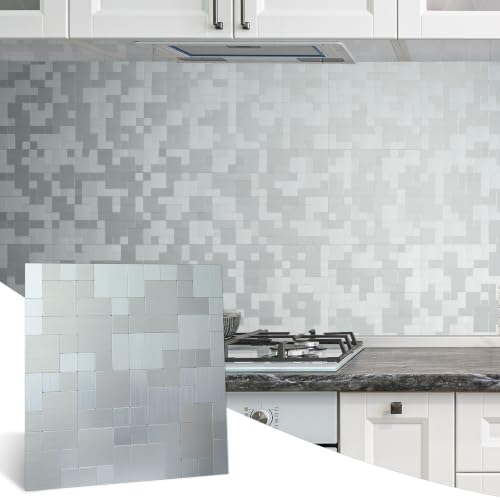
Brushed stainless steel has a directional grain that disguises fine scratches and water spots. It is a practical choice beside a sink, but the grain should run consistently across adjoining sheets. Mirror-polished silver gives the strongest reflective effect and can make a small kitchen feel brighter, although it highlights fingerprints, dried splashes, and imperfect wall preparation.
Champagne, copper, bronze, and gold finishes create warmth but can vary noticeably between production batches. Order enough for the complete project, including waste, rather than expecting a later box to match perfectly. A printed metallic film is usually lighter and less expensive than a genuine aluminum face; it can look convincing from a distance but may show wear first at cut edges and corners.
Thickness and construction
Very thin tiles are easy to cut but can telegraph wall imperfections and feel less substantial around outlets. Tiles around 3–4 mm thick generally offer a better balance of rigidity and weight for a permanent kitchen update. A thicker tile is not automatically superior: it may require deeper outlet spacers, create a visible step beside countertops, and be harder to trim neatly.
Look for a stated construction such as aluminum-faced composite, solid aluminum, PVC composite, or vinyl. “Metallic” by itself may describe only the printed surface. Check whether the decorative face is protected by a clear coating, and whether the manufacturer permits cleaning with degreaser.
Adhesive performance
Peel-and-stick adhesive works best on a smooth, dry, sealed, grease-free surface. It is not a substitute for repairing loose paint, crumbling drywall, heavy texture, or dampness. Strong adhesive can hold well on a prepared wall but may remove paint during relocation, so renters should test an offcut in an inconspicuous place.
Tiles with a larger continuous adhesive area usually have fewer weak points than tiny individual mosaic pieces. However, sheets with very narrow pieces can follow gentle curves more easily. Press every section firmly, especially along corners and around outlets, using a clean roller or a soft cloth rather than relying on hand pressure alone.
Head-to-head: the main metallic backsplash options
Real aluminum tiles
Aluminum gives the most authentic metal appearance and is usually the strongest choice for a backsplash behind a preparation counter. It is lightweight, does not absorb water, and can be wiped clean. Its weaknesses are visible dents, sharp untrimmed cut edges, and possible discoloration if exposed to unsuitable abrasive cleaners or excessive heat.
Metallic PVC or vinyl tiles
These are often the most economical and easiest to cut with household tools. They are useful for a rental or a low-splash wall, but the surface may scratch or lift sooner, particularly at seams and around the cooktop. Heat limits are especially important: some decorative films are intended for general backsplash areas but not the wall immediately behind a burner.
Metal-look glass or resin mosaics
These provide a glossy, decorative effect without the weight of a full metal sheet. They can be attractive in a dry bar area or behind a sink, but their adhesive and topcoat determine whether they tolerate cooking grease and heat. Resin-like surfaces may soften, yellow, or distort if installed too close to a high-temperature appliance.
Heat limits are a selection issue, not a footnote
Do not assume that a metal-looking tile is automatically suitable behind a hob. Many peel-and-stick products have a maximum continuous-temperature rating, while others specify a minimum distance from a burner or advise against installation behind gas ranges altogether. Follow the product’s published instructions and the appliance manufacturer’s clearance requirements.
For a wall behind a cooktop, choose a product explicitly approved for that position. A metal face may tolerate heat while its adhesive, plastic backing, or printed finish does not. Avoid placing tile where a pan handle, direct flame, or hot cookware can contact it. If the manufacturer provides no heat information, treat the product as suitable only for cooler backsplash zones.
Trim and installation details that affect the finished result
- Outside corners: Use a matching L-shaped metal trim or corner profile rather than leaving a raw cut edge exposed.
- Top edge: A J-channel, end cap, or narrow finishing strip prevents peeling where the tile meets painted wall.
- Countertop joint: Leave the manufacturer’s recommended movement gap and seal it with a compatible kitchen-grade sealant where appropriate.
- Outlet openings: Turn off power before removing plates, cut tiles carefully, and use electrical box extenders if the new surface changes the plate depth.
- Inside corners: A neat butt joint is usually less conspicuous than forcing a tile to bend sharply.
Check the trim color under your kitchen lighting. Bright silver beside a slightly warm champagne tile can look mismatched, even when both are described as metallic.
Coverage calculation before ordering
Measure each rectangular wall section separately. Multiply width by height, subtract large permanent openings, and add at least 10% for cutting waste. For example, a wall measuring 72 by 18 inches covers 1,296 square inches, or 9 square feet. Adding 10% gives 9.9 square feet, so a practical order is 10 square feet or the next full package size.
Increase the allowance to 15% if the design has a repeating pattern, many outlets, diagonal cuts, or multiple corners. The leftover material is valuable for replacing a damaged tile later, especially when a metallic finish may be discontinued or reformulated.
Ownership realities: what wears first?
In most installations, the first failure is not the center of the tile. It is an exposed corner, a seam contaminated with grease, or an edge that was not firmly bonded. Steam and repeated wiping can gradually loosen poorly prepared areas. Around a cooker, discoloration or adhesive softening may occur before the decorative face shows damage.
Clean with a soft cloth, warm water, and a mild detergent unless the manufacturer specifies otherwise. Avoid scouring pads, powdered cleaners, acetone, and aggressive solvent-based degreasers. Wipe splashes promptly, particularly on brushed finishes where residue can collect along the grain. Do not saturate seams or direct steam at them.
Bottom line
Choose brushed aluminum composite tiles around 3–4 mm thick for the best all-round balance of appearance and durability. Choose a thinner PVC or vinyl-look option when low cost, easy cutting, or temporary installation matters more than long-term wear. For any area directly behind a hob, make the published heat rating and required clearance the deciding factors, then finish the installation with compatible trim and careful edge sealing.

Write Your Review
No reviews yet. Be the first to share your experience!